So, you're looking for an RV in North Carolina? You've picked a fantastic place to start. From the misty peaks of the Blue Ridge Mountains down to the sun-drenched Outer Banks, the Tar Heel State is practically begging to be explored on wheels. But finding that perfect rig, whether it's an RV for the road or a boat for the water, can feel like a monumental task.
This guide is your roadmap. We're going to break down the entire process, step-by-step, so you can find the right RV with total confidence.
North Carolina has a seriously vibrant RV and boating scene, which is great news for you. The demand has been climbing for years as more people discover the freedom of hitting the road or the water. This means you've got a fantastic selection to choose from, whether you’re dreaming of a brand-new luxury motorhome or a lovingly-cared-for used travel trailer.
Think of this less as a simple purchase and more as an investment in a new lifestyle. The time you put in now will pay off in years of happy adventures.
It's the geography, really. You can be hiking mountain trails near Asheville one weekend and then kicking back by the ocean in Wilmington the next. This incredible variety of landscapes, from mountain lakes to coastal waterways, means you need to think hard about what kind of recreational vehicle fits the adventures you want to have.
Before you even start scrolling through listings, get a feel for the local market. Here in North Carolina, you'll see a bit of everything:
- Luxurious Class A Motorhomes: These are the big guys, perfect for long-haul trips where comfort is king.
- Versatile Class C Motorhomes: A real sweet spot for families, offering a great mix of space and easy handling.
- Nimble Class B Camper Vans: The go-to for couples or solo travelers who want to stay mobile and park just about anywhere.
- Towable Travel Trailers & Fifth Wheels: The options here are endless, with sizes and layouts to fit nearly any budget and tow vehicle.
We're going to walk you through the entire journey—from the first spark of an idea to the moment you drive your new rig off the lot. We’ll cover setting a realistic budget, getting your financing in order, what to look for during an inspection, and how to handle all the final paperwork.
The goal here is simple: arm you with practical, real-world advice to help you sidestep the common mistakes. Let's get you ready for the road ahead.
Before you even think about scrolling through listings for an RV for sale in NC, the absolute smartest first step is to nail down your budget. It's incredibly easy to get swept away by a stunning motorhome or a perfectly laid-out travel trailer, but the true cost of ownership goes way beyond the sticker price.
Getting this right from the start ensures your new adventure rig is a source of joy, not a constant financial headache.
The sticker price is just the down payment on your adventure. Understanding the full financial picture from day one is what lets you shop confidently and avoid any nasty surprises down the road.
So many first-time buyers fixate on the monthly loan payment, and that's a huge mistake. That single number misses a massive chunk of the real-world cost. Let's break down the other line items you absolutely must account for when buying an RV in North Carolina.
-
Insurance: RV insurance isn't optional in NC. Costs can be all over the map depending on the RV's class, age, value, and your driving history. A new, high-end motorhome could easily run you over $1,500 annually, while a simple policy on a used travel trailer might be a fraction of that.
-
Taxes and Registration: Get ready for the taxman. North Carolina hits you with a 3% Highway Use Tax (HUT) on the purchase price, though it's thankfully capped at $2,000. Beyond that, you've got annual registration fees and, depending on your county, personal property taxes to contend with.
-
Routine Maintenance: An RV is a house on wheels, and both parts need regular upkeep. You need to budget for everything from oil changes and tire rotations to roof sealant checks and generator servicing. A smart rule of thumb is to set aside 1-2% of the RV’s purchase price every year for maintenance and the inevitable "uh-oh" repairs.
-
Storage: Can you park it at your house? If not, you're looking at a monthly storage bill. HOA rules or just a lack of space are common issues. A basic outdoor spot might only be $50 a month in a rural area, but if you need a covered or climate-controlled unit near Raleigh or Charlotte, you could be looking at $200+ per month.
The purchase price is just one piece of the puzzle. To help you visualize the ongoing expenses, here's a breakdown of what you might expect to spend each year as an RV owner in North Carolina.
| Expense Category |
Estimated Annual Cost (Low End) |
Estimated Annual Cost (High End) |
Key Considerations |
| Insurance |
$400 |
$2,500+ |
Depends on RV type, value, usage, and driving record. Full-time policies cost more. |
| Maintenance & Repairs |
$500 |
$3,000+ |
A newer RV will have lower initial costs, but older models can bring expensive surprises. |
| Property Taxes |
$150 |
$1,500+ |
Varies significantly by county and the assessed value of your RV. |
| Registration/Inspection |
$50 |
$150 |
Standard annual state fees. |
| Storage |
$600 |
$2,400+ |
Only applies if you can't store it at home. Covered/indoor storage is pricier. |
Remember, these figures don't even include fuel, campground fees, or propane. Those are your "fun" costs, but the ones in the table are the non-negotiable costs of just owning the rig.
The kind of RV you pick will have the biggest impact on every single number we've talked about. The market is packed with options, and they all come with dramatically different price points and ownership demands.
We're seeing a huge surge in popularity for Class B camper vans, which are nimble and efficient but still typically run between $100,000 and $150,000. At the other end of the spectrum, you have the magnificent Class A motorhomes that can easily top $500,000. For a deeper dive into market trends, The Adventure Travelers offers some fantastic industry insights.
Here's a quick rundown of the main players:
- Class A: The big, bus-style rigs. They’re the kings of the road, offering maximum living space and luxury. They also come with the highest price, worst fuel economy, and most expensive maintenance bills.
- Class C: These are built on a truck chassis and are easily identified by the bed area over the cab. They’re a fantastic middle ground—plenty of space for a family without the intimidating size or cost of a Class A.
- Class B (Camper Vans): The smallest and most agile of the motorhomes. They drive like a large van, are easy to park anywhere, and get the best gas mileage. The trade-off is, of course, a much cozier interior.
- Travel Trailers: Incredibly popular for a reason. Towables offer a massive range of sizes and floor plans at a more accessible price. Just don't forget you need a capable truck or SUV to pull it, which is a major part of the budget equation.
Unless you're paying cash, you'll be looking for a loan. RV and boat loans are a bit different from car loans; the terms are often much longer, sometimes stretching out to 15 or even 20 years. This makes the monthly payment look temptingly low, but you'll pay a lot more in interest over the long haul.
Here's a pro tip: get pre-approved for a loan before you step onto a dealer's lot. Talk to your local bank or, even better, a credit union. Many North Carolina credit unions are very familiar with recreational vehicle financing and can offer fantastic rates.
Walking into a negotiation with a pre-approval letter in your pocket is a game-changer. It shows you're a serious buyer and immediately sets your spending limit. It's the single best move you can make to gain leverage and potentially save yourself thousands of dollars.
Alright, you’ve got your budget dialed in and a picture in your head of the perfect rig. Now for the fun part: the hunt. Finding the right RV in NC for sale is an adventure in itself, and where you look makes all the difference in what you find and what you pay. The Tar Heel State is packed with options, from massive dealership lots to hidden gems tucked away in someone’s driveway.
The first big question you need to answer is whether to go through a dealership or buy from a private seller. There's no single "right" answer here; it really boils down to your own comfort level, what you're willing to spend, and how much of the process you want to handle yourself.
Walking onto a dealership lot offers a certain kind of reassurance. They streamline the whole process, handling the paperwork, often providing on-site financing, and sometimes even offering a limited warranty on newer used models. For a first-time buyer, that peace of mind can be worth its weight in gold.
On the flip side, you can often score a much better deal by buying directly from the owner. Private sellers don’t have the overhead of a dealership and are usually more motivated to negotiate. Of course, this path means you're in the driver's seat for everything—arranging an independent inspection, sorting out the DMV paperwork, and lining up your own loan. The trade-off for that extra legwork can be thousands of dollars in savings.
A good rule of thumb I've learned over the years: If you value convenience and want a built-in safety net, stick with reputable dealers. If you're confident in your negotiating skills and don't mind doing some homework to save a chunk of cash, the private market is your playground.
One of the great things about North Carolina is how its geography shapes the recreational vehicle market. You’ll find that certain areas are hotspots for specific types of rigs, simply because of the local lifestyle.
-
The Mountains (Asheville, Boone, Hendersonville): This is adventure country. Expect to see a ton of smaller, nimbler options like Class B camper vans, rugged truck campers, and compact travel trailers—all perfect for navigating those winding mountain roads.
-
The Piedmont (Charlotte, Raleigh, Greensboro): These are the state's population centers, and it shows. The selection here is massive and diverse, with huge dealerships carrying everything from giant Class A diesel pushers to family-sized fifth wheels.
-
The Coast (Wilmington, Outer Banks): Unsurprisingly, this is where you'll find the "beach rigs." Travel trailers and motorhomes used for seaside vacations are common, as are boats of all sizes. Just be extra careful during your inspection; salty air is brutal, so checking for rust and corrosion is non-negotiable.
North Carolina has a massive vehicle market, with around 9.74 million registered vehicles. This constant turnover, which generates over $353 million in used vehicle sales tax revenue, means the inventory of available RVs is always fresh. You can see just how active this market is and understand why it’s a great place to be a buyer.
Let's be honest, almost every search for an RV in NC for sale begins online these days. Sites like RV Trader, Facebook Marketplace, and even Craigslist are fantastic resources, but you have to learn how to sift through the noise.
When you're scrolling, you need to read between the lines. A seller who’s proud of their rig will post dozens of clear, well-lit photos showing every angle—inside, outside, the roof, and the tires. Vague descriptions or just a couple of blurry pictures? That's a red flag.
And if a deal seems too good to be true, it almost certainly is. A price that’s way below market value could be hiding a salvage title, serious water damage, or an outright scam. Before you even think about scheduling a visit, get the VIN and run a history report. Getting good at spotting the duds online will save you a ton of time and wasted trips, letting you focus only on the RVs that are truly worth your attention.
So, you've scrolled through what feels like a million listings and finally found an RV in NC for sale that ticks all the boxes. Your heart's probably racing a bit. This is the exact moment where it’s easy to let excitement take over, but slowing down for a meticulous inspection is the single best thing you can do to protect yourself.
Trust me, rushing this part is a one-way ticket to some very expensive regrets.
Think of it as putting on your detective hat. Your job is to uncover the RV's real history, looking beyond a fresh wash and wax to find the gremlins hiding underneath. This isn't about being pessimistic; it's about making a smart, eyes-wide-open purchase.
The chart below gives you a solid feel for the average retail prices of different RVs. It’s a good reality check to see where your potential rig falls and how much you have on the line.
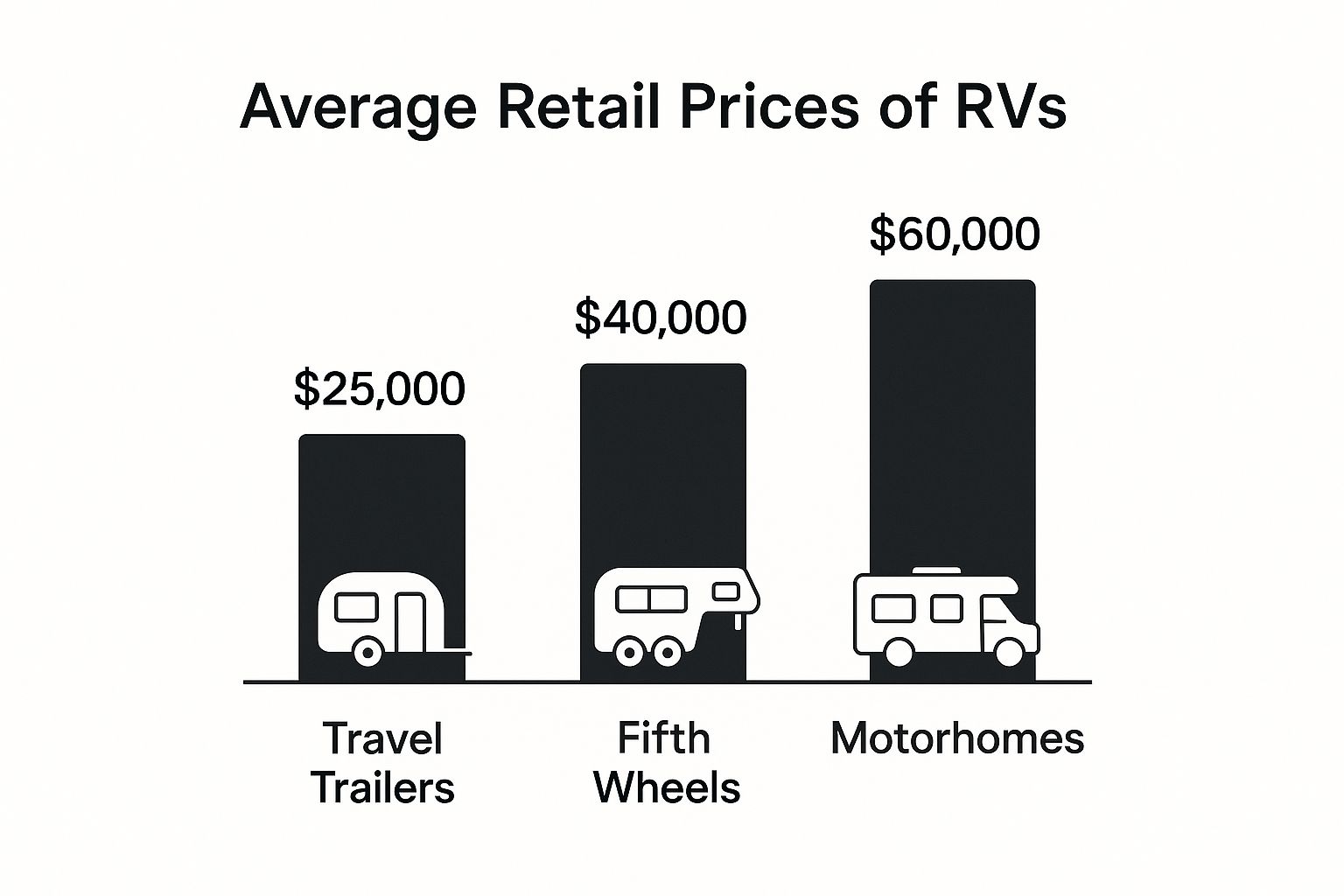
As you can see, the price jumps between classes are significant. That's a good reminder that the more complex the RV, the more there is to inspect—and the more that can go wrong.
Always start your inspection outside, and don’t be in a hurry. You’re hunting for the RV’s worst enemy: water. A leak that seems tiny today can cause thousands in structural damage down the line.
Get on the roof. I can’t stress this enough. Ask the owner for a ladder or bring your own, but you have to get up there. Look for any cracks in the sealant around vents, the A/C unit, and antennas. Gently press on the roof decking—if you feel any soft, spongy spots, that’s a massive red flag for water damage. While you’re looking, scan the sides for delamination, which looks like bubbles or waves in the fiberglass siding.
Next up, the tires. Don't just kick them and glance at the tread. You need to find the DOT date code, a four-digit number stamped on the sidewall. A code like "3520" means the tire was made in the 35th week of 2020. RV tires often age out before they wear out and should be replaced every 5-7 years, no matter how good they look. Sun and time are not their friends.
Once you’re done with the tires, methodically test every single moving part on the exterior:
- Run all slide-outs in and out a few times. They should move smoothly, without any loud grinding or jerky motions.
- Extend and retract all the awnings. Check the fabric for any rips, mold, or mildew stains.
- Open every single storage bay. Look and smell for any evidence of water getting in.
- Test the leveling jacks to make sure they operate correctly.
This initial exterior check gives you a great sense of how the RV has been cared for before you even set foot inside.
Okay, time to head inside. The very first thing to do is trust your nose. If you get a whiff of anything musty or moldy, your water-damage alarms should be going off immediately.
From there, get your eyes on every surface. Carefully check the ceiling, walls, and floors, paying close attention to the corners, the areas inside cabinets, and the space around windows. You're looking for subtle discoloration, water stains, or wall panels that feel soft to the touch.
Now for the hands-on part. You need to test everything. Don't take the seller's word for it—verify it all yourself.
- Plumbing: Fill the freshwater tank a bit and run every faucet, both hot and cold. Listen to the water pump; if it keeps cycling on and off when the faucets are closed, you likely have a leak somewhere. Flush the toilet and check for a solid seal.
- Electrical: Flip every switch, test every outlet (a cheap outlet tester is great for this), and check every light. Plug the rig into shore power if you can, then unplug it to make sure the 12-volt battery system takes over.
- Appliances: This is a big one. Run the fridge on both electric and propane to ensure it gets cold on both sources. Fire up the microwave, the stove burners, and the oven. And definitely test the water heater and the furnace to make sure they ignite and run properly.
Remember, every single thing you find that doesn't work is a negotiation tool. A dead RV fridge can easily set you back $2,000, so documenting these issues with photos gives you powerful leverage.
To help you spot some of the most common and costly problems, I've put together this quick-reference table. Keep an eye out for these deal-breakers.
| Red Flag |
What to Look For |
Potential Problem & Cost |
| Soft Spots on Roof/Floor |
Spongy or bouncy areas when you walk on them, especially near walls or in corners. |
This almost always points to significant water intrusion and potential rot in the subfloor or roof structure. Repair can easily cost $3,000-$10,000+. |
| Delamination |
Bubbles, waves, or bulges on the exterior fiberglass walls. |
The layers of the wall are separating due to water getting in. This is a very expensive and difficult structural repair, often costing $5,000+ per section. |
| Musty/Moldy Smell |
A persistent damp or earthy smell inside, especially in closets or under beds. |
Hidden mold and mildew from an ongoing leak. This is a health hazard and a sign of deeper water damage. Remediation is costly. |
| Frame Rust |
Heavy, flaking rust (not just surface rust) on the main frame rails, outriggers, or suspension components. |
Severe rust compromises the structural integrity of the entire RV. This is often a deal-breaker and not worth repairing. |
| Jerky Slide-Outs |
Grinding, popping, or struggling noises when extending or retracting a slide-out. |
The slide mechanism could be out of alignment, or the motor could be failing. Repairs can range from $500 for an adjustment to $3,000+ for a motor replacement. |
Finding any of these issues doesn't just mean a small repair; it could mean you're looking at a total money pit. Proceed with extreme caution.
Feeling a bit out of your depth? That’s completely normal, especially if this is your first RV or you’re looking at a complex motorhome.
This is where hiring a certified RV inspector can be the smartest money you'll spend. A pro from an organization like the National RV Inspectors Association (NRVIA) will spend hours going over the rig with a fine-toothed comb. They’ll give you a massive report detailing everything, big and small.
An inspection like this will typically run you $400 to $1,200, depending on the RV’s size and type. It might feel like a big check to write, but it can save you from a five-figure nightmare. This is particularly true in North Carolina, where data shows the average vehicle age is 12.7 years, a bit older than the national average. As you can discover from more insights about NC vehicle statistics, older rigs have simply had more time to develop problems.
In the end, whether you do it yourself or hire an expert, a thorough inspection gives you the confidence to either negotiate a fair price or, just as importantly, walk away from a bad deal.
You’ve done the hard work. After all the searching and crawling around during the inspection, you've finally found the one. Now you're at the finish line, facing the final two hurdles: agreeing on a fair price for your chosen rv in nc for sale and navigating the closing paperwork without a hitch.
This is where a little preparation goes a long way. Walking into a negotiation with a clear strategy and a firm grasp of the RV’s real-world value puts you firmly in the driver's seat.
Never, ever walk into a negotiation with an offer based purely on emotion or the seller's sticker price. A strong offer is always grounded in cold, hard facts.
Before you even think about mentioning a number, you need to do your homework. Start by looking up the specific year, make, and model on a resource like NADAguides for RVs. This gives you a solid baseline for its "book value," but don't stop there. The real magic is in seeing what similar rigs are actually selling for right now, right here in North Carolina. Scour listings on RV Trader and even Facebook Marketplace to get a feel for the current market.
Your most powerful negotiating tool? That detailed inspection report you made. Every single issue you uncovered—from a water stain in a cabinet to tires that are a few years from expiring—is a future out-of-pocket cost for you. Tally up these estimated repair costs to build a logical case for a lower offer.
I've found that a respectful, fact-based approach almost always works better than aggressive lowballing. You're not just buying a machine; you're often dealing with an owner who has made a lot of memories in their rig. When you can calmly present your offer with clear, logical reasons, it builds trust and makes the seller much more likely to work with you.
Whether you're standing on a dealership lot or in a private seller's driveway, the core principles of a good negotiation are the same. You'll want to start with a firm but reasonable offer—one that’s lower than your absolute max—to give yourself some wiggle room to meet in the middle.
Here are a few tactics that have worked for me:
- Reference Your Findings: Try saying something like, "The RV is in great shape, but as we both saw, the roof sealant needs a complete overhaul. I got a quote, and that's about a $1,200 job right off the bat. My offer reflects that immediate expense."
- Know Your Walk-Away Price: Before you even start talking, decide on the absolute highest price you're willing to pay. If you can't get the seller to that number, you have to be prepared to thank them for their time and walk away. It's your strongest move.
- Stay Calm and Patient: Don't let excitement rush you into a bad deal. If a seller needs a night to think over your offer, let them. A little patience at this stage can easily save you thousands of dollars.
Once you’ve shaken hands, you're not quite done. The paperwork phase is just as critical for protecting your new investment.
In North Carolina, a few key documents are non-negotiable for making the sale official. Getting these wrong can create a massive headache when you get to the DMV.
First up is the Bill of Sale. Don't settle for a generic template. Make sure it includes:
- Full names and addresses for both you and the seller.
- A complete description of the RV: year, make, model, and the all-important Vehicle Identification Number (VIN).
- The final, agreed-upon purchase price.
- The date of sale and signatures from everyone involved.
Next, and most importantly, is the title. Inspect this document like a hawk. The seller's name must be listed as the legal owner, and you need to check for any liens. If there is a lienholder listed, the seller must provide you with a formal lien release letter from their bank. Without it, you can't transfer ownership.
One last pro tip: physically match the VIN on the title and the Bill of Sale to the metal VIN plate on the RV itself. A single typo can create a bureaucratic nightmare. Taking a few extra minutes to verify every single detail ensures a clean transfer and gets you that much closer to hitting the open road.
You’ve negotiated the price and you’re holding the keys—congratulations! Now there's just one last hurdle before you can officially hit the road: a trip to the North Carolina Division of Motor Vehicles (NCDMV).
It might sound like a hassle, but getting your new rig titled and registered is actually pretty straightforward if you know what to bring. This is the final piece of the puzzle that separates you from your first big adventure.
You’re not alone, either. You're joining a massive community. In 2021, a record-breaking 11.2 million households owned an RV, with over 40 million Americans RVing every year. For a deeper dive into these numbers, you can discover more insights about RV industry statistics.
The secret to a smooth, one-trip visit to the license plate agency is simple: be prepared. Get everything together in a single folder before you walk out the door. Forgetting just one piece of paper can send you right back home.
Here’s your checklist for what to bring:
- The Signed Title: This has to be the original vehicle title, properly signed over to you by the seller.
- A Completed Title Application (Form MVR-1): This is the official state form for getting a new title in your name.
- Valid NC Driver's License: Standard procedure to prove who you are.
- Proof of Liability Insurance: Your insurance card or the declarations page of your policy will work, as long as it lists your new RV.
Take a close look at that title before you go. The seller’s signature needs to match their printed name exactly, and there can't be any scribbles or mistakes. The NCDMV is a real stickler for this, and an error can cause major delays.
Getting your RV road-legal involves a few fees. The main one you'll pay is the Highway Use Tax (HUT), which is 3% of what you paid for the RV.
The good news? For a big-ticket item like an rv in nc for sale, this tax is capped at $2,000. So even if you bought a high-end Class A, you won't pay more than that for the HUT. You'll also have smaller fees for the title transfer and the annual registration to get your license plate.

