Finding the right cuddy boats for sale is all about matching the boat to your life on the water. These incredibly versatile boats hit a sweet spot, giving you a small cabin for shelter and overnight trips without the bulk and expense of a full-blown cabin cruiser. They're a perfect entry point for families and adventurers looking to expand their outdoor experiences from land to water.
So, you're in the market for a cuddy cabin. This guide is your practical roadmap to making a smart, confident purchase. We're going to skip the generic advice and get right into the details of finding a boat that genuinely fits your plans, whether that's weekend fishing trips, family fun, or quiet overnights on the hook.
First, let's nail down what makes a cuddy so appealing. It masterfully blends the open-air freedom of a bowrider with the cozy convenience of a small, enclosed cabin. That little "cuddy" is your escape from a sudden downpour, a secure spot for your gear, or even a place for a quick nap—much like having a compact cabin on the water for your adventures.
Before you even glance at a single listing for cuddy boats for sale, the most critical step is to get honest about how you'll actually use the boat. The perfect boat for a solo angler is worlds away from the ideal setup for a family of four that loves watersports.
Ask yourself these questions:
- Who's in your crew? Think about who you'll have aboard most of the time. Most cuddy cabins can handle 6 to 8 people for a day on the water, but the cabin itself usually sleeps just two.
- What's the main event? Will you be trolling for fish, pulling a skier, or cruising to a secluded cove to spend the night? Your main activities will dictate the best layout, engine size, and features.
- Where will you be boating? A boat destined for big, open lakes or coastal chop needs a totally different hull and more size than one that will live on smaller, protected rivers.
Thinking this through early on stops you from buying too much—or too little—boat for your needs. It’s easy to get wowed by a big, flashy model on the showroom floor, but if you just need a simple rig for afternoon fishing, you’ll end up paying for bells and whistles you never touch.
Here’s a piece of advice I always give new buyers: Buy the boat for how you'll spend 90% of your time on the water, not the 10% you dream about. That simple rule ensures you end up with a boat you love using every single weekend.
To help you get a clearer picture, here’s a quick breakdown of what makes a cuddy a cuddy.
This table provides a quick overview of the key features that define a cuddy cabin boat, helping you understand what to look for.
| Feature |
Description |
Primary Benefit |
| Forward Cabin |
A small, enclosed cabin located in the bow, typically with a V-berth. |
Provides shelter, secure storage, and a private space for changing or resting. |
| Open Cockpit |
The main seating and helm area, located behind the cabin. |
Offers ample space for socializing, fishing, or enjoying the sun. |
| V-Berth |
A V-shaped sleeping area in the cabin that often converts to a seating area. |
Allows for comfortable overnight stays for one or two people. |
| Helm Station |
The control center of the boat, with steering, throttle, and navigation. |
Gives the captain clear visibility and access to all controls. |
| Transom |
The back wall of the boat, which may include a swim platform. |
Provides easy access to the water for swimming and watersports. |
Understanding these core components helps you evaluate different models and layouts as you begin your search.
The appeal of these boats is no secret. The global market for cuddy cabins is a serious business, valued at around USD 4.3 billion in 2026. And it's set to grow, fueled by boaters who want that perfect mix of day-tripping fun and overnight capability. You can dive deeper into cuddy cabin market trends to see where the industry is headed.
All this popularity means you've got a fantastic selection of new and used boats to choose from. You'll find everything from sporty models under 20 feet that are a breeze to tow, all the way up to 30-footers that feel like mini-yachts.
With a clear picture of what you need, you can start sorting through those options with confidence. By matching your real-world plans to the right size, layout, and features, you're already well on your way to finding the perfect boat.
Now that you have a picture of your perfect boat in mind, the real hunt begins. This is where you move from dreaming to digging, and a methodical approach here is your best defense against buying a headache or paying too much for a boat that won't hold its value.
First things first, you need to know where the good boats are hiding. A simple web search will throw thousands of cuddy boats for sale at you, but the quality listings are usually found where serious buyers and sellers gather. This is how you sift through the noise to find the real gems.
To find the best boat, you need to cast a wide net. Don't just stick to one website; a fantastic deal could pop up where you least expect it. I always start by checking a few key places.
- The Big Online Marketplaces: Sites like Boat Trader and YachtWorld are the industry giants for a reason. Their search filters are incredibly powerful, letting you zero in on boats by length, year, price, and location. It's the fastest way to compare dozens of options side-by-side.
- Dealer Websites: If you're considering a new or certified pre-owned boat, go straight to the source. Local and regional boat dealers often post their inventory on their own websites before it ever hits the major marketplaces.
- Owner Forums and Clubs: This is my secret weapon for finding exceptionally well-maintained boats. Enthusiast forums for specific brands like Sea Ray or Bayliner almost always have a "For Sale" section. These are boats sold by people who are passionate about them, and they often come with meticulous service records.
Reading a boat ad is an art form. You have to learn to look past the shiny photos and focus on what the seller isn't saying. A great ad is packed with details: engine hours, maintenance history, and a list of all the recent upgrades. Vague descriptions or a suspicious lack of photos? Those are usually red flags.
As you scroll through ads, certain details should make you either sit up and take notice or click away immediately. The first thing I always look for is engine hours—this is a boat's equivalent of mileage on a car or boat. For a typical gas engine, anything under 500 hours is pretty low, while over 1,000 hours means it’s seen a lot of time on the water.
Next, I scan for any mention of maintenance. Phrases like "complete records available," "professionally maintained," or "risers and manifolds replaced last season" are music to my ears. On the flip side, be very cautious of ads that use vague terms like "needs a little TLC" or sell "as-is." That's often code for "get ready to open your wallet."
A classic rookie mistake is falling for a boat that looks perfect on the outside but has a neglected engine. A shiny gelcoat is easy to fake, but a reliable engine is the direct result of consistent, documented care. Always, always prioritize mechanical history over cosmetic perfection.
The market for these boats is booming. The global small boat sector, which includes cuddy cabins, was valued at around USD 31.93 billion in 2023. Forecasts predict it will rocket to USD 84.05 billion by 2032, as top manufacturers keep rolling out new and innovative designs. For you, this means more choices, but it also makes doing your homework more important than ever. You can learn more about small boat market growth to see where the industry is headed.
One of the biggest forks in the road is deciding between a private seller and a dealership. Both have their pros and cons, and the right path really depends on your budget and how much risk you're comfortable taking on.
Buying from a Private Seller:
- The Upside: You can often get a much better price because there's no dealer overhead or commission.
- The Downside: The sale is almost always "as-is." If the engine blows a week after you buy it, that's your problem. You're completely on your own for inspections and verifying the boat's history.
Buying from a Dealership:
- The Upside: Dealers often offer a limited warranty on their used boats and handle all the painful title and registration paperwork. They also have a business reputation to uphold, so they're less likely to offload a boat with known, catastrophic issues.
- The Downside: You'll almost certainly pay more for the exact same boat than you would in a private sale.
Let's say you find two identical cuddy boats. A private owner has one listed for $25,000. A dealership has the same model for $29,000, but it comes with a fresh service and a 30-day engine warranty. That extra $4,000 might just be the best money you ever spend for peace of mind.
By the end of this stage, your goal is to have a solid shortlist of three to five top contenders. These are the boats you'll actually go see in person, so make sure every single one has passed your initial online screening with flying colors.
Alright, you've done your homework and narrowed down the list. Now for the exciting part: seeing the boats in person. This is where you get to go beyond the pictures and find out if a boat is as good as it looks online. Getting methodical here can save you from a world of hurt—and unexpected repair bills—down the road.
Think of yourself as a detective. You're not just kicking tires; you're systematically checking every key part of the boat. You don't need to be a professional surveyor to spot some of the biggest red flags. You just need to know where to look.
First things first, you absolutely want to see the boat out of the water. On a trailer or dry-docked is perfect. This gives you a clear, unobstructed view of the hull, which is the very foundation of the vessel.
Start with the gelcoat, the boat's protective outer skin. Is it badly faded or chalky? That can point to a life of neglect. More importantly, you need to hunt for stress cracks. These are fine, spidery lines you’ll often find around high-load areas like cleats, railings, and the joint where the deck meets the hull. A few tiny cosmetic cracks are one thing, but a web of them could mean the hull has some serious structural flex.
Now, crouch down and inspect the hull below the waterline for any blisters. These bubble-like bumps are a sign of osmosis, which happens when water gets past the gelcoat. A couple of small ones can be managed, but a hull covered in them spells a very expensive fix.
The most revealing trick in the book is the "tap test." Grab a screwdriver with a plastic handle or a small rubber mallet and tap your way along the hull and deck. You’re listening for a sharp, solid "thwack" sound. If you hear a dull "thud" or feel a soft spot under your feet, that’s a massive red flag for a rotted core—a repair so costly it’s almost always a deal-breaker.
The second you step aboard, trust your nose. Open that cabin door and take a good, long sniff. A heavy, musty smell is the classic signature of leaks and water intrusion. Don't let a seller brush it off as "that normal boat smell." It almost always means water is getting in through leaky windows, hatches, or deck hardware.
Once you’re inside the cuddy, zero in on these spots:
- Upholstery and Headliner: Check the cushions and the ceiling fabric for any water stains, especially around portholes and hatches.
- Storage Lockers: Open up every single compartment. Feel around inside for dampness and look for any black or green speckles of mold.
- Bilge Access: Find the bilge—the lowest point inside the boat. Is it reasonably clean and dry, or is it a swamp of scummy water? A little bit of clean water is okay, but if you see an oily sheen or sludge, you're likely looking at engine or system leaks.
This visual gives a great summary of what makes a well-cared-for cuddy boat so rewarding.
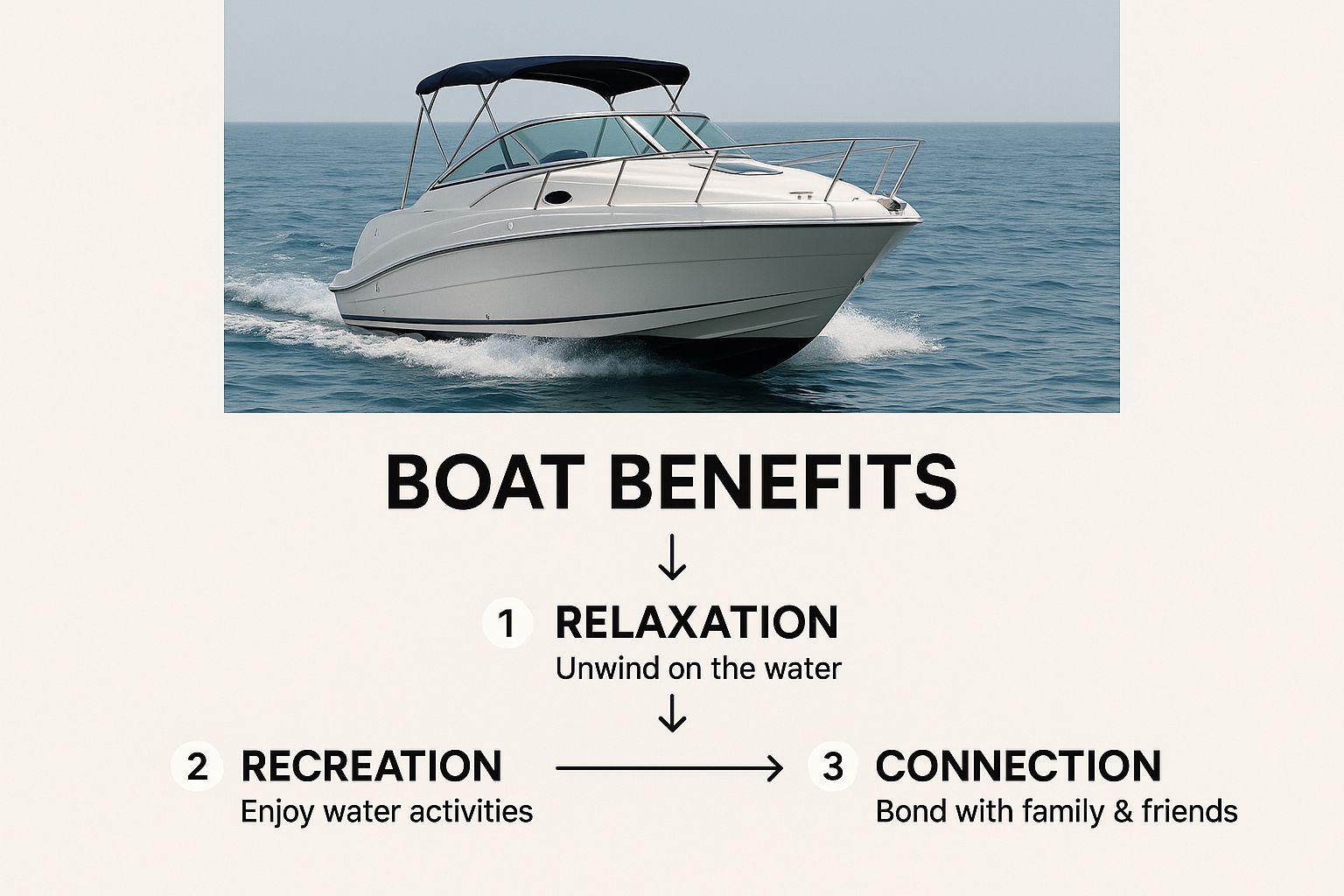
It really highlights how the boat's design—from the versatile cabin to the open deck space—comes together for a better experience on the water when everything is in good shape.
The engine is the heart of the boat, and it's a critical part of your inspection when looking at cuddy boats for sale. Even if you're not a mechanic, you can perform some vital basic checks.
Start with a simple visual. Pop open the engine compartment. Is it clean and tidy, or a greasy mess of disorganized, corroded wires? A clean engine room is often the sign of a meticulous owner.
Next, get a closer look at the engine itself:
- Pull the Dipstick: Check the oil. It should look like clean, honey-colored motor oil. If it's milky or foamy, that means water is getting into the oil—a potentially catastrophic engine failure waiting to happen.
- Check Belts and Hoses: Give them a good squeeze. They should feel firm yet flexible, not brittle, cracked, or spongy.
- Look for Corrosion: Scan the engine block, exhaust manifolds, and electrical connections. Some light surface rust on cast iron parts is normal, but heavy, flaky rust or green-and-white buildup on electrical terminals is a bad sign.
Finally, do a quick systems check at the helm. Flip every single switch. Do the navigation lights come on? How about the horn, bilge pump, and cabin lights? Flickering lights or dead switches can point to wiring gremlins hiding behind the panels. This systematic once-over is your best defense against buying a floating money pit.
A boat might look perfect sitting on its trailer, but you'll only discover its true personality out on the water. After you've given it a thorough once-over on land, the sea trial is your next move. This isn't just a casual spin around the bay; it's a hands-on performance test. You're there to see how the boat actually handles and if the engine is as strong as it seems.
Think of the sea trial as your chance to put the boat through its paces. The goal is to see how every system holds up under a real-world load, not just sitting at the dock.
Don't just leave the dock without a game plan. The seller or broker will be right there with you, so be prepared to take the helm and confidently work through a mental checklist.
First, see how the boat behaves at low speeds. Does it track in a straight line, or are you constantly fighting the wheel to keep it from wandering? Check its maneuverability around the marina by shifting from forward to neutral and then into reverse. You want to feel how it responds in tight quarters.
Once you have some open water, it's time to open it up.
- Getting on Plane: Push the throttle forward in one smooth motion. You're looking for a clean transition onto plane without the bow pointing at the sky or the engine bogging down. Make a mental note of the RPMs needed to get on plane—that's a great indicator of performance.
- Handling at Cruising Speed: Once you’re cruising, make some gentle S-turns. Does the boat feel planted and predictable? Or does it lean uncomfortably or feel skittish? Pay attention to any odd groans or rattles from the hull or engine during these maneuvers.
- Wide-Open Throttle (WOT): Find a safe, open area and, for just a minute or two, push the engine to its maximum recommended RPM. It should run smoothly without any major vibrations or signs of overheating. This is a stress test that can reveal problems you'd never find during a leisurely cruise.
While you're at the helm, don't get so focused on the engine that you forget everything else. Turn on the GPS, flick on the bilge pumps, and play with the trim tabs to see how they change the boat’s attitude in the water. This is your one shot to see it all work together.
Even if the sea trial was fantastic, you're not ready to shake hands yet. The next step is probably the single most important part of buying any boat: hiring a professional marine surveyor. This is absolutely non-negotiable, especially when you're looking at used cuddy boats for sale. A surveyor is your expert investigator, equipped with specialized tools and a trained eye to spot problems you'd never see.
Finding the right surveyor is critical. Look for an accredited professional from an organization like the Society of Accredited Marine Surveyors (SAMS) or the National Association of Marine Surveyors (NAMS). Whatever you do, never use a surveyor suggested by the seller or their broker. You need someone whose only loyalty is to you.
A good survey is your ultimate safety net. I once saw a buyer looking at a gorgeous cuddy cabin that looked brand new. The surveyor pulled out a moisture meter and found a huge, water-saturated section in the transom's core—a $10,000 repair that was completely invisible. The buyer walked away and dodged a massive financial bullet.
A few days later, you’ll get a comprehensive report. This document will detail every single finding, often breaking them down by how serious they are. It’s going to cover everything from the hull and deck structure to the engine, electrical systems, and safety gear.
Your job is to read it from cover to cover and understand what it's telling you. No used boat is perfect, so expect a list of issues. You're on the hunt for the "deal-breakers"—major structural delamination, severe hull blisters, a failing engine block, or dangerous wiring.
Minor things like a worn-out pump or a cracked fuel hose aren't reasons to kill the deal. Instead, they become ammunition for negotiation. You can use the surveyor's estimated repair costs to make a lower, well-justified offer. A survey doesn't just protect you from disaster; it gives you the leverage to pay a truly fair price.
Alright, you've done the heavy lifting. The inspection, the sea trial, and the professional survey have laid all the boat's cards on the table. Now it's time to translate that knowledge into a great deal. This is the moment you switch from boat inspector to savvy negotiator to make sure you're paying a fair price for the cuddy you want.
The secret to a good negotiation isn't about being aggressive or throwing out a lowball offer. It’s about building a case for a fair price based on the boat’s actual condition and what the market says it's worth. Your survey report is the most powerful tool in your arsenal.
Your opening offer should be a direct reflection of what you found during your due diligence. A good way to approach this is to start with the seller's asking price and then clearly deduct the estimated costs for every necessary repair the marine surveyor flagged. Have the report handy so you can point to the exact findings that justify your numbers.
For instance, if the surveyor found a faulty bilge pump and a worn-out cutlass bearing—repairs that add up to around $1,500—it’s completely fair to subtract that from the asking price. This isn't just haggling; it's a logical, fact-based approach to finding common ground.
I see it all the time: buyers get caught up in the excitement and overpay, or they get defensive and make an insultingly low offer that kills the deal. Stay level-headed. Treat it like a business transaction, and you'll find that a respectful, evidence-backed offer almost always gets a serious response.
Whenever possible, put your offer in writing. A documented proposal outlining your price and any conditions (like a final walkthrough) shows you’re a serious, organized buyer. It also prevents any "he said, she said" confusion later on.
It also helps to know the market you're in. The global leisure boat market was a USD 47.2 billion industry in 2026 and is projected to climb to USD 81.4 billion by 2034. A staggering 80.5% of that market is made up of used boats, meaning there are tons of buyers looking for pre-owned cuddy boats for sale, just like you. North America leads the pack, and understanding these dynamics gives you a much better feel for a boat’s true value. You can dive deeper into these trends in this leisure boat market report.
Nearly every seller will counter your offer. Don't let it throw you. This is just part of the dance. If their counter feels reasonable, you might decide to meet them in the middle. But if the repair list is long and expensive, don't be afraid to stand firm on your initial price.
Before you even start this conversation, decide on your absolute walk-away price. Know your limit and stick to it. There are plenty of other boats out there. Falling in love with one boat is the quickest way to cloud your judgment and overpay.
Once you've shaken hands on a price, it's time to nail down the paperwork to make it official. Getting the documentation right is critical—it protects you and the seller and ensures a clean transfer of ownership. Skipping this step can create massive headaches when it's time to get a title and registration.
Having a clear plan for the final payment and document exchange is crucial. This checklist breaks down the final steps to ensure nothing gets missed when you're buying one of the many cuddy boats for sale.
Closing The Deal Checklist
Here’s a quick-glance table to help you manage the final, critical steps of the purchase process. Follow these to ensure a smooth and legally sound transaction.
| Task |
Key Action |
Why It's Important |
| Bill of Sale |
Get a detailed bill of sale signed by both parties. It must include the boat's info (HIN, make, model, year), sale price, and date. |
This is your legal proof of purchase and the official document for the transfer of ownership. |
| Title Transfer |
Make sure the seller properly signs the boat's title over to you. If there’s a lien, the lender holds the title until it's paid. |
You cannot legally register the boat in your name or prove ownership without a correctly transferred title. |
| Trailer Title & Registration |
If a trailer is included, it needs its own title and registration. Treat it just like buying a used car. |
A trailer is a separate registered vehicle. You need legal ownership to tow it on public roads. |
| Payment |
Use a secure, traceable payment method like a cashier's check or bank wire. Steer clear of large cash deals. |
This provides a verifiable record of your payment and protects both you and the seller from potential fraud. |
With the paperwork signed and the keys in your hand, you've officially navigated the buying process. Now, the only things left are to get your new-to-you boat registered with your state's boating agency, lock in some insurance, and finally, hit the water.
Even after you've done all the homework, inspected a few boats, and narrowed down your choices, some questions always seem to pop up right before you're ready to pull the trigger. That's a good thing! It means you're being thorough.
Buying a boat is a major decision, and it pays to have all your ducks in a row. Let's tackle some of the most common questions I hear from buyers, from seasoned boaters to first-timers, when they're looking at cuddy boats for sale.
What Should I Realistically Budget for Annual Maintenance?
This is the big one, and overlooking it is the quickest way to turn your dream boat into a financial headache. A solid rule of thumb I've always stood by is to set aside 10% of the boat’s purchase price for annual maintenance and operating costs.
It might sound like a lot, but it’s a realistic figure that keeps you from getting caught off guard.
So, if you buy a $30,000 cuddy, you should plan on spending around $3,000 a year to keep it in prime condition. What does that cover?
- Engine Service: Think oil changes, new filters, and crucial winterization before the cold hits.
- Bottom Paint: If your boat lives in the water, you'll need fresh anti-fouling paint every year or two to keep marine growth at bay.
- Insurance: This is non-negotiable. Costs will vary based on your boat's value, where you live, and your boating history.
- Storage & Slip Fees: Whether it's a slip at the marina, a spot in a dry-stack, or just a space at a storage facility, this is a fixed cost.
- The "Uh-Oh" Fund: Things break. A pump here, a light there, a hose that decides it's done. Having a cushion for these small, inevitable repairs is just smart planning.
Factoring this 10% in from the get-go means you can actually afford to enjoy and properly care for your investment without any nasty financial surprises.
The answer is a firm "maybe," and you absolutely have to do the math. Towing capacity isn't a suggestion; it's a critical safety limit. The good news is that many smaller cuddy cabins, especially those under 22 feet, are built with trailering in mind and can often be handled by a properly equipped mid-size or full-size SUV.
Before you even think about hitching up, you need to find three numbers:
- Your Vehicle's Max Towing Capacity: It’s in your owner's manual. Let's say your SUV is rated for 5,000 lbs.
- The Boat's Dry Weight: This is the boat's weight straight from the factory—no fuel, no gear. A 21-foot cuddy might come in around 3,500 lbs.
- The Real Weight: Now add the trailer (~1,000 lbs), a full tank of gas (~300 lbs), and all your water toys, safety gear, and coolers.
When you add it all up (3,500 + 1,000 + 300 + gear), you can see how quickly you can push past that 5,000 lbs limit. You always want to be well under your vehicle's maximum for safe handling, especially when braking or dealing with a crosswind.