When you start looking at fish and ski boats for sale, you’re really searching for one boat that can do it all. It’s the perfect answer for the family that wants to reel in a trophy bass in the morning and then spend the afternoon carving up the wake on a slalom ski. These versatile boats are truly the Swiss Army knives of the water, much like a versatile SUV combines utility and capability in one package.
Sifting through dozens of listings for fish and ski boats can be overwhelming. Each one throws a wall of technical specs and features at you, making it hard to know where to even start. Think of this guide as your personal roadmap, here to cut through the jargon and point out what’s actually important for your family’s time on the water.
We’re going to help you move past the confusing details so you can walk up to any boat that catches your eye with confidence. We'll break down exactly what makes these hybrid models the ideal all-in-one package for people who refuse to choose between fishing and watersports.
A fish and ski boat is a lot like a crossover SUV; it's designed for multiple missions. It’s got the rugged, practical features you need for an off-road fishing trip, but it also delivers the smooth performance and comfort for a family cruise. It’s this dual-purpose design that means you don’t have to compromise.
The big wins with this hybrid approach are pretty clear:
- Maximized Family Time: You get one boat that makes everyone happy, from the serious angler to the kids who just want to go tubing. No need for separate, specialized watercraft.
- Cost-Effectiveness: Buying, insuring, and maintaining a single multi-purpose boat is a whole lot easier on the wallet than trying to manage two.
- Space Efficiency: Whether it's tied to a dock or parked on a trailer in your driveway, storing one boat is just plain simpler.
We've structured this guide to take you from a curious window-shopper to a confident buyer. We’ll dive into the critical things that define a quality fish and ski boat, from hull designs built to handle choppy water to the engine power needed to get a skier up with ease.
By the time you're done here, you’ll be able to look at any listing for a fish and ski boat and know exactly what to look for—how to judge its real value, its functionality, and whether it’s the right fit for making memories with your family.
We're going to get past the flashy brochure features and into the practical stuff that ensures your investment pays off for years to come. Let's get you ready to find that perfect boat for your next adventure.
So, what exactly makes a boat a "fish and ski" model? It's all about a smart, hybrid design that merges features from two very different worlds into one versatile package. Getting a handle on these core design elements is the key to confidently sizing up any of the fish and ski boats for sale you'll encounter.
Let’s start with the very foundation of any boat: the hull. You can think of a boat's hull like a car's chassis and suspension—it's built to handle specific conditions on the water. Fish and ski boats almost always feature one of two hull designs, each with its own strengths.
A Deep-V hull is the off-road suspension of the boating world. Its sharp, V-shaped profile is designed to slice right through choppy water and big waves, giving you a surprisingly smooth and stable ride when conditions get rough. This is a massive plus if you spend your time on larger lakes or coastal waters where the wind can really kick things up.
The other popular choice is the Modified-V hull. This design is more like the suspension on a modern crossover SUV—it's a fantastic all-arounder. The hull is still V-shaped up front to handle waves but flattens out toward the back. This provides incredible stability when you're at a standstill, which is perfect for casting a line without rocking the boat. That flatter rear section also helps produce a cleaner wake for waterskiing.
The choice really boils down to where you do most of your boating. If you need a smooth ride in potentially rough water, the Deep-V is your best bet. But for calmer inland lakes where you want maximum stability for fishing, the Modified-V usually wins out.
Now, let's look at what's pushing you across the water. The engine is the heart of your boat, and in the fish and ski world, you'll generally find two main types. Each one caters to a different set of priorities for the active shopper.
An outboard motor is like a high-performance, self-contained power pack. It's mounted directly onto the transom (the very back of the boat), which offers some great advantages:
- Easy Maintenance: Everything is right there in the open, making routine service and repairs much simpler.
- More Interior Space: With the engine outside the boat, you free up a ton of valuable cockpit and storage room.
- Shallow Water Access: You can tilt the entire motor up, letting you sneak into shallow coves without worrying about dinging the propeller.
On the flip side, you have the inboard/outboard (I/O) engine, often called a sterndrive. Think of this more like a car's engine. The engine block is housed inside the hull, and it connects to a drive unit that goes through the transom to the prop. This setup has its own appealing perks.
The biggest win for an I/O is the wide-open swim platform it creates at the back. It’s a completely uncluttered space, perfect for swimmers hopping in and out or for skiers getting their gear on. The weight distribution of an inboard engine can also create a more balanced ride and help sculpt a better wake for tow sports. Getting a feel for these fundamental design choices is the first step in comparing fish and ski boats for sale, as they directly shape how the boat will perform for both fishing and family fun.
Every boat is a compromise, and that’s especially true when you start looking at fish and ski boats for sale. It’s easy to get distracted by a shiny finish, but the real key to making the right choice is focusing on the practical features that will actually shape your days on the water. You’ve got to separate the non-negotiables from the nice-to-haves based on what your family really wants to do.
Think of it like shopping for any vessel—the right size depends entirely on how you plan to use it. The same logic applies here—the right features will make or break your fishing trips and watersports weekends.
For anyone serious about fishing, a few key features are absolutely essential. These aren't just flashy add-ons; they're the tools of the trade that directly impact your ability to find, catch, and keep fish.
- Livewells: A simple bucket won't cut it. You need a proper aerated livewell that keeps fresh, oxygenated water circulating. This is crucial for keeping your catch healthy, especially for tournament anglers or if you're practicing catch-and-release.
- Rod Holders: Don't just count the rod holders—look at where they are. Well-placed holders keep your expensive gear safe and out of the way when you're moving, but they need to be right at hand when you get a bite.
- Trolling Motor: A bow-mounted trolling motor is a total game-changer. It gives you the stealth and precision to sneak up on fish without firing up the noisy main engine. You get hands-free control to cast while quietly working your way down a promising shoreline.
When it's time to swap the fishing rods for a tow rope, a whole different set of features takes center stage. This is all about creating the best—and safest—experience for everyone, whether they’re on skis, a tube, or a wakeboard.
The image below gives you a sense of the financial side of things, comparing new vs. used prices and showing how much value a boat can lose in its first year. This is a huge factor for any buyer to consider.
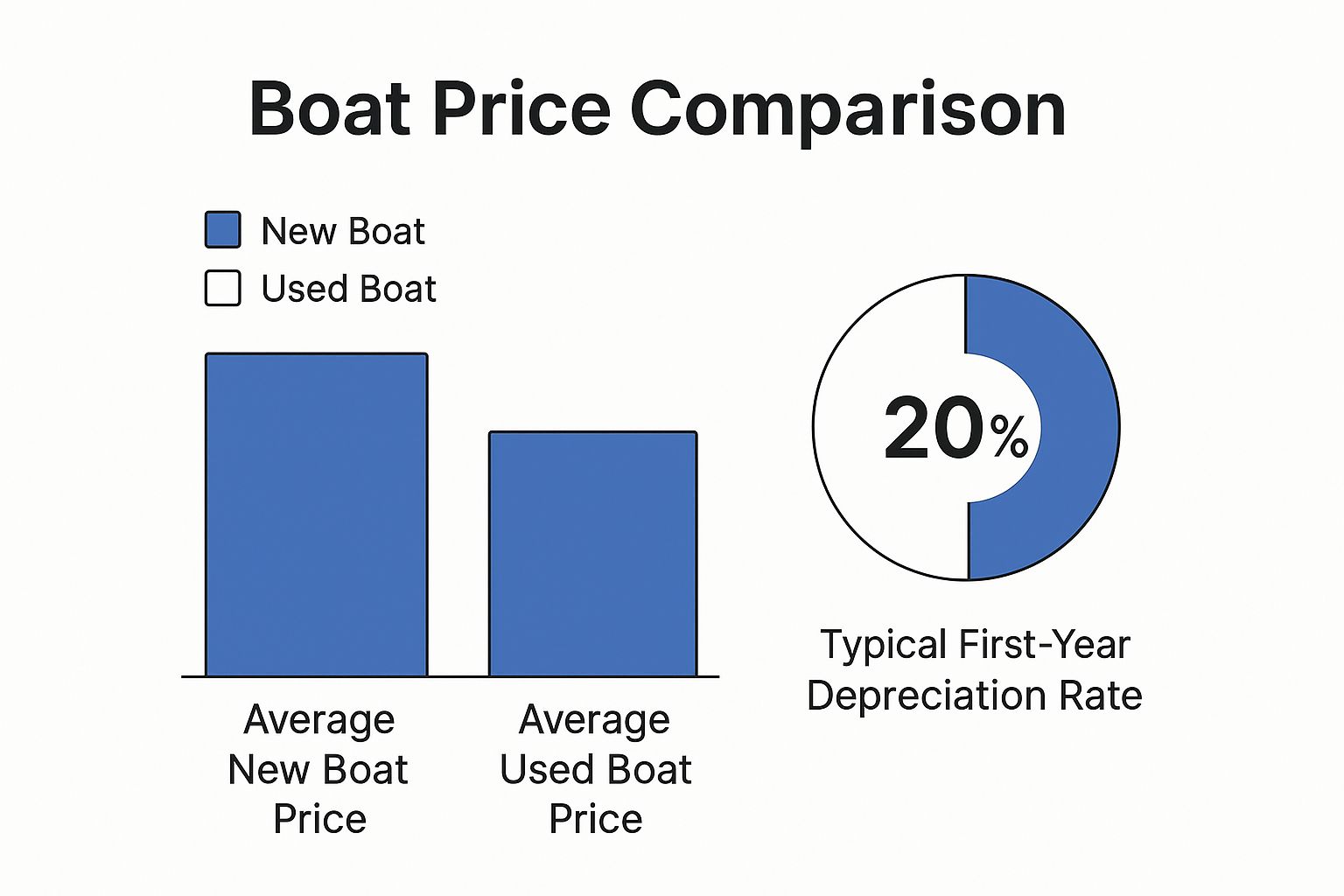
As you can see, buying a well-maintained used boat can save you a bundle, often letting you step up to a model with more features while avoiding that initial, steep depreciation hit.
Beyond the engine, the right equipment is what makes watersports safe and fun for the whole family.
- Ski Pylon or Tower: Sure, you can pull a small tube from a hook on the transom, but for real skiing or wakeboarding, a reinforced ski pylon or a full wakeboard tower is a must. It elevates the rope, which helps pull the rider up out of the water cleanly and keeps the line from dragging.
- Swim Platform and Ladder: An integrated swim platform is your staging area for all water activities. Just as important is a good deep-reach ladder with at least three steps. Trust me, when you're tired, trying to climb back aboard with a dinky two-step ladder is no fun.
So, how do you weigh these competing priorities? The table below is a good starting point. Use it to think about which features matter most for your crew.
Use this table to weigh the importance of key features against your primary activities, helping you choose a model that best suits your family's needs.
| Feature |
Value for Fishing |
Value for Watersports |
Key Considerations When Buying |
| Trolling Motor |
High - Essential for precise, quiet positioning. |
Low - Gets in the way of bow seating and anchoring. |
Look for quick-release brackets for easy removal when not in use. |
| Livewell System |
High - Critical for keeping bait and catch alive. |
Low - Takes up valuable storage space. |
Can the livewell double as a cooler or dry storage on ski days? |
| Wakeboard Tower |
Low - Obstructs casting and can be a hassle. |
High - Non-negotiable for serious wakeboarding and skiing. |
Check for fold-down towers that make storage and low bridges easier to manage. |
| Convertible Seating |
Medium - Bow cushions must be removable for a casting deck. |
High - Crucial for maximizing passenger comfort and lounge space. |
How quickly and easily can the seating be converted from one mode to the other? |
| Swim Platform |
Low - Can get in the way of fighting a fish off the stern. |
High - Essential for safety and convenience. |
Look for an extended platform that offers space without interfering with the motor. |
Ultimately, the goal is to find a boat that lines up with how you’ll actually use it, not just how you imagine using it.
By creating a checklist of these must-have features before you start shopping, you can look at any fish and ski boat listing with a clear head. It helps you cut through the marketing and find a model that truly delivers on its promise of all-in-one fun.

This is one of the biggest forks in the road you'll face when shopping for fish and ski boats for sale: do you spring for a brand-new model, or go for a pre-owned one? It's a choice that dramatically shapes your budget, the features you get, and what ownership will look like down the road. There’s no single right answer—it all comes down to what you value most.
A new boat is a beautiful thing. It's a blank canvas with that unbeatable "new boat smell," the latest gadgets, and a full manufacturer's warranty backing you up. There’s a certain peace of mind that comes with knowing you're the first person to own it, with no hidden history to worry about.
The trade-off, however, is depreciation. Just like buying a new car, a boat loses a hefty chunk of its value the second it hits the water. You can expect it to drop by as much as 10% in that first year alone. That financial reality is exactly why so many experienced boaters turn to the used market.
Going the used route can be one of the smartest financial decisions you make. The biggest advantage is simple: you let someone else take that massive, initial depreciation hit. This lets your money go so much further.
Suddenly, you might find yourself able to afford a higher-end model with a bigger engine or more bells and whistles than you could ever touch on the new market. A well-maintained two or three-year-old boat can give you the same performance and fun as a new one, but for thousands less. It opens up a whole new world of premium brands that might have seemed out of reach.
Of course, the trick is knowing what you're looking at. A great deal is only great if the boat is sound. This is where a thorough pre-purchase inspection isn't just a good idea—it's absolutely non-negotiable.
Before you even think about making an offer, you need to put on your detective hat. A methodical inspection can save you from a world of headaches and wallet-draining repairs later on. Don't rush it, and never be afraid to walk away if you find too many red flags.
Think of this inspection as a crucial interview for your potential boat. You need to ask the right questions and look in the right places to ensure it's the right candidate for your family's adventures.
Here's a battle-tested checklist for what to look for on any used fish and ski boats for sale:
- Hull and Structure: Get on your hands and knees and inspect the entire hull. You're looking for stress cracks, especially around the transom where the heavy engine hangs. Check for blisters, deep gouges, or any signs of a major repair.
- Engine Examination: Ask to see the engine service records. A thick file of regular maintenance is a fantastic sign. Pull the dipstick and check the oil—if it looks milky, that means water is getting in, which is a major problem. Also, look for corrosion and leaks.
- Electrical and Systems Test: This is a big one. You need to test every single switch, pump, and light on the boat. Flip on the navigation lights. Turn on the bilge pump. Fire up the livewell aerator. Faulty wiring can be a frustrating and expensive nightmare to chase down.
- Floors and Upholstery: Walk every inch of the deck, paying close attention to how it feels under your feet. Any soft or spongy spots are a bad sign, suggesting rot is happening beneath the vinyl or carpet. Check all the seat cushions and vinyl for mildew, torn seams, and heavy sun damage.
Beyond kicking the tires, your conversation with the seller is just as telling. How they answer can reveal a lot about how the boat was cared for.
- Why are you selling the boat? It’s a simple question, but the answer can be incredibly insightful.
- Where was the boat stored? Was it tucked away in a garage, kept under a cover, or left out in the sun and rain?
- Has it been used in saltwater? Salt is brutally corrosive, so a saltwater boat needs much more meticulous upkeep than a freshwater one.
- Can we take it for a sea trial? This is the ultimate test. You should never, ever buy a boat without first running it on the water.
By following this process, you can find a fantastic used boat with confidence. A little bit of diligence on the front end will ensure you get the best value for your money and set you up for years of fun on the water.
https://www.youtube.com/embed/GJDX9sdR-f0
When you first start looking at fish and ski boats for sale, it’s natural to think of it purely as a purchase. But a good boat is so much more than that—it’s an investment in a lifestyle and a real asset that holds its value surprisingly well.
Unlike a new car that loses value the second you drive it off the lot, the boat market has proven to be incredibly resilient. The desire for versatile, family-friendly ways to get outdoors has never been stronger, and that directly props up the value of models like fish and ski boats. It helps to think of your boat less as a toy and more as a desirable piece of equipment in a booming market.
The steady interest in recreational boating means there's always a healthy market for used boats. As more people prioritize family time, local getaways, and watersports, a fresh wave of buyers is always on the hunt for a quality pre-owned vessel. This constant demand acts as a buffer, protecting your investment from a steep nosedive in value.
This is especially true for boats that can do it all. A fish and ski model appeals to serious anglers and families who just want to tube and ski. That makes its potential buyer pool way bigger than that of a specialized tournament bass boat or a high-end wake boat. That broad appeal is one of the biggest reasons they hold their value so well over the years.
Your boat isn't just an expense; it's an asset that provides incredible returns in memories and holds a tangible financial value. Understanding the market forces at play helps you appreciate the full worth of your investment.
The entire boating world is on an upswing, which only helps solidify your boat's value. Just look at the aluminum fishing boat market, which is a huge slice of the recreational pie. Right now, it's a USD 1.7 billion global market, and it’s on track to hit USD 2.6 billion by 2034. You can read more about what’s driving that trend on GlobeNewswire.com.
What's behind this growth? It’s pretty simple: recreational fishing is more popular than ever, and new freshwater fishing spots are opening up all over the world. People want boats that are light, tough, and don’t guzzle gas—all things that many fish and ski models deliver.
While a hot market is great, how you treat your boat is what really determines its long-term worth. Some things matter a lot more than others when it comes time to sell or trade it in.
If you want to get the most out of your investment, here’s where to focus:
- Consistent Maintenance: Nothing beats a complete, documented service history. Regular tune-ups, oil changes, and proper winterization prove to the next owner that you took care of it.
- Cleanliness and Condition: A boat that looks good, sells well. Keeping the hull waxed, the vinyl seats clean, and the carpet free of mildew goes a long way in preventing permanent wear.
- Brand Reputation: Let's be honest, some brands are just known for building a better boat. A manufacturer with a reputation for quality and durability will almost always fetch a higher resale price.
- Upgrades and Features: Modern electronics, a high-quality trolling motor, or a solid wake tower can seriously boost your boat’s appeal and its final price tag.
As you get closer to buying a boat, a few last-minute questions always seem to pop up. It's completely normal. These are the practical, real-world details that people often think about right before they commit.
We've heard them all over the years. Here are some straightforward answers to the most common questions we get from people looking at fish and ski boats for sale, designed to give you that final boost of confidence.
For a fish and ski boat in that popular 17 to 19-foot range, you'll want an engine between 115 and 150 horsepower. That's the real sweet spot for this type of boat.
An engine in this class has plenty of muscle to yank a skier or wakeboarder right out of the water without a struggle. But it’s also efficient enough that you can dial it way back for a slow, quiet troll when you’re trying to land the big one. A great rule of thumb is to pick an engine that’s around 75-90% of the boat's maximum horsepower rating. This gives you all the performance you actually need without paying for power you’ll rarely use.
The classic rule of thumb is to budget 10% of the boat’s purchase price for your annual costs. And honestly, it’s a pretty solid guideline. This isn't just about gas money; it covers everything that comes with the territory of boat ownership.
So, what does that 10% actually cover?
- Routine engine service, like oil changes and tune-ups.
- Getting it professionally winterized for the offseason and ready for summer.
- Boat insurance and your yearly registration fees.
- Slip fees at a marina or costs for off-season storage.
- All the little things, like cleaning supplies and small repairs.
Putting it into perspective, if you buy a $40,000 boat, you should be prepared for about $4,000 in total expenses each year to keep it running well and legally.
This one really boils down to where you’ll be using your boat most of the time. They both have their strengths.
Fiberglass hulls are heavier, which helps them slice through choppy, open water for a much smoother and quieter ride. They also give manufacturers the freedom to create those sleek, molded designs with a high-end, polished finish.
Aluminum, on the other hand, is much lighter. That makes it easier to tow with a smaller tow rig and simpler to launch and retrieve. It’s also incredibly tough—a bump against the dock or a scrape on a rocky shoreline that would gouge fiberglass will likely just scratch an aluminum hull. It's a durable, practical, and often more affordable choice, especially for boating on inland lakes and rivers.
Think of it like this: Fiberglass is your smooth-riding luxury sedan for the open highway, while aluminum is the tough, go-anywhere pickup truck that isn't afraid of a few backcountry roads.
Yes, absolutely! Bolting on a wakeboard tower is one of the most common upgrades people make to their fish and ski boats for sale. There are plenty of companies that build universal-fit towers that can be installed on almost any boat, instantly upping its watersports game.
A word of caution, though: this isn't a simple weekend project for most people. You'll want a marine professional to handle the installation. Pulling a rider puts an incredible amount of stress on the tower and the hull, so they’ll need to reinforce the deck with strong backing plates to make sure everything is safe and secure.
Ready to find the perfect boat that fits your family’s adventures and your budget? At SearchShop.com, we provide the tools you need to research pricing history, compare features, and browse thousands of new and used listings. Explore your options and make your next purchase with confidence at https://www.searchshop.com.