So, you're in the market for a sports fishing yacht. Let's be clear: you're not just buying a boat. You're investing in a high-octane machine that masterfully combines the raw thrill of offshore angling with the refined comfort of a luxury cruiser. These are specialized vessels, engineered from the keel up for one thing: chasing big game in deep water with power and precision.
Starting the hunt for the right sportfisher is more than just a purchase; it’s an entry into a lifestyle built on adventure. It's crucial to understand that these aren't just your average luxury yachts. Think of it like this: you can have a high-end SUV, which is comfortable and capable, or you can have a purpose-built rock crawler. Both are impressive, but only one is specifically designed to conquer the toughest terrain. A sportfisher is that specialized machine for the ocean.
Your journey starts right here, by learning what makes these incredible vessels tick. Consider this guide your personal chart, helping you navigate the market with the confidence of a seasoned captain.
We're going to pull back the curtain on the entire buying process. No jargon, no fluff. We'll cover everything from decoding technical specs to realistically budgeting for the total cost of ownership. The goal is simple: to give you the knowledge to make a smart, informed decision.
By the end, you'll be able to:
- Tell the difference between various sportfisher models and know their pros and cons.
- Pinpoint the must-have features that align with your personal fishing style.
- Recognize what makes a yacht a solid long-term investment versus just a pretty face at the dock.
And you're not alone in this pursuit. The global market for sport-fishing motor-yachts is booming, valued at around USD 2.19 billion and on track to hit USD 3.12 billion by 2032. That's a lot of people discovering the passion for offshore angling. You can dig into the numbers and sportfishing motoryachts market trends on Verified Market Research.
Owning a sports fishing yacht is about so much more than the fish you catch—it’s about the whole experience. It’s the pre-dawn departures into a rising sun, the shared stories and laughter on the deck, and that heart-pounding moment when a trophy fish hits the line miles from anywhere. These boats are platforms for making memories that last a lifetime.
A true sportfisher is a perfect marriage of form and function. It must be rugged enough to handle rough seas and powerful enough to chase down marlin, yet comfortable enough to serve as a second home on the water.
As you start browsing the countless sports fishing yachts for sale, keep this in mind: every single feature, from the cockpit layout to the hull design, is there for a reason. Understanding these details is the first and most important step toward finding the vessel that will be your gateway to the open sea.
Before you start looking at listings for sports fishing yachts for sale, you need to know what separates a real sportfisher from a simple cruiser with a few rod holders. A true sportfishing yacht is a purpose-built machine. Every single curve, feature, and piece of gear has a job to do.
Think of it like this: a luxury yacht is a grand touring car, built for comfort and style. A sportfisher is a track-ready race car, engineered from the ground up for high-stakes performance. Its whole reason for being is to find, fight, and land big game fish, all while giving you a rock-solid platform in rough seas.
You can spot a serious sportfisher from a mile away. The classic profile isn't just for looks; every element gives you a major strategic advantage out on the water.
- Flared Bow and Deep-V Hull: That sharp, aggressive bow isn't just for show. It’s designed to slice cleanly through waves and throw spray out to the sides, keeping the deck dry and the ride from beating you up. The deep-V hull gives the boat its stability and grip, especially when you're running hard in a chop.
- Flybridge or Tuna Tower: This elevated command center is the captain's eyes and ears. It offers a crucial 360-degree vantage point for spotting fish breaking the surface, navigating around floating debris, and communicating with the crew in the cockpit below.
- Spacious Cockpit: The back deck of a sportfisher is where the action happens. It's intentionally wide-open and free of clutter. This gives your crew room to manage the lines and, most importantly, allows an angler to move freely when fighting a powerful fish.
This combination of a powerful hull and unmatched visibility is the foundation that all the other fishing gear is built on.
Look past the overall shape, and you'll find the specialized equipment that truly sets a sportfisher apart from a pleasure boat. These are the tools of the trade, and knowing what to look for is key when you're evaluating a potential buy.
A sportfisher isn’t just a boat with rod holders. It’s an integrated system where the hull, deck, and equipment all work in concert to give the angler every possible advantage over their prey.
Here are the non-negotiable features you should be looking for:
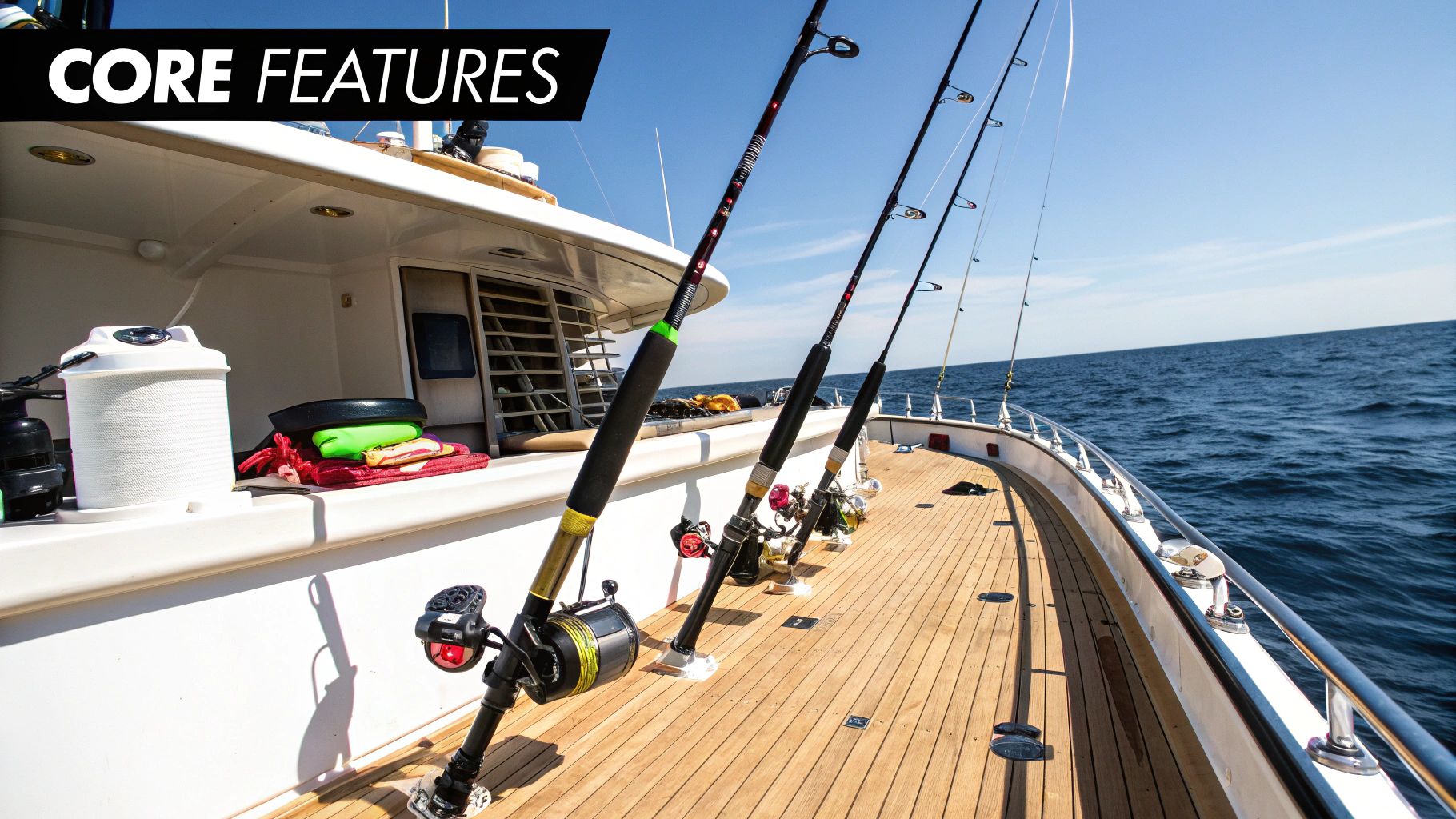
- Outriggers: Those long poles swinging off the sides are essential. They let you spread multiple fishing lines far out from the boat's wake, creating a wide trolling pattern that looks like a school of baitfish. This dramatically increases your odds of getting a strike.
- Livewells: A livewell is a tank that constantly pumps fresh seawater through it to keep your bait alive, healthy, and kicking. Lively bait is far more effective at attracting big predators than dead or dying bait.
- Insulated Fish Boxes: These are large, built-in coolers, often right in the deck, designed to hold your catch. Good insulation is critical for keeping your fish fresh and preserving its quality during a long day offshore under the hot sun.
- Fighting Chair: Bolted right in the center of the cockpit, the fighting chair is an iconic piece of big game hardware. It gives an angler a secure platform to brace against, using their full body weight to battle huge, powerful fish like marlin and tuna for hours on end.
Once you understand this anatomy, you're not just browsing boats anymore. You're evaluating a highly sophisticated fishing platform, ready to find the perfect sports fishing yachts for sale to fuel your offshore adventures.
Staring at a spec sheet for a sport fishing yacht can feel like trying to read a foreign language. It's often just a wall of numbers, abbreviations, and technical jargon that can make your head spin, even if you’ve been around boats for a while. But getting a handle on these details is absolutely essential—they’re the blueprint for how the boat will perform, feel, and function out on the open water.
Think of the spec sheet as the yacht's resume. It tells you exactly what that vessel was built to do and how well it does it. Learning to translate these specs into real-world performance will give you the confidence to compare different sports fishing yachts for sale like a seasoned pro.
At the core of every sportfisher is its power plant. The engines dictate everything, from how quickly you can get to the fishing grounds to how far you can venture before turning back. It's not just about bragging rights and raw power; it's about finding the right balance for how you plan to use the boat.
Here are the key metrics to zero in on:
- Engine Configuration: Most sportfishers run on twin inboard diesel engines from trusted names like Detroit Diesel, MAN, or Caterpillar. The specific setup (like a V8 versus an inline-six) can affect everything from torque and fuel burn to how easy it is for a mechanic to work on them.
- Horsepower (HP): This is the engine’s raw output. More horsepower typically translates to a higher top speed and a faster, more efficient cruise. A 46-foot Post, for example, might have twin 450 HP engines, giving it a comfortable cruising speed of around 20 knots.
- Fuel Capacity: This number, listed in gallons, is your lifeline. It directly determines your yacht's range. A bigger tank, say 640 gallons, means you can make those long offshore runs to remote canyons without constantly worrying about your next fuel stop.
These three things are a team. A beast of an engine is useless if you don't have the fuel to feed it, and a giant fuel tank just adds weight if the engines are inefficient. The goal is to find a setup that perfectly matches your ambitions, whether that’s chasing fish nearshore or embarking on multi-day bluewater adventures.
Beyond what’s in the engine room, the hull is arguably the most critical part of any sportfisher. Its shape is what dictates how the yacht behaves in different sea conditions, which is a massive factor for both comfort and safety. You'll constantly see the term "deep-V hull" on listings for a good reason.
A deep-V hull has a sharp, V-shaped entry at the bow that allows it to slice cleanly through waves instead of slamming down on top of them. This design delivers a dramatically smoother and more stable ride in choppy offshore waters—a non-negotiable for serious anglers who don't head for the barn just because the wind picks up.
The image below lays out the key steps in a smart buying process, starting with your needs and ending with the final inspection.
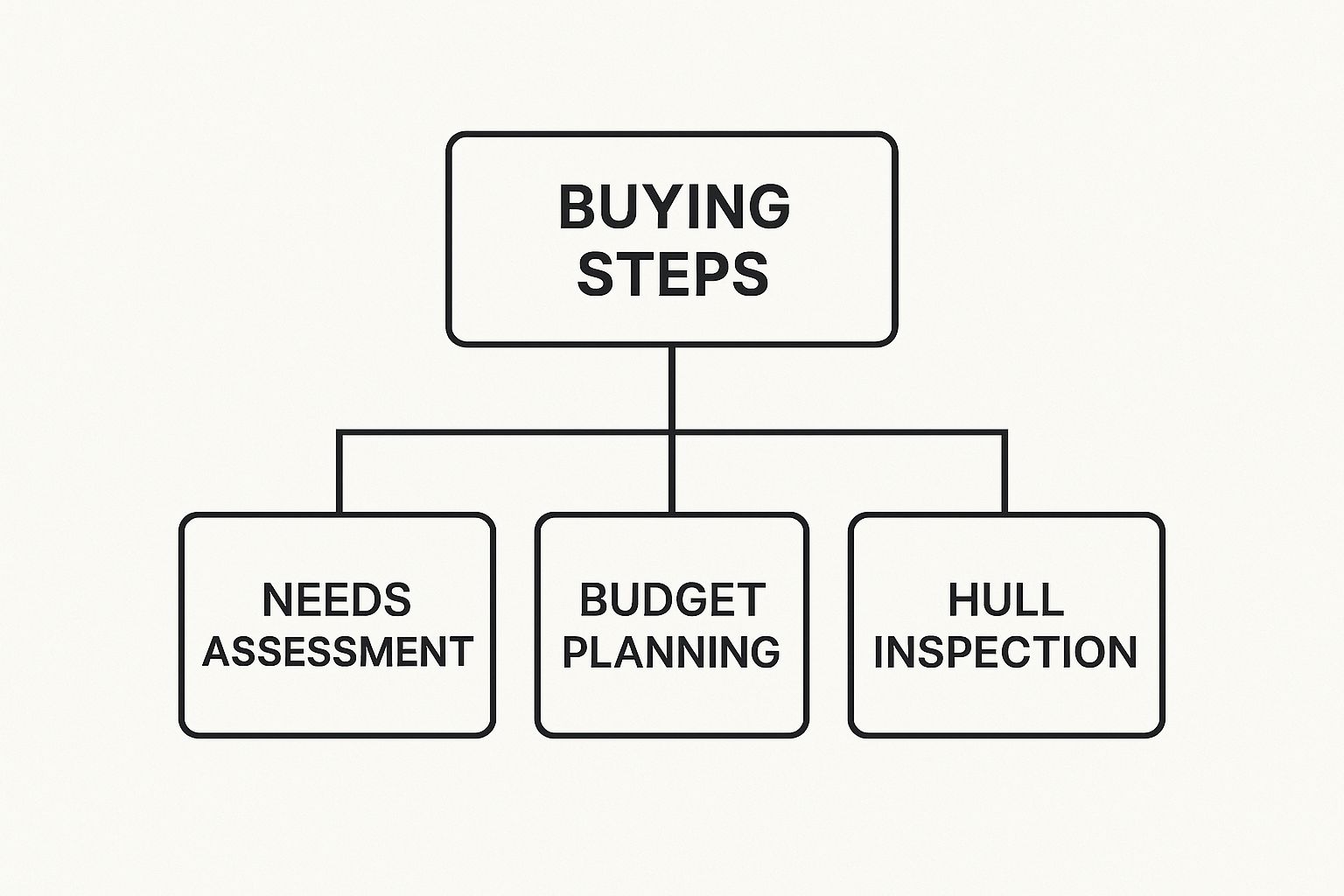
As you can see, a successful purchase begins long before you ever step on a boat. It all starts with having a crystal-clear idea of your needs and budget.
Today’s sport fishing yachts are loaded with incredible technology designed to give you a serious advantage on the water. As you scan a spec sheet, keep an eye out for these modern systems that can make a huge difference in your fishing success and overall enjoyment.
A gyrostabilizer is a complete game-changer for comfort. It uses a high-speed flywheel to counteract the boat's natural roll, dramatically reducing seasickness and fatigue. On a rough day, it can be the difference between a great trip and a miserable one.
Look for a boat with a modern electronics suite from brands like Furuno, Garmin, or Simrad. A good package will include powerful sonar for marking fish, high-definition radar for navigating in fog or at night, and a reliable GPS chartplotter. These high-tech features are a big reason the sport fishing boat market in North America is growing, especially in the high-performance and luxury segments. You can discover more about sport fishing market trends to see just how much technology is shaping what buyers want.
To help you sort through it all, this table breaks down some of the most critical features you'll encounter. It explains what they do and why they matter for different types of fishing, helping you create a "must-have" list for your search.
| Feature |
What It Does |
Why It Matters for Anglers |
Best For |
| Outriggers |
Long poles that spread fishing lines away from the boat, creating a wider spread. |
Allows you to troll more lines without tangles, covering more water and attracting more fish. |
Offshore trolling for pelagic species like marlin, tuna, and dolphin (mahi). |
| Livewell |
A tank with circulating water designed to keep baitfish alive and healthy. |
Fresh, lively bait is often the key to getting bites from picky gamefish. |
Any angler using live bait, from coastal kingfishing to offshore sailfishing. |
| Fighting Chair |
A heavy-duty swiveling chair in the cockpit for battling large, powerful fish. |
Provides leverage and support during long fights, reducing strain on the angler. |
Big-game anglers targeting marlin, giant bluefin tuna, and large sharks. |
| Gyrostabilizer |
A device with a spinning flywheel that counteracts the boat's side-to-side roll. |
Drastically improves comfort by creating a more stable platform, reducing seasickness. |
All offshore anglers, especially those who spend long days in choppy seas. |
| Fishfinder/Sonar |
Uses sound waves to detect fish and map the bottom structure beneath the boat. |
Helps you locate fish-holding structure like reefs and ledges and see where the fish are. |
Virtually all fishing styles, from bottom fishing to trolling. |
Understanding these key features and what they bring to the table is the final piece of the puzzle. With this knowledge, you're ready to read a spec sheet like a pro and find the perfect sportfisher for your next adventure.
When you start looking at listings for sports fishing yachts for sale, it's easy to get fixated on the sticker price. That big number is what grabs you, but honestly, it’s just the tip of the iceberg. The real number you need to wrap your head around is the Total Cost of Ownership (TCO).
Just like buying a high-end RV, the purchase price is only the beginning. After that, you've got insurance, fuel, specialized maintenance, and storage to keep it ready for your next adventure. A sportfisher is the exact same idea, just on a much grander scale. Getting a handle on these ongoing costs is what makes the difference between a dream come true and a financial nightmare.
A smart budget is what keeps the dream alive, long after you've signed the papers.
Once you get past the initial purchase and any loan payments, you'll have a set of annual operating costs. A good rule of thumb that's been kicked around the marine industry for years is to budget about 10% of the yacht's purchase price for annual expenses. So, if you buy a $1 million yacht, you should be prepared for roughly $100,000 a year in upkeep.
That number covers a whole lot of ground:
- Insurance: This is absolutely non-negotiable. The cost will depend on the yacht's value, your personal boating experience, and where you plan to cruise.
- Marina Fees: Think of this as rent for your yacht's parking spot. Dockage fees can swing wildly based on the marina's location and what kind of amenities it offers.
- Routine Maintenance: This is the constant stuff—regular engine service, hull cleaning to keep marine growth off, and making sure all your systems from plumbing to electronics are in good shape.
- Fuel Consumption: Diesel isn't cheap, and this will be one of your biggest variable costs. It all comes down to how often you head out and how far you run.
Nailing these figures down before you buy is the key to creating a financial plan that actually works.
The initial purchase price gets you the yacht, but a well-planned operational budget is what keeps you on the water. Overlooking these recurring costs is the single biggest mistake new owners make.
On top of the predictable annual bills, a smart owner always has a fund for the big, less frequent stuff. This is your war chest for things like a major engine overhaul, upgrading a dated electronics package, or handling a repair that comes out of nowhere. A sudden squall could shred your canvas, or a critical pump could give out when you're miles offshore.
The market for these incredible boats is as strong as ever. One analysis pegged the sport-fishing motor-yachts market revenue at USD 3.2 billion, with forecasts expecting it to hit USD 5.7 billion by 2033. This shows just how much demand and innovation are driving things forward. You can learn more about sport-fishing motor-yacht market projections to get a better sense of the economic trends.
For bigger boats, don't forget about crew. Once you get over 60 feet, you'll likely need a captain or at least a part-time mate to help run the boat, especially if you're planning long trips or fishing tournaments. Budgeting for these long-term and potential costs means you're ready for anything, so you can keep your mind on the adventure ahead.
Alright, you’ve pored over the spec sheets and you know your budget. Now comes the exciting part: actually making a move on a boat. This stage can feel a little intimidating, but it’s really just a logical series of steps designed to protect everyone involved—you, the seller, and the boat itself.
Think of it as a clear roadmap from finding "the one" to holding the keys. Having a seasoned yacht broker in your corner makes all the difference here. They've walked this path countless times and can guide you through the negotiations, paperwork, and potential pitfalls that can trip up a deal.
Before you even think about making an offer, get pre-approved for a marine loan. Seriously. It puts you in a much stronger position by showing sellers you’re a serious, qualified buyer, and it gives you a firm grasp on exactly what you can afford. Marine lenders will look at the usual stuff—credit score, finances, and your debt-to-income ratio—so having this sorted out ahead of time is a huge advantage.
Once you’ve found the right vessel, it’s time to put in a formal, written offer. This isn't just a handshake; it’s a legal document that’s almost always contingent on two big things: a clean marine survey and a successful sea trial. You'll also need to put down a good-faith deposit, typically 10% of the offer, which goes into a secure escrow account to show you mean business.
I can't stress this enough: the marine survey is the single most important step when buying any pre-owned sports fishing yacht for sale. Think of it like a home inspection on steroids. You’ll hire your own independent, certified marine surveyor to go over the boat with a fine-tooth comb.
This isn’t just a quick look-around. The surveyor digs into every system on the boat, including:
- Hull Integrity: Looking for any hint of structural damage, osmosis blisters, or water getting where it shouldn't.
- Engine and Mechanical Systems: A deep dive into the condition of the engines, generator, props, and shafts.
- Electrical and Plumbing: Testing every pump, wire, and switch to make sure it's all safe and working properly.
The surveyor’s report is your power tool. It will either give you the green light, confirming the yacht is as good as it looks, or it will uncover issues. And those issues become your leverage to either renegotiate the price or have the seller fix them before you close.
Never, ever skip a professional survey. The few hundred or even thousand dollars it costs is nothing compared to the tens of thousands in hidden repairs it can save you from. It's the best insurance you can buy.
With a good survey in hand, the sea trial is your chance to really see what she can do. This is where you get to feel the boat perform out on the water. You'll run the engines up to speed, see how she handles in a chop, and test out the electronics. It’s your final gut check to confirm this boat is the right fit for you.
If everything checks out after the survey and sea trial, you're on the home stretch. The closing process involves signing the final ownership documents and bill of sale and wiring the funds. Once the ink is dry and the keys are in your hand, she’s all yours. Time to start planning that first trip offshore.
Alright, you've done your homework. Now comes the fun part: moving from research to the actual hunt. Staring at the massive market of sports fishing yachts for sale can feel like trying to find a needle in a haystack, but that’s where today’s online tools really shine. The goal here is to take everything we've talked about and build a shortlist of contenders, and it all begins with a smart, filtered search.
Think of an online marketplace like SearchShop.com as your digital first mate. Instead of spending weeks manually combing through endless listings, you can tell the system exactly what you're looking for and let it do the heavy lifting. This is your biggest advantage—it saves you a ton of time and focuses your energy on the boats that truly fit the bill.
The trick to a successful online search is to use the filters wisely. I always tell people to start broad and then narrow it down. If you get too specific right out of the gate, you might accidentally filter out a fantastic boat that was just a foot longer or a year older than your initial idea.
Here’s a practical way to approach it:
- Length and Price: Start here. Plug in your desired length overall (LOA) and your absolute maximum budget. This single step cuts out a huge amount of noise and instantly shows you what’s realistically in play.
- Brand: Got your heart set on a few specific builders? Maybe you’re a Viking, Hatteras, or Post fan. Add those brands to the filter next to compare models from the names you already know and trust.
- Year: Set a minimum year. This is a great way to make sure you're only seeing boats with the kind of modern systems and construction you expect.
- Location: Finally, filter by region. This keeps you from getting attached to a perfect boat that's an expensive cross-country delivery away.
Once you have a list of potential boats, it's time to put on your detective hat. A good online listing should tell you a story, but you have to know how to read the details and, more importantly, the photos.
A great listing is an open book. It’s packed with high-resolution photos of everything—especially the engine room, bilge, and electronics—not just pretty shots from the dock. If the details are sparse, it's often a red flag.
When you're scrolling through a listing, look for signs of a well-cared-for vessel. A clean, organized engine room is probably the best indicator of an owner who didn't cut corners. In the written description, keep an eye out for mentions of recent upgrades, like new electronics, or a clear record of engine service. Vague descriptions and blurry photos? That might mean the owner has something to hide. Trust your gut—if a listing feels off, it probably is. This initial deep dive is what separates the real contenders from the time-wasters.
Here are some of the most common questions that pop up when you're getting serious about buying a sportfisher. Getting clear, honest answers to these is what gives you the confidence to pull the trigger on such a big purchase.
Think of this as your final gut check. We’ll get into the real-world differences between the popular styles, weigh the new vs. used debate, and hammer home why a professional inspection is so critical. Nailing these last few details will let you move forward without any second-guessing.
One of the first forks in the road is deciding on the layout. A convertible sportfisher is that classic offshore profile you probably have in your mind's eye, with the main helm station up on the flybridge. That high perch gives the captain an incredible view for spotting fish, reading the water, and navigating through crowded marinas.
An express sportfisher, on the other hand, keeps the helm on the same level as the cockpit. This gives the boat a sleek, lower profile and makes for a much more social atmosphere. The captain is right there in the action, easily chatting with the crew and anglers in the cockpit. It really comes down to what you value more: the bird's-eye strategic advantage of a convertible or the connected, single-level layout of an express.
This is the age-old question, and frankly, there's no single right answer. Both options have serious perks.
Going new means you get the absolute latest in hull design, marine tech, and electronics. Plus, it comes with a full factory warranty and the chance to put your own spin on certain features. The flip side, of course, is a much higher price tag and the sting of initial depreciation—that value drop the second it becomes "yours."
A used yacht, however, can be an incredible value. The first owner has already taken the biggest depreciation hit, and a lot of the little bugs that plague brand-new boats have likely been found and fixed. The trade-off is that a pre-owned boat might need more maintenance right away and could be due for some big-ticket upgrades sooner rather than later.
When you're buying used, a comprehensive marine survey is the great equalizer. It is the single most important tool you have for uncovering hidden issues and making sure you're buying a solid boat, not someone else's expensive problems.
Let me be crystal clear: a marine survey is non-negotiable when buying a pre-owned yacht. It's an incredibly detailed, top-to-bottom inspection done by a certified, independent surveyor who is working for you. They will meticulously check everything from the structural integrity of the hull and the health of the engines to the electrical and plumbing systems.
The survey report is your ultimate bargaining chip. It gives you a professional, unbiased rundown that can expose costly problems you'd never spot yourself, like delamination or a failing engine component. This gives you the power to negotiate a better price, insist the seller fix the issues before closing, or—most importantly—walk away from a boat that could turn into a financial nightmare. Besides, most banks and insurance companies will require a recent survey before they'll even consider a loan or policy.
In the world of sportfishers, a few legendary names consistently set the standard for quality, performance, and durability. While lots of companies build great boats, these are the builders that serious anglers and captains trust when the weather turns nasty.
- Viking Yachts: The benchmark for speed, luxury, and innovative design.
- Hatteras Yachts: Legendary for their bulletproof construction and their ability to chew through rough seas.
- Bertram Yachts: A true classic, famous for building tough, no-nonsense fishing machines with a deep-V hull that delivers an unbelievably smooth ride.
- Cabo Yachts: Highly respected for their top-tier engineering, particularly in their express models.
- Spencer Yachts: The go-to for custom builds, creating some of the fastest and most stunning sportfishers on the water.
If you're looking for sports fishing yachts for sale, a great way to start is by exploring the models from these builders that fit your size and budget. You really can't go wrong.
Your next adventure on the water is waiting. At Se
Whether you're targeting inshore species or heading offshore for a multi-day trip, choosing the right fishing spot — and the right boat to get you there — makes all the difference. Explore sport fishing yachts with the range and equipment for serious offshore angling at SearchShop.com.