Trying to find the perfect boats for sale fish and ski can feel like you're looking for two boats in one. And in a way, you are. These incredibly versatile hybrids are built for the family that wants to spend the morning chasing bass and the afternoon pulling the kids on a tube—all without owning two separate boats. The trick is understanding the clever design trade-offs that make this dual-purpose magic possible.
A fish and ski boat is the ultimate compromise for the boater who refuses to pick just one hobby. It’s engineered from the keel up to blend the must-have features of a serious fishing boat with the performance and comfort you need for watersports. This unique design solves a huge problem for families who want one affordable boat that can truly do it all.
What really defines a fish and ski boat is its convertible layout. Designers get creative, integrating features that can pull double duty, letting you switch from fishing mode to fun mode in just minutes.
- Convertible Seating: You'll often see rear jump seats that fold down flush, instantly creating a wide-open casting deck at the stern.
- Removable Cushions: The bow seating cushions typically snap off, revealing a sturdy, non-slip platform for fishing, usually with a spot to mount a pedestal seat.
- Integrated Storage: These boats are masters of space. It's common to find dedicated rod lockers right next to a cavernous in-floor ski locker, so all your gear has a place.
The real draw here is getting a single boat that’s genuinely good at two very different things. Instead of being great at one and terrible at the other, a well-designed fish and ski delivers respectable performance for both. They’re built on hulls that are stable enough to stand and cast from, but can also get on plane quickly and carve out a clean wake for skiing.
The core challenge for shoppers exploring boats for sale fish and ski is finding one vessel that excels at two different passions. Success lies in identifying the model that aligns best with how your family actually spends its time on the water.
This guide is here to help you compare your options and make the right call. But before we get into specific models, you need to understand the fundamental design choices that make one of these boats lean more toward fishing or more toward watersports.
The table below breaks down the key areas to look at.
| Feature Area |
Leans Toward Fishing |
Leans Toward Watersports |
| Deck Layout |
Maximizes open casting space and stable platforms. |
Prioritizes passenger seating and lounge areas. |
| Engine Power |
Enough power for getting to the spot and trolling. |
Higher horsepower for a strong hole shot and towing speed. |
| Storage |
Livewells, rod lockers, and tackle compartments. |
In-floor ski lockers, rope storage, and coolers. |
| Hull Design |
Optimized for stability at rest and smooth tracking. |
Designed for sharp turning and clean wake creation. |
Before you ever step foot on a fish and ski boat, its personality is largely set by two things: what it’s made of and the shape of its hull. This foundation dictates everything, from how it slices through choppy water to how steady it feels when you’re casting a line. Getting a handle on these elements is crucial when you're looking at boats for sale fish and ski.
The two main players in this game are fiberglass and aluminum, and each one brings a completely different ownership experience to the table. Your choice here will ripple through performance, maintenance, and even where you feel comfortable taking your boat.
You can usually spot a fiberglass boat from a mile away. They have those smooth, flowing lines and a glossy gelcoat finish that just looks sharp. This material gives builders the freedom to create complex, hydrodynamic shapes, which translates directly into better performance and slick, integrated features like built-in coolers and seamless storage.
For families who put a premium on a comfortable, plush ride, fiberglass is tough to beat. The sheer weight of the material helps the hull cut through waves instead of bouncing over them, which means a more stable and less jarring experience in choppy water. That makes it a fantastic choice for big lakes where the wind can really kick things up.
Of course, that beautiful finish comes with a bit of homework. To keep that gelcoat looking new, you’ll need to wax and polish it regularly to fend off oxidation. And while it's tough, a hard knock against a dock or a submerged rock can cause spider cracks or chips that often require a professional to fix right.
Aluminum boats, especially the welded ones, are all about durability and no-nonsense function. They are considerably lighter than fiberglass boats of a similar size, and that simple fact unlocks a ton of practical benefits for an owner.
For starters, a lighter boat is easier to tow, meaning you might not need a massive truck to get it to the lake. It's also more fuel-efficient and can often get on plane with a smaller—and more affordable—outboard. For anyone who loves exploring rocky shorelines or shallow rivers, aluminum is the hands-down winner. It can take scrapes and dings that would give a fiberglass owner a heart attack.
The trade-off? Usually, it's the ride. Because they're lighter, aluminum boats have a tendency to ride on top of the waves, which can make for a bumpier trip in rough conditions. Modern designs have come a long way in smoothing things out, but as a general rule, a fiberglass hull will give you a softer ride.
The decision between fiberglass and aluminum really boils down to form versus function. Fiberglass delivers a heavier, smoother ride with integrated, almost automotive-style comforts. Aluminum, on the other hand, gives you lightweight, rugged durability that's a breeze to maintain and tow.
After the material, the hull's shape is the next piece of the puzzle. Fish and ski boats are almost always V-hulls, but the angle of that "V" changes everything about how the boat acts on the water.
-
Deep-V Hulls: Picture a sharp, aggressive "V" that runs the length of the boat. This design is purpose-built to slice through rough water like a knife, giving you the smoothest and driest ride possible in nasty chop. It's the go-to for big, open water where conditions can get unpredictable. The only real downside is that this deep V can make the boat a bit more "rolly" or less stable when you're at a dead stop and people are moving around.
-
Modified-V Hulls: This is the jack-of-all-trades and by far the most common design you'll find when shopping for boats for sale fish and ski. It starts with a sharper V at the bow to cut the waves, but it gradually flattens out toward the back. This hybrid design is a brilliant compromise, offering a respectable ride in the chop while being incredibly stable when you’re fishing or swimming.
Ultimately, your perfect boat is a combination of these factors, tailored to how you'll actually use it. A die-hard angler on a huge, windswept lake will probably be happiest with a deep-V fiberglass hull. But a family who trailers their boat to different smaller lakes and rivers every weekend might find that a modified-V aluminum boat is the more practical and durable choice for their adventures.
The real magic of a great fish and ski boat is found in its smart design compromises. These boats are built from the ground up to please two very different crowds: the serious angler and the fun-loving, watersports-focused family. When you're looking at boats for sale fish and ski, don't just tick off a feature list. The key is to understand how the builder balanced these competing demands.
A top-tier design doesn't just slap fishing gear onto a ski boat, or vice-versa; it cleverly integrates everything. Take the casting deck, an absolute must for any angler. For a family just out for a cruise, that’s just wasted space. The elegant solution? A set of plush, removable bow cushions that transform that fishing platform into a comfortable sun pad in seconds.
This dual-purpose thinking is what separates the good from the great. It’s all about creating a boat that can completely change its personality to fit the day's plan.
When you're sizing up a boat's fishing chops, you have to look past the obvious. The quality and thoughtful placement of the fishing features tell you just how serious the manufacturer is about the "fish" half of the equation.
- Livewells and Baitwells: A solid fish and ski model needs at least one aerated livewell, usually tucked into the bow or stern casting deck. Check its capacity (always measured in gallons) and look for pro features like timers and recirculation pumps. These are critical for keeping your catch healthy all day long.
- Rod Storage Solutions: You need dedicated, lockable rod lockers. While in-gunwale storage is common, the best models feature large, in-floor compartments that can safely stow away several expensive rod-and-reel combos, protecting them from damage and theft.
- Trolling Motor Mounts: A reinforced mounting plate on the bow is non-negotiable. Most come pre-wired for a trolling motor, which saves you a ton of hassle and money on installation later.
The demand for these do-it-all boats is a big deal in the marine industry. The global fishing boat market is growing steadily, projected to jump from about USD 10 billion in 2025 to USD 15 billion by 2033. That's a compound annual growth rate of roughly 5%. This boom is largely thanks to more people having the resources to enjoy recreational fishing, pushing demand for private boats that can handle more than one activity. You can dig into more data on the global fishing boat market and see what's driving its growth.
On the other side of the coin, you have the features that are all about family fun. A boat’s watersports game is defined by its power, its towing gear, and how comfortable it is for passengers.
Sure, a basic transom hook is fine for pulling a tube now and then, but for serious waterskiing or wakeboarding, you need specialized equipment. This is where you’ll see a major difference between a budget model and a premium one.
The most effective fish and ski designs feature modular components that don't permanently sacrifice space. Fold-away seating, removable ski pylons, and convertible sun pads are hallmarks of a boat that successfully serves both fishing and watersports without major compromises.
For any skier, a dedicated ski pylon is a must-have. This is a tough, removable pole that mounts near the back of the boat, keeping the tow rope up and clear of the outboard engine. If you're into wakeboarding, an optional wakeboard tower is the ultimate upgrade, giving you a much higher tow point for getting bigger air and better board control.
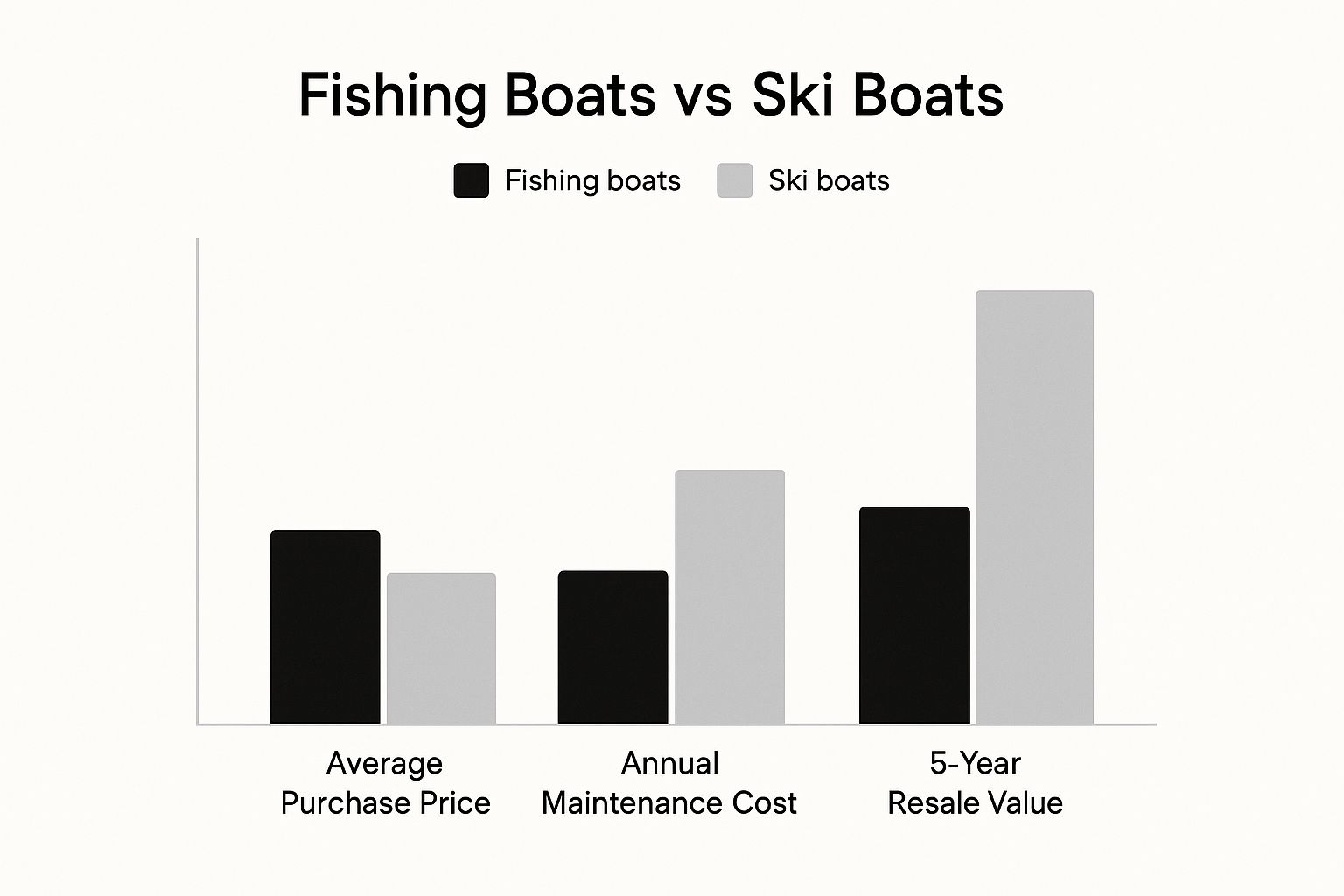
This breakdown really puts things in perspective. While you might pay a similar price upfront, dedicated ski boats often come with higher maintenance bills and can depreciate a bit faster. That makes the financial flexibility of a fish and ski a pretty attractive compromise.
To really nail down your choice, it helps to see how specific features are tweaked for one purpose over the other. This side-by-side look shows where the compromises are made in a typical fish and ski model.
| Feature Category |
Optimized for Fishing |
Optimized for Watersports |
Common Compromise in Fish & Ski Models |
| Seating Layout |
Pedestal seats and flip-up jump seats to create open casting decks. |
Wraparound lounge seating, bow riders, and dedicated sun pads. |
Removable bow cushions that fit over a casting deck; fold-down stern seating. |
| Storage Space |
Aerated livewells, secure rod lockers, and integrated tackle trays. |
Large in-floor ski locker, wet storage for gear, and built-in coolers. |
A single ski locker paired with smaller rod storage and a dedicated livewell. |
| Stern Design |
An open rear casting platform with easy water access. |
A large swim platform with a deep-reach boarding ladder for easy re-entry. |
Smaller, integrated swim platforms positioned on either side of the outboard. |
| Towing Hardware |
Basic transom tow hooks for light-duty pulling. |
A removable ski pylon or a full-size wakeboard tower. |
A reinforced, removable ski pylon is the most common and effective option. |
By thinking through these trade-offs, you can look past the sales pitch and really figure out which boats for sale fish and ski are built for the way you and your family actually spend your time on the water. It’s the best way to make sure you end up with a boat that’s a perfect match.
A boat's engine is its heart. It’s the difference between a thrilling wakeboard run and a quiet troll across the lake. When you’re looking at boats for sale fish and ski, the powertrain isn't just a spec on a sheet—it defines your entire experience on the water. Getting it right means having plenty of power for fun without getting hammered on fuel and maintenance costs.
The first question I always hear from buyers is, "how much horsepower do I really need?" Honestly, it comes down to what you plan to do. If you're mostly fishing and cruising with a couple of friends in a 17 to 19-foot boat, a 90-115 horsepower engine will do the job beautifully and sip fuel.
But watersports change the game entirely. That 115 HP is the absolute minimum if you want to pull a skier or wakeboarder. For a solid "hole shot"—that burst of power that gets a skier up on plane without dragging them—you really want to be looking at 150 horsepower or more. Underpowering a boat is one of the most common mistakes I see, and it leads to sluggish, frustrating performance while putting a constant strain on the engine.
Next up is the big debate: outboard or sterndrive? In the fish and ski world, these are your two main choices, and each one fundamentally changes how you use your boat.
-
Outboard Engines: Think of these as self-contained power pods bolted to the back of the boat. They are wildly popular for a reason. Maintenance is simpler, winterizing is a breeze, and you can tilt the whole unit completely out of the water. This is a massive advantage if you're in saltwater or trying to sneak into shallow coves. The trade-off? They eat up space right where you'd want a big swim platform.
-
Sterndrive (I/O) Engines: A sterndrive (or inboard/outboard) tucks the engine inside the hull like a car, with just the drive unit sticking out the back. The immediate payoff is a huge, clean swim platform that's perfect for getting skis on or just dangling your feet in the water. It also makes for a quieter ride since the engine is tucked away in a sound-dampened compartment, which usually doubles as a sprawling sun pad. The catch is that maintenance and winterization are more involved.
The choice between an outboard and a sterndrive boils down to convenience versus space. Outboards deliver easy maintenance and shallow-water capability, while sterndrives give you that killer swim platform and a quieter ride.
Your engine choice and hull material will hit your wallet long after the initial purchase. It’s simple physics: lighter boats need less power to get up and go, which means better fuel economy. This is a huge reason why aluminum boats have remained so popular for decades.
Take aluminum fishing boats, for example. That market segment was valued at around USD 1.7 billion in 2024 and is projected to hit USD 2.6 billion by 2034. That growth is all about their lightweight design, toughness, and efficiency, which keeps running costs down. You can dig into more details about the growing aluminum fishing boat market in this market analysis.
Today’s four-stroke outboards and fuel-injected sterndrives are incredibly efficient compared to the old two-strokes. But at the end of the day, a heavy fiberglass boat with a big V8 sterndrive is going to drink a lot more fuel than a similar-sized aluminum boat with a 150 HP outboard. When you're budgeting, think beyond the sticker price. Factor in the long-term cost of fuel and annual service to make sure your new boat is a source of joy, not a constant drain on your bank account.
As you start looking at different boats for sale fish and ski, you’ll see the same names pop up again and again. Each boat builder has its own personality, focusing on certain materials, a specific level of quality, and a particular type of boater. Getting to know these brand identities is the first step in whittling down your options to a boat that fits your budget and your weekend plans.
It's worth remembering that these recreational boats are part of a much bigger picture. The entire fishing vessel market, which includes the big commercial rigs, is on track to bring in around USD 1.69 billion in revenue in 2025. That figure is only expected to grow, driven by the global appetite for seafood. You can dig deeper into the fishing vessel market's trajectory to see the economic forces at play.
Tracker and Tahoe are absolute powerhouses in the boating industry, both falling under the White River Marine Group. Their secret sauce? Massive production volume. This allows them to pack their boats with features and offer them at prices that are tough to beat, making them a fantastic starting point for many families.
Tracker is all about tough, all-welded aluminum boats. Their fish and ski models are built to be practical workhorses that can take a beating and keep on going. They’re more about function than flash, which is perfect if you just want a dependable boat for fishing freshwater lakes and rivers without a lot of fuss.
Tahoe, on the other hand, sticks exclusively to fiberglass. This gives their boats sleeker lines, more comfortable interiors, and a smoother ride when the water gets a little choppy. A Tahoe is often the pick for buyers who find themselves leaning more toward the "ski" side of things, where cruising comfort and watersports are the main event.
For boaters who live and breathe fishing, brands like Lund and Ranger are legendary. Both have earned their stripes on the professional fishing circuits, building a reputation for incredible build quality, smart fishing features, and an ability to handle rough water with confidence.
Lund is a king in the aluminum boat world, especially up north where the lakes are big and the wind can kick up in a hurry. Their deep-V hulls are famous for delivering a dry, stable ride, and the layouts are designed by fishermen, for fishermen. You’ll pay a premium for a Lund, but they're known for holding their value incredibly well.
Ranger sets the standard for quality in fiberglass boats. Known for what they call a "one-piece feel" construction and a perfect finish, a Ranger is built to be the last boat you ever buy. While their tournament bass boats are their claim to fame, their fish and ski models are built with that same obsessive attention to detail, delivering an elite experience for those with a bigger budget.
Choosing a brand isn't just about the logo on the side of the boat; it's about buying into a philosophy. Tracker gives you an accessible, get-the-job-done package. Ranger delivers uncompromising quality and performance for the person who demands the best.
This quick breakdown highlights the core differences between these major players.
| Brand |
Primary Material |
Target Customer |
Key Strength |
| Tracker |
Aluminum |
Budget-conscious anglers and families |
Unbeatable value and rugged durability. |
| Tahoe |
Fiberglass |
Families focused on watersports and comfort |
Stylish design and smooth ride at a great price. |
| Lund |
Aluminum |
Serious anglers in big-water environments |
Legendary rough-water performance and resale value. |
| Ranger |
Fiberglass |
Discerning buyers seeking top-tier quality |
Unmatched build quality and premium fishing features. |
At the end of the day, browsing the boats for sale fish and ski will show you that every brand brings something unique to the table. Once you understand what each one is really about, you can quickly zero in on the builders making boats for people just like you.
https://www.youtube.com/embed/tSjQLvjLsYw
You’ve done the homework—weighing materials, comparing layouts, and narrowing down the brands. Now it’s time to close the laptop and head to the showroom. This is where all that research on boats for sale fish and ski gets real, and you finally connect the dots between what your family needs and the actual boat you might buy.
The goal here is simple: turn your digital shortlist into a hands-on experience. A boat can seem perfect in a brochure or online video, but you'll only know for sure once you step aboard.
Before you even think about hitting the water, a thorough walkthrough is a must. This is your chance to get a feel for the boat's layout and build quality in a way no picture can ever convey.
- Walk the Deck: Move from the bow casting platform all the way back to the swim ladder. Is there enough room to move around, or does it feel tight? Try to picture your whole crew and all their gear on board.
- Test Everything: Open every single hatch, storage locker, and glove box. Do they feel solid and secure, or flimsy? Try converting the seats from fishing to skiing mode—is it an easy, one-person job, or a frustrating puzzle?
- Check the Helm: Hop into the captain’s chair. Are the controls within easy reach? Can you see clearly over the bow? Stand on the casting decks to see how stable they feel under your feet.
The right fish and ski boat isn’t just the one with the most gadgets. It’s the one where everything is well-designed and just plain works. A poorly thought-out layout will make for a miserable day on the water, no matter how cool the boat looks.
The sea trial is, without a doubt, the most important part of the buying process. Don't settle for a quick spin around a calm marina; insist on testing the boat in conditions you’ll actually be using it in. A boat that feels amazing on glass-calm water might be a rough ride in a bit of afternoon chop.
Pay close attention to how the boat performs. How quickly does it get on plane with a few people on board? Does it feel responsive and stable when you make a sharp turn or cross another boat’s wake? This is also your chance to listen. Are there any weird rattles, squeaks, or vibrations? Those little noises can be tell-tale signs of build quality issues.
Often, the final decision comes down to buying new or used. A brand-new boat gives you a full warranty and the comfort of knowing you’re the first owner, but you’ll also take the biggest hit on depreciation. On the other hand, a used boat can be an incredible value, sometimes allowing you to get a bigger or better-equipped model for the same money.
If you decide to go the used route, a professional marine survey is absolutely non-negotiable. An experienced surveyor can uncover hidden structural problems or mechanical issues that could easily turn your dream boat into a money pit. Whether you opt for new or pre-owned, taking the time for these final hands-on evaluations will ensure your investment brings you years of fun, not frustration.
When you start looking at boats for sale fish and ski, you're bound to have some questions. It’s only natural. You're trying to find one boat that can do it all for your family, and figuring out the practical side of things is key to making a smart buy. Let's tackle some of the most common things people ask.
The big trade-off with a fish and ski boat is always going to be specialization versus flexibility. Let's be honest: a dedicated bass boat will always have a better, bigger casting deck for the die-hard fisherman. In the same way, a purpose-built ski boat is designed to throw the perfect wake and has that plush, wraparound seating for a big crew.
A fish and ski boat is the jack-of-all-trades, not the master of one. You might have a little less deck space for casting, or the wake might be perfect for tubing but not quite right for a serious wakeboarder. The best ones, though, are designed so cleverly that these compromises feel incredibly minor for the typical family that wants to do a bit of everything.
This is a huge one, and it directly affects how much fun you'll have on the water. The right amount of horsepower really depends on the boat's size, its weight, and what you plan on doing with it.
For most 17 to 19-foot boats, an engine in the 115-150 HP range will do the trick for pulling a single skier or a tube with a couple of people in the boat. But if you’re thinking about pulling multiple skiers, a wakeboarder who needs a powerful start, or loading up a boat over 20 feet with the whole family and all their gear, you need to be looking at 175 HP or more.
One of the most expensive mistakes you can make is underpowering your boat. You’ll regret it every time you go out. A good rule of thumb is to choose an engine that's at least 75% of the boat's maximum rated horsepower to keep it from feeling sluggish and overworked.
This really boils down to budget versus peace of mind. There are solid a
Whether you lean toward a new boat with a full warranty or a used one with proven value, the most important thing is choosing the engine and hull that match how you actually use the water. Compare fish-and-ski listings by price, size, and condition at SearchShop.com.

