So, you’re ready to find the perfect cabin cruiser boat for sale. The key isn't about scrolling through endless listings; it's about knowing what you're looking for and making smart, informed choices along the way. This guide is your roadmap to navigating the entire process with confidence, from setting a realistic budget to stepping aboard your new boat.
Welcome aboard! Getting into the cabin cruiser life is a huge step, and it's an investment in a lifestyle filled with freedom, adventure, and unforgettable memories. Whether you're picturing quiet weekends anchored in a secluded cove or planning longer trips up the coast, the right boat is everything. This guide is designed to give you the practical, real-world knowledge you need to pick a vessel that brings you years of joy, not a constant stream of headaches.
It’s easy to get swept up in the excitement and just focus on a boat’s length or brand name. But a truly successful purchase starts long before you ever look at a listing. It begins with an honest look at your needs, a solid financial plan, and a clear understanding of what to look for—and, just as importantly, what to walk away from.
We've laid this guide out to walk you through each critical stage of the buying journey. Think of it as having a seasoned captain standing next to you, pointing out the little things you might otherwise miss. Our mission is to demystify the whole process so you can make the best choice for you and your family.
Here’s a look at what we'll cover:
- Budgeting Beyond the Price Tag: We'll dig into the total cost of ownership, from obvious expenses like insurance and slip fees to less-obvious costs like routine maintenance and winterization.
- Choosing the Right Boat for You: You'll learn how to figure out your "boating style" and turn that into a list of must-have features. This ensures you're only looking at boats that actually fit your life.
- Conducting a Thorough Inspection: We'll cover the essential checks for the hull, deck, and engine room. Plus, we'll explain why a professional marine survey is an absolute must.
- Navigating Financing and Closing: We'll break down how marine loans work and give you practical tips for negotiating a fair price based on what you find during the inspection.
You might hear that the average size for a cruising boat is around 40 feet, but don't get hung up on that number. The perfect boat is one you can handle comfortably and afford without financial stress. Honestly, some of the best adventures happen on smaller, more manageable boats that can sneak into shallow coves and tight marinas where the big yachts can't go.
Remember, the goal isn't just to buy a boat; it's to buy the right boat. Don't let someone on a forum tell you what to buy. Do your own homework, walk through different layouts, and trust your gut on what feels right for you and your crew.
For example, a couple planning coastal weekend getaways has completely different needs than a family getting ready to tackle a big trip like the Great Loop. The first pair might want a big, open cockpit for entertaining, while the family needs tons of storage, a robust electrical system for living on the hook, and probably a second stateroom.
By working through this guide, you’ll build a solid foundation of knowledge. You'll learn to read between the lines on a listing, what questions to ask the seller, and how to spot potential red flags during a walkthrough.
Let's get started on finding the perfect cabin cruiser boat for sale to be your new home away from home on the water.
Before you even think about scrolling through listings for a cabin cruiser boat for sale, it's time for some honest talk—with yourself. It's so easy to get swept away by a gorgeous photo of a boat cutting through the water at sunset. But grounding your search in two key things—your budget and how you actually plan to use your boat—will save you a ton of time and prevent future headaches.
The biggest mistake I see new buyers make is fixating on the asking price. That number is just the beginning. The real figure you need to wrap your head around is the total cost of ownership, which includes all the ongoing expenses that come with keeping your boat safe, legal, and ready for adventure. Ignoring these costs is the quickest way to turn your dream vessel into a financial anchor.
You’re not alone in this dream, either. Boat ownership, both on the water and bater, is booming. The cabin cruiser market was already valued at $5 billion in 2024 and is projected to hit $6 billion by 2029. This trend is fueled by a growing passion for getting out and exploring, and modern boats are more comfortable than ever. You can dig deeper into the boating market trends and their drivers to see just how popular this lifestyle has become.
To avoid any nasty surprises down the line, you need to map out every expense, from the one-time purchase costs to the recurring annual fees. Think of it as creating a business plan for your boating life. The more thorough you are now, the more you can relax and enjoy the water later.
Here are the big-ticket items you absolutely must account for beyond the initial purchase price:
- Insurance: This is non-negotiable. Most marinas and lenders require it. Your rate will depend on the boat’s value, its age, your experience level, and where you plan to cruise.
- Mooring or Slip Fees: Unless you have space for a trailer at home, you'll need to rent a spot at a marina. These fees can be a huge chunk of your annual budget and vary wildly by location.
- Routine Maintenance: A boat needs constant care. We're talking annual engine servicing, oil changes, bottom painting to fight marine growth, and replacing zinc anodes to prevent corrosion. A good rule of thumb is to set aside 10% of the boat’s value every year just for maintenance.
- Fuel Costs: This is the ultimate "it depends" expense. It hinges on your engine type (diesel is usually more efficient) and how often you're out on the water. Try to estimate your seasonal hours to get a rough idea.
- Winterization and Storage: If you live in a colder climate, you can't skip this. You'll need to pay a pro to winterize the engines and plumbing systems, plus the cost of storing the boat on land through the off-season.
Don't just pull these numbers out of thin air. Make some calls. Get a few insurance quotes. Talk to local marinas and marine mechanics. The more accurate your budget is from the start, the more confidence you'll have when you finally start looking for that perfect cabin cruiser boat for sale.
To help you get organized, I’ve put together a simple checklist. Use it to map out what you can expect to spend both upfront and over the long haul.
| Expense Category |
One-Time Cost |
Estimated Annual Cost |
Notes |
| Purchase Price |
✓ |
The starting point of your budget. |
| Sales Tax & Titling |
✓ |
Varies significantly by state. |
| Marine Survey & Haul-Out |
✓ |
A critical pre-purchase inspection. Non-negotiable. |
| Insurance |
✓ |
Get multiple quotes; rates depend on boat value and your experience. |
| Mooring/Slip Fees |
✓ |
A major recurring expense unless you can trailer the boat. |
| Routine Maintenance |
✓ |
Budget 10% of the boat's value annually. |
| Fuel Costs |
✓ |
Highly variable; estimate your average usage per season. |
| Winterization/Storage |
✓ |
Essential for boats in colder climates. |
| Unexpected Repairs |
✓ |
Always have a contingency fund for things that break. |
This table should give you a solid framework for building a realistic financial plan. Having these numbers nailed down will make the entire buying process much smoother.
With a realistic budget in hand, now comes the fun part: figuring out what you actually need in a boat. This is where you can daydream a bit, but with a practical purpose. A few key questions will help you build a "must-have" list that will act as your filter.
Ask yourself:
- Who is my crew? Are you planning solo fishing trips, quiet weekends for two, or are you bringing the kids and their friends along? This will dictate whether you need multiple cabins, a bigger galley, or more deck space.
- Where will I be boating? The waters you plan to cruise make a huge difference. A boat built for protected lakes might not be safe for open-ocean journeys. This also affects the draft—how deep the boat sits in the water. If you're exploring shallow bays, you'll need a boat with a shallower draft.
- What will we do on board? If you love to cook and entertain, a well-appointed galley and a spacious cockpit are non-negotiable. If you're dreaming of long-distance cruising, you’ll want to prioritize a large fuel capacity, a generator, and plenty of storage. For weekend fun, a great swim platform and comfortable sun pads might be at the top of your list.
By answering these questions, you create a clear profile of your ideal boat. This list of priorities is your single most powerful tool for cutting through the noise and focusing only on the listings that truly fit your vision.
Alright, you've found a few boats that look promising online. Now comes the most important part: the in-person inspection. This is where you separate a well-maintained gem from a floating money pit. An online listing is just the highlight reel; a hands-on look tells the boat's true story.
It’s easy to get swept up in the excitement of finding a potential cabin cruiser boat for sale, but don't let that rush you. A meticulous inspection now will save you a world of headaches and unexpected bills later on.
Your inspection begins before you even step aboard. The hull is the boat’s foundation, so give it your full attention. Take a slow walk around the entire boat, keeping your eyes peeled for any signs of trouble.
Here's what to look for:
- Blistering: Check for any bubbles or bumps in the gelcoat, especially below the waterline. These can be a sign that moisture has gotten into the fiberglass, and that’s a repair you don't want to pay for.
- Stress Cracks: You'll often see fine, spiderweb-like cracks around high-stress areas like hardware mounts or the corners of the cabin. While a few minor ones might just be cosmetic, widespread cracking is a huge red flag for structural flexing.
- Hidden Repairs: Does an area of the gelcoat look a little off? Maybe the color or texture doesn't quite match the rest of the boat. This is often a dead giveaway of a past repair from a collision or grounding. Be sure to ask the owner directly about it.
Once you’ve scrutinized the hull, it's time to get on board and check out the deck. Walk every single inch of it. You’re feeling for any soft, spongy, or bouncy spots under your feet—a serious warning sign of core rot. This happens when water gets in and separates the fiberglass from its internal core. Also, give all the deck hardware a good tug. Cleats, stanchions, and railings should be rock-solid; any looseness could be a potential entry point for water.
The engine room is the heart of any cabin cruiser. You don't have to be a master mechanic to spot the obvious signs of neglect. Honestly, a clean and well-organized engine compartment usually points to a diligent owner.
When you're looking at the engines, focus on these key things:
- Fluid Leaks: Get a flashlight and check for any oil, coolant, or fuel drips under the engines and transmissions. Look closely at hoses for cracks and check the clamps for rust.
- Corrosion: Pay close attention to the wiring, exhaust manifolds, and engine mounts. A ton of rust and corrosion is a good sign the boat has seen some hard use in saltwater without proper maintenance.
- Belts and Hoses: Give the belts a squeeze to check their tension and look for any fraying or cracking. The hoses should feel firm, not brittle or mushy.
After the engine room, it's time to test every single system on the boat. I mean everything. Flip every switch, turn on all the lights, run the faucets, and flush the toilets. Fire up the generator, test the air conditioning, and play with all the electronics. Never assume something works—verify it yourself.
No matter how confident you feel after your own inspection, it's no substitute for a professional marine survey. Hiring a certified marine surveyor is the single best investment you can make when buying a used boat. They have the training, experience, and specialized tools to find problems you’d never spot.
A good surveyor works for you—not the seller, not the broker. Their job is to give you a completely unbiased report on the boat's condition, from its structural integrity to the health of its mechanical systems. Besides, most lenders and insurance companies will require a survey for a used cabin cruiser boat for sale anyway.
The survey process is designed to give you a complete picture of the boat's health. The journey from finding a boat to making it yours really hinges on these critical validation steps, as you can see below.
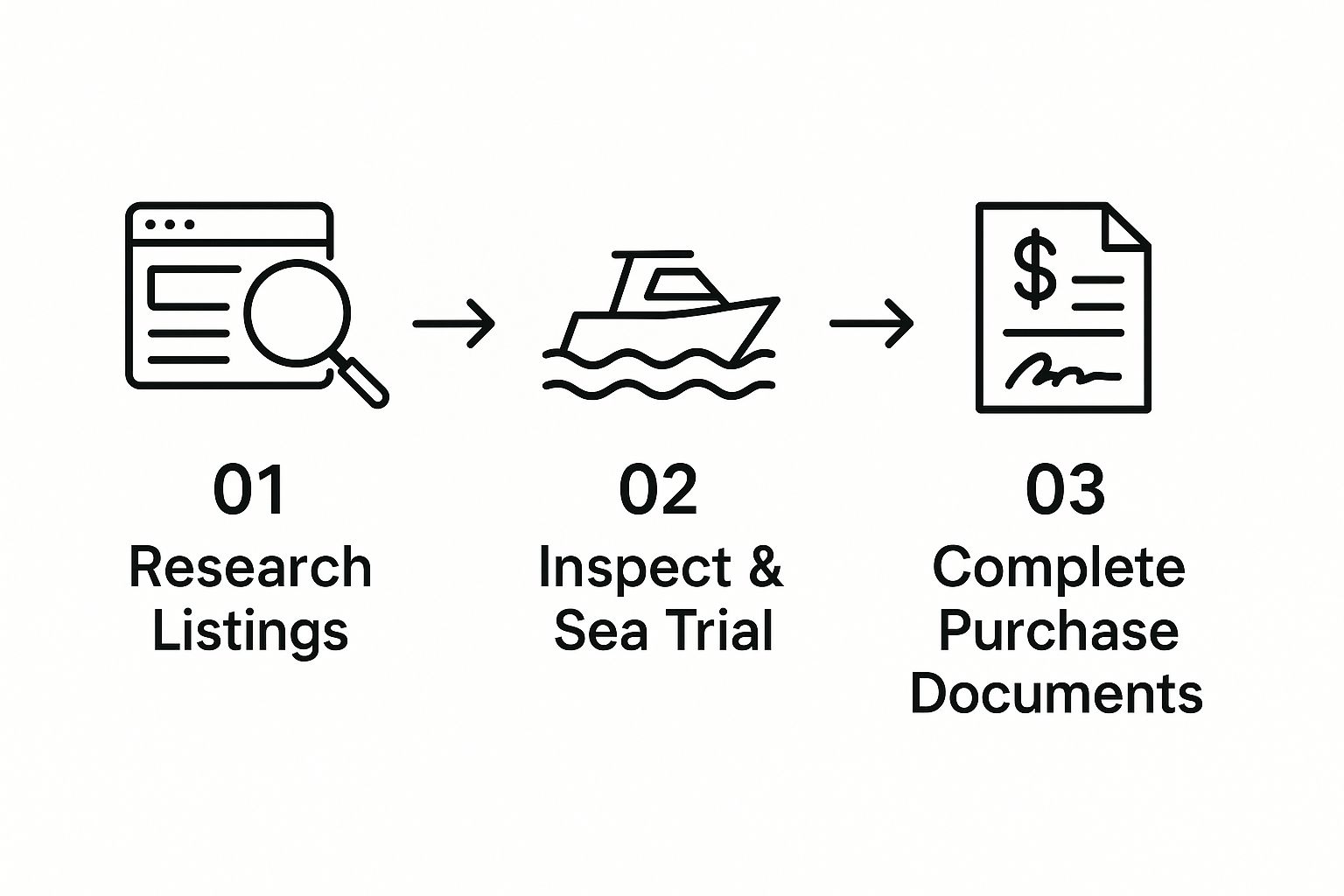
This simple flow shows that a smart purchase always comes down to a thorough inspection and a successful sea trial before you sign on the dotted line.
When you get the surveyor's report, read it cover to cover. It will list all findings and recommendations, usually categorized by how urgent they are. This report isn't just a "buy or don't buy" document; it’s also a powerful tool for negotiating on price or required repairs.
Finally, the sea trial. This is so much more than a fun little joyride; it’s your chance to see how the boat actually performs on the water.
Pay attention. Listen for any weird noises coming from the engines when they're under load and keep an eye on the temperature gauges. See how the boat handles at different speeds. Make some turns to both port and starboard to get a feel for its responsiveness. Play with the trim tabs and see how they affect the ride. This is also your final opportunity to make sure all the navigation gear and the autopilot work correctly while underway. A solid sea trial is the final piece of the puzzle, confirming you've found the right boat.
You've done the hard part. The sea trial went great, the surveyor gave you a thumbs-up, and you've found the cabin cruiser you want to call your own. Now it's time to handle the final—and arguably most important—details: locking down the financing and signing on the dotted line. This is where a little bit of diligence goes a long way to ensure a smooth transition from shopper to proud boat owner.
It's important to remember that marine financing isn't quite like getting a car loan. Lenders see boats as luxury assets, which means the approval process is usually more rigorous. They'll take a hard look at your credit score, your debt-to-income ratio, and, critically, the boat's age and condition. This is another reason that professional survey report is worth its weight in gold.
When it comes to securing a loan for a cabin cruiser boat for sale, you've typically got three main avenues. It really pays to explore each one to see who can offer you the best terms for your specific financial picture.
- Dealership Financing: Going through the dealer can feel like a one-stop shop, and that convenience is a big plus. They often have solid relationships with a network of marine lenders, which can simplify the application process. Just be sure to cross-shop their rates with other options to make sure you're getting a competitive offer.
- Your Bank or Credit Union: Don't forget to check with your personal bank, especially if you have a long-standing relationship with them. Credit unions, in particular, often have some of the most favorable rates around. The only potential snag is that some may have stricter rules about the age or value of the boats they're willing to finance.
- Specialized Marine Lenders: These are the pros who live and breathe boat and RV financing. They get the market inside and out, which means they often provide more flexible options like longer loan terms—sometimes up to 15-20 years—and are more willing to finance older, well-maintained vessels that a traditional bank might pass on.
Boating is more popular than ever. The cabin cruiser market hit about USD 1.5 billion globally in 2023 and is projected to climb to USD 2.5 billion by 2032. This isn't just a number; it reflects a real, growing passion for recreational boating and leisure on the water. You can dive deeper into the cabin cruiser market forecast on Dataintelo.
That survey report you paid for? It’s not just a checklist; it’s your single most powerful negotiation tool. A good surveyor will neatly categorize their findings by severity, handing you a clear, objective list of items that need to be addressed.
You can probably let the minor cosmetic scuffs slide. But for the bigger-ticket items—the ones that impact safety or come with a hefty repair bill—you've got real leverage. You can ask the seller to fix the problems before closing the deal, or you can negotiate a price reduction that lets you handle the repairs yourself. When you back up your request with a professional surveyor's written opinion, it’s tough for a seller to simply say no.
Once you've settled on a final price, you're in the home stretch. The last hurdle is the paperwork, and it's crucial to get it right to protect both you and the seller. Don't rush this part.
Make sure you have all the essential documents buttoned up before you celebrate:
- Purchase and Sale Agreement: This is the legally binding contract. It spells out everything—the final price, the closing date, and any contingencies (like that "subject to a satisfactory survey" clause). Make sure both you and the seller have signed it.
- Bill of Sale: Think of this as the official receipt. It needs to include the boat’s Hull Identification Number (HIN), engine details, the sale price, and the signatures of both parties.
- Vessel Title or Certificate of Documentation: Just like a car, a boat has a title that proves who owns it. The seller needs to sign it over to you. For larger vessels, this might be a federal Certificate of Documentation from the U.S. Coast Guard instead of a state title.
- State Registration: With the signed title and bill of sale in hand, you'll head to your state's DMV (or equivalent agency) to officially register the boat in your name. This is when you'll get the registration numbers to display on your hull.
Getting these details sorted ensures a clean, hassle-free transfer of ownership. Then, you can finally shift your focus to the best part: planning that first unforgettable trip on your new cabin cruiser.
Alright, you've got your budget locked in and a good idea of what you want. Now for the fun part: starting the hunt for a cabin cruiser boat for sale. These days, the search almost always kicks off online, and knowing how to work the digital marketplaces is what separates a frustrating search from a successful one.
Think of sites like SearchShop.com as more than just a wall of listings. They're powerful tools for finding boats, RVs, and more, but only if you know how to use them to your advantage. The real secret isn't just typing in "cabin cruiser" and hoping for the best—it's about digging into the search filters to turn a sea of thousands of vehicles into a manageable shortlist.
Think of advanced search filters as your personal buying assistant. They do all the heavy lifting for you. This one step will save you countless hours of scrolling through boats that are too big, too small, too expensive, or a thousand miles away.
First, plug in your non-negotiables. These are the big-picture items that immediately weed out the wrong boats:
- Price Range: Stick to the budget you already set. No sense torturing yourself with boats you can't afford.
- Location: How far are you realistically willing to drive for a viewing? Set a firm radius.
- Length Overall (LOA): Filter for the size that makes sense for your slip, your crew, and where you plan to boat.
- Manufacturer: If you're already partial to brands like Sea Ray, Carver, or Regal, this is a great way to narrow the field.
Once that's done, you can start layering on the finer details. This is where you can specify engine types (gas vs. diesel), the number of staterooms, or even deal-breaker amenities like a generator or air conditioning.
With a solid list of contenders, it’s time to put on your detective hat. A smart buyer can tell a lot about a boat’s condition and history just from the online listing, long before ever stepping aboard.
Start with the photos. A seller who posts dozens of crisp, clear pictures—including the engine room, bilges, and inside storage lockers—is usually proud of their boat and isn't trying to hide anything. Be skeptical of listings with just a handful of blurry, far-away shots.
I always pay close attention to what’s going on in the background of the photos. Is the cockpit a mess? Does the engine room look greasy and disorganized? Little clues like these often paint a bigger picture of the owner’s overall approach to maintenance.
Next, dive into the written description. Vague, one-sentence descriptions are a red flag. What you want to see is detail: specific upgrades with dates, a summary of recent maintenance, and maybe even a note about why they're selling. The magic words you're looking for are "service records available."
Beyond the pretty pictures and prose, two numbers in any listing for a cabin cruiser boat for sale tell a huge part of the story: engine hours and maintenance history.
- Engine Hours: This gives you a quick snapshot of the boat's use. A well-cared-for diesel engine can easily last 5,000+ hours, while you can expect a gas engine to have a lifespan closer to 1,500-2,000 hours. Be wary of a 10-year-old boat with suspiciously low hours—that might mean it sat unused for long stretches, which can lead to its own set of issues with seals, hoses, and corrosion.
- Maintenance Records: This is the absolute gold standard. An owner who hands you a thick binder full of receipts for every oil change, winterization, and repair is showing you they cared for the boat properly. Honestly, I'd rather see a boat with higher hours and meticulous records than one with low hours and no paper trail.
There’s no doubt that more people are getting into this lifestyle. The global cabin cruiser market is projected to soar past $9 billion by 2033, a boom fueled by more efficient designs and better onboard tech. You can read more about the growth of the cabin cruiser market on DataInsightsMarket.com. For a buyer, this means more choices than ever, which makes using these online tools to compare models and connect with good sellers absolutely essential.
Once you get serious about finding a cabin cruiser boat for sale, the questions really start to pile up. It's a huge investment, and you want to be sure you're making the right moves. We've gathered some of the most frequent questions we hear from buyers to help you sort through the final details.
Think of this as your straight-talk guide for the home stretch, after the initial excitement wears off and it's time to get down to business.
This is, without a doubt, the most important question you can ask. The sticker price is just the cover charge; the real cost of admission is what you'll spend year after year to keep the boat running. It’s easy to budget for the loan payment and fuel, but a few other expenses tend to catch new owners by surprise.
The big ones you absolutely have to plan for are:
- Slip or Mooring Fees: Unless you have a place to park it on a trailer at home, you’ll be paying for a spot at a marina. This can be a major monthly or annual expense, and costs vary wildly depending on where you are. Your best bet is to call a few local marinas to get a real-world estimate.
- Annual Insurance: This isn't optional. Your marina will require it, and so will your lender. The price tag will depend on the boat's value, your personal boating history, and where you plan to take it.
- Routine Engine Maintenance: A boat's engine needs consistent care, just like your car. Think annual oil changes, new fuel filters, and replacing raw water pump impellers before they fail.
- Winterization and Storage: If you live anywhere that freezes, this is a non-negotiable annual ritual. It protects your engines and plumbing from the kind of catastrophic damage that can end your boating season before it starts.
A good rule of thumb that's been passed around docks for years is to budget about 10% of the boat's purchase price for annual upkeep. So, for a $100,000 cruiser, you should be ready to spend around $10,000 a year.
Yes. One hundred percent, absolutely. A professional marine survey is the single best tool you have to protect yourself from buying someone else's problems. A certified surveyor brings an expert eye and specialized tools to find structural, mechanical, or safety issues that you'd almost certainly miss.
Look at it this way: spending a few hundred dollars on a survey could easily save you thousands—or even tens of thousands—in repairs down the line. Plus, most insurance companies and marine lenders won't even talk to you about an older cabin cruiser boat for sale without a recent survey in hand.
This one isn't as simple as just looking at a number on a gauge. It’s far more about how the engine was treated during those hours.
A well-cared-for diesel engine can chug along happily for 5,000 hours or more. A gasoline engine, on the other hand, generally has a shorter lifespan, often in the 1,500 to 2,000
Engine hours are just one piece of the puzzle. A well-documented service history, a qualified marine survey, and a sea trial together give you a far more complete picture than any single number. Explore cabin cruiser listings with full specs at SearchShop.com.

