Welcome aboard this hands-on handbook for sport fishing boats for sale. Sifting through specs, hull designs, and price tags can feel overwhelming. That’s why we’ve boiled everything down into clear, actionable steps—so you spend less time guessing and more time casting lines. Whether you’re shopping for sport fishing boats or browsing RVs, SearchShop.com has the inventory and tools to help you find your ideal ride.
Buying a sport fishing boat isn’t just a big purchase; it’s an invitation to weekends full of salt spray, sunrise casts, and lifelong memories. Think of it as investing in a floating clubhouse where every outing brings a new adventure.
As you move from browsing listings to stepping aboard your future boat, questions will pop up: What hull shape matches my style? How much horsepower do I really need? We’ll tackle all of that, guiding you toward a choice that feels right—from your very first look to your first trophy catch.
More anglers are trading crowded clubhouses for open water. Recreational fishing’s popularity has surged, driven by a collective craving for fresh air and real challenges.
That shift is reshaping the market. The global sport fishing boat market is valued at approximately $2.5 billion in 2025 and is projected to grow to $4 billion by 2033. Discover more insights about the growing sport fishing boat market trends.
“A boat is a big purchase, but it’s not just a material object. It’s a key that unlocks countless experiences—from the quiet solitude of a sunrise fishing trip to the shared excitement of a trophy catch with family and friends.”
By the time you finish this guide, you’ll be able to:
- Pinpoint the boat style that suits your fishing ambitions
- Highlight the must-have features for both performance and comfort
- Size up engine options and calculate total ownership costs confidently
Choosing the right sport fishing boat is a lot like picking the right tool for a job—you wouldn't use a sledgehammer to drive a finishing nail. The boat that’s perfect for chasing marlin 50 miles offshore is going to be all wrong for stalking redfish in a shallow coastal flat. It all comes down to where you fish, what you're targeting, and how you plan to spend your time on the water.
Your journey starts by understanding the main designs out there. Each type is built for a specific environment and angling style, meaning the hull shape, deck layout, and features are all there for a reason—to give you an edge in those exact conditions.
This overview breaks down the most common types of sport fishing boats for sale you'll come across.
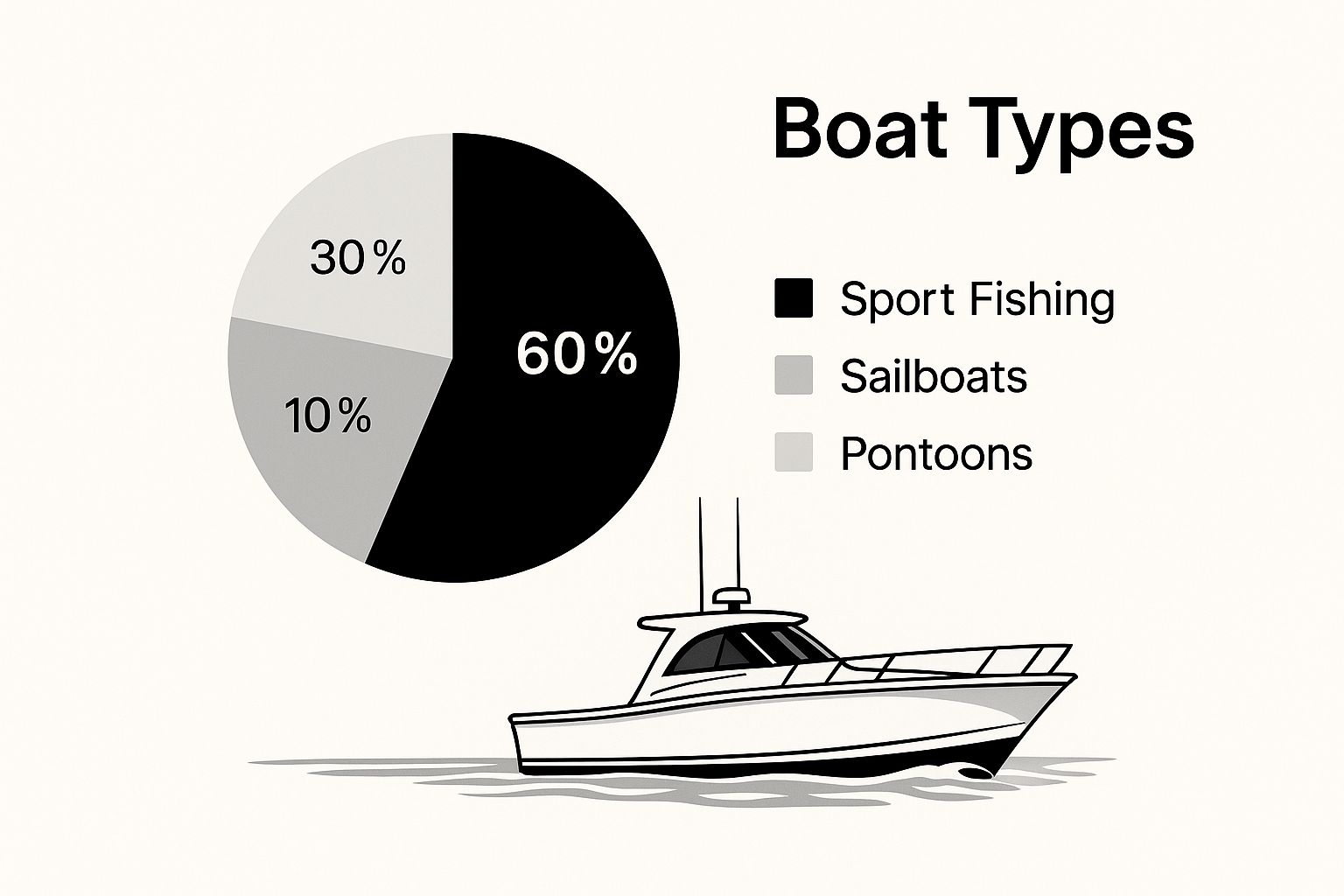
As you can see, each style has its own sweet spot, from inshore specialists to deep-sea titans. Let's dig a little deeper into what makes each one tick.
To help you compare your options, here's a quick rundown of the most popular sport fishing boat categories.
| Boat Type |
Ideal for |
Typical Size |
Pros |
Cons |
| Center Console |
Versatile inshore, nearshore, and offshore fishing; family boating |
18-40+ feet |
360-degree fishability, great for casting, handles chop well, versatile layout |
Limited shelter from weather, can be a wet ride in rough seas |
| Bay Boat |
Inshore and nearshore waters like bays, estuaries, and coastal flats |
18-26 feet |
Shallow draft for skinny water, stable casting platform, good fuel economy |
Not suited for rough offshore conditions, less deadrise means a bumpier ride |
| Walkaround |
Longer fishing trips, family outings, and light overnight stays |
22-35 feet |
Small cabin offers shelter and amenities, safer bow access, good balance of fishing and comfort |
Cabin reduces cockpit fishing space, can be more top-heavy than a center console |
| Offshore Sportfish |
Serious deep-sea, big-game fishing for species like marlin and tuna |
35-80+ feet |
Superior rough water handling, long range, extensive amenities for multi-day trips |
High initial cost and maintenance, requires a large slip, not practical for inshore use |
This table gives you a starting point, but the real feel for each boat comes from understanding its design philosophy.
If there's a "do-it-all" boat, the Center Console is it. Think of it as the sport utility vehicle of the water. The helm is smack in the middle, which opens up the entire perimeter of the boat for fishing. This 360-degree fishability is its superpower, letting multiple anglers cast and fight fish without tripping over each other.
Most have a deep-V hull designed to slice through choppy water, which means a smoother, drier ride than you'd get from a flatter-bottomed boat. They're true workhorses, just as comfortable trolling nearshore reefs as they are heading offshore on a nice day.
Bay Boats are the nimble scouts of the fishing world. They are purpose-built for the "in-between" water—the bays, estuaries, and coastal flats that are too choppy for a tiny skiff but too shallow for a big offshore boat. Their shallow draft is the key, letting you sneak into skinny water where gamefish hide.
They don't have the deep hull to conquer big offshore waves, but that's not their game. Instead, they offer a perfect balance: a wide, stable platform for casting, enough seaworthiness for a breezy bay, and the ability to get you where the fish are.
Bay boats master the in-between zones. They grant you access to a massive range of coastal fishing opportunities that other, more specialized boats simply can't reach.
Walkaround boats bring a crucial element to the fishing equation: comfort. The defining feature is a small cabin at the bow, often with a simple V-berth for naps and a private head (toilet). The name comes from the recessed walkways on either side of the cabin, which let you safely move up to the bow when you've got a big fish on the line.
That little cabin is a game-changer on long days or when a surprise storm rolls in. It makes them fantastic for family trips or for anglers who want a bit more than just a wide-open fishing platform, blending serious fishing features with welcome creature comforts.
When you dream of chasing giant tuna and marlin in the deep blue, you're dreaming of an Offshore Sportfish. These are the heavyweights, built from the ground up to handle serious seas far from the sight of land. Typically ranging from 35 to over 80 feet, these boats are all about power, range, and capability.
They come loaded with features like fighting chairs, tuna towers for spotting fish from afar, and massive livewells. These aren't day-trippers; they are serious machines designed for multi-day offshore tournaments and expeditions where failure is not an option.
The right features are what separate a simple boat from a serious fishing machine. Sure, the hull gets you to the spot, but it's the gear on board that helps you find, fight, and ultimately land the fish. When you start looking at different sport fishing boats for sale, zeroing in on these core components will mean your new ride is ready for action the moment it hits the water.
Think of it this way: a boat without the right fishing features is like a workshop with just a hammer. You can get a few things done, but you’re seriously limited. The right equipment is like having a full set of specialized tools, each one designed to make your time on the water more productive and a whole lot more fun.
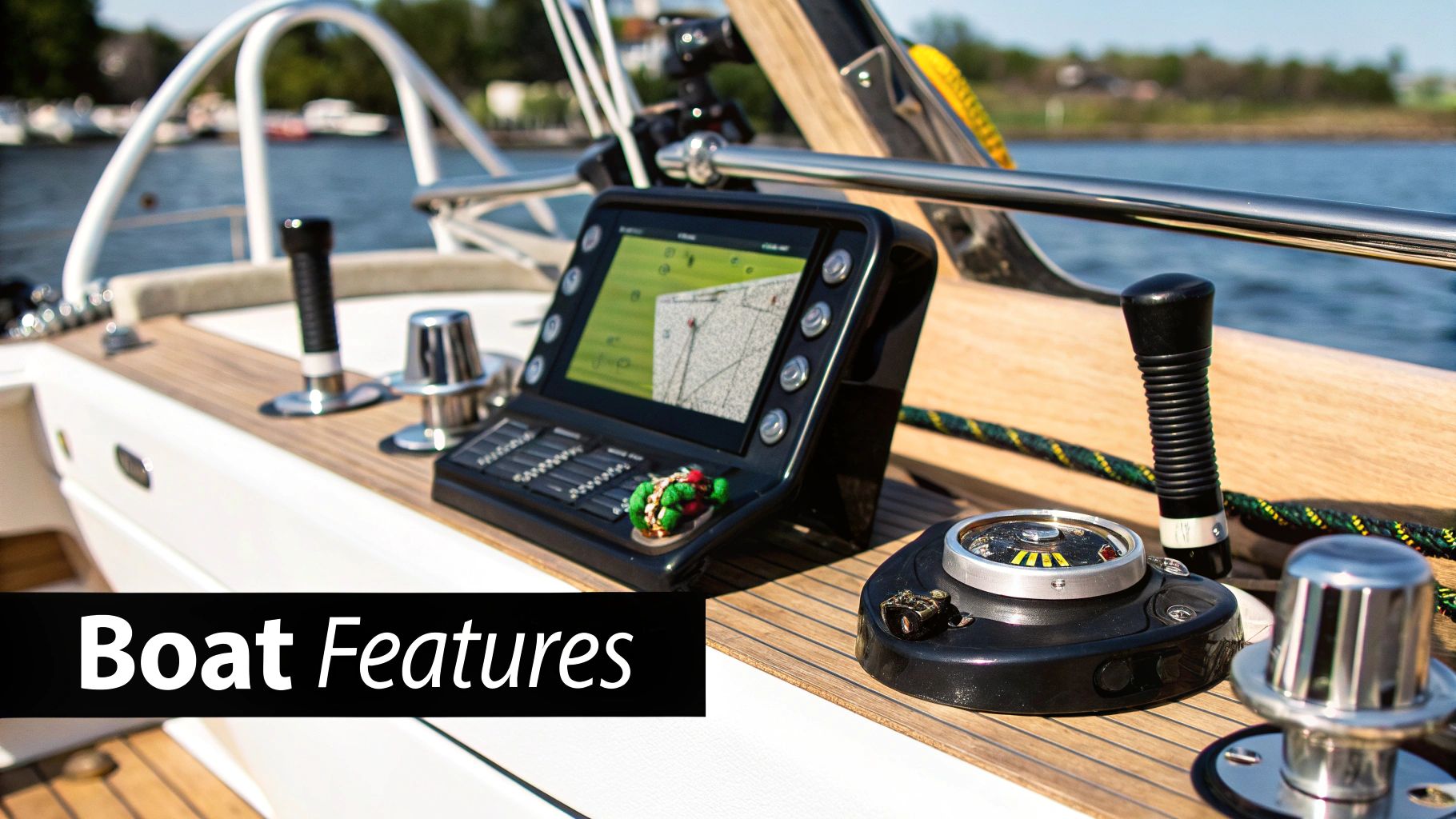
Before you get dazzled by shiny electronics, check how the boat handles the absolute fundamentals: your bait and your gear.
- Livewells: Keeping your bait frisky is the name of the game. A good livewell with a solid circulation system is non-negotiable. While a basic raw-water pump will do the job for a bit, a recirculating system with an aerator is the gold standard for keeping bait lively all day, especially when the water gets warm.
- Rod Holders: Let’s be honest, you can never have too many. Look for flush-mounted holders along the gunwales for trolling and vertical holders—often called "rocket launchers"—on the console or T-top for easy storage. Smart placement is key to preventing a tangled mess of lines and ensuring your expensive rods stay put when things get choppy.
- Outriggers: If you have any plans to troll offshore, outriggers are a must. These long poles extend out from the sides of the boat, spreading your lines wide. This lets you pull more baits without them tangling and creates a much more tempting presentation for big game fish.
Today’s marine technology has completely changed how we fish. The right electronics are your eyes and ears under the water, taking the guesswork out of finding fish and turning it into a science. The entire recreational boat market is constantly evolving, with new tech making boating safer and more efficient. You can read more about the growth of the recreational boat market to see just how fast things are moving.
Think of a boat’s electronics suite as its central nervous system. A good fishfinder and GPS chartplotter combo is probably the single most important fishing tool you'll own, right after the boat itself.
Here are the non-negotiables for your electronics checklist:
- GPS Chartplotter: This is your digital roadmap. It’s absolutely essential for navigating safely and, just as importantly, for marking those secret honey holes, wrecks, or reefs so you can find your way back to them time and time again.
- Fishfinder with CHIRP Sonar: A modern fishfinder does more than just show you blobs on a screen. With CHIRP (Compressed High-Intensity Radiated Pulse) sonar, you get amazingly clear images of the bottom structure. You can literally tell the difference between a school of bait and the bigger fish stalking them. It’s a game-changer.
- VHF Radio: This isn't just a nice-to-have; it's a critical piece of safety gear. A VHF allows you to communicate with other boats, talk to the marina, and call for help from the Coast Guard if you ever need it. Don't leave the dock without one.
Figuring out the right boat size and engine setup is easily one of the biggest decisions you'll make when you start looking at sport fishing boats for sale. It’s kind of like picking out a truck; the setup you'd want for hauling a heavy trailer on the interstate is completely different from what you'd need for navigating a tight, muddy backroad. Your boat's size is going to dictate its stability, how it handles rough water, and even how much of a hassle it is to tow and store.
Most people get hung up on a boat's length, but the beam—its width—is just as critical. A wider beam generally means more stability when you're anchored or drifting, which makes for a much better platform for casting and fighting fish. On the flip side, a narrower hull often slices through waves more cleanly, giving you a smoother, drier ride when you're on the move. It's a classic trade-off between stability at rest and performance in the chop.
Where you plan to fish will tell you almost everything you need to know about the right size. It's all about the right tool for the job. You wouldn't take a giant offshore battlewagon into a shallow backwater creek, just like you wouldn't take a tiny flats skiff 50 miles out into the ocean.
-
Inshore and Flats (17-22 feet): In the skinny water, smaller boats are king. Their shallow draft lets them sneak into spots where bigger boats can't dream of going, but be warned, they can get bounced around pretty good in an open bay when the wind kicks up.
-
Nearshore and Coastal (23-28 feet): This range is the jack-of-all-trades. These boats are big enough to confidently handle some moderate chop a few miles offshore, yet they're still manageable enough for one person to launch and trailer with a decent truck.
-
Offshore Canyons (29+ feet): When you're heading for the deep, size equals safety. Bigger boats give you the fuel range, stability, and rugged seaworthiness you absolutely need to handle the unpredictable conditions you'll find far from shore.
Once you've zeroed in on a size, it's time to talk power. The single-versus-twin-engine debate is as old as outboards themselves. There are good arguments for both.
A big, single outboard is usually more fuel-efficient and costs less to buy and maintain. At the end of the day, you only have one system to service, which keeps things simple.
But then there are twins. Twin engines give you a massive leg up in reliability and maneuverability. If one engine gives up the ghost 40 miles offshore, you have a backup to get you home. You can't put a price on that peace of mind. Twins also make you look like a pro at the dock, letting you spin the boat on a dime.
Choosing your engine setup really comes down to balancing your budget against your personal tolerance for risk. If you’re an angler who consistently pushes far offshore, the redundancy of twin engines is almost always worth the extra cost.
Ultimately, you're looking for that sweet spot: the perfect power-to-weight ratio. An underpowered boat is a dog—it will struggle to get on plane, handle poorly in rough seas, and just guzzle fuel. But putting too much power on a hull is wasteful and can even be dangerous. Thankfully, most boat builders publish performance reports that show you the optimal horsepower for their hulls, so you can nail that perfect balance of performance and efficiency.
When you see the price tag on one of those gleaming sport fishing boats for sale, it's easy to get excited. But hold on—that number is just the starting line, not the finish. The real cost of owning a boat isn't what you pay at the dealership; it's the total amount you'll invest over the years you own it.
Think of it like buying a house. The mortgage is the big, obvious number, but you also have to account for taxes, insurance, and the occasional leaky roof. Ignoring these ongoing costs is probably the biggest mistake first-time boat owners make, and it can quickly turn a dream into a serious headache. A realistic budget keeps the fun in fishing and the stress out of your bank account.
So, what's the real number? A good rule of thumb in the boating world is to budget about 10% of the boat’s purchase price for annual operating expenses. If you buy a $100,000 boat, you should be prepared to spend around $10,000 each year just to keep it running.
Here’s where that money typically goes:
- Insurance: This is absolutely mandatory. Your premium will depend on the boat's value, size, engine, and even where you plan to use it.
- Storage or Slip Fees: Unless you have room on a trailer at home, you’ll be paying for a spot at a marina (a wet slip) or a space in a dry-stack facility. These fees can add up to a significant monthly bill.
- Routine Maintenance: An engine needs its oil changed, filters swapped, and proper winterization. You'll also need to keep the hull clean and waxed to protect your investment from the elements.
- Fuel: This is a big one. How much you spend depends entirely on how often you're on the water, how far you go, and how thirsty your engine is. It’s a variable cost, but it's never a small one.
- Repairs: Let's face it, things break. From a bilge pump that gives out to a glitchy GPS, you need a slush fund for those unexpected fixes.
Very few people walk in and pay cash for a new boat. Most of us need to look at financing. The good news is you've got options, and knowing the difference can save you a lot of money.
Dealer Financing is often the path of least resistance. It's a one-stop shop where the dealership handles the loan application for you, often with lenders who specialize in marine financing. It’s fast and convenient.
Bank or Credit Union Loans, on the other hand, can often get you a better interest rate, especially if you have a good relationship with your bank. It means you have to do the legwork of applying separately, but the potential savings over the life of the loan can be huge.
A pro tip: Get pre-approved for a loan from your own bank or credit union before you even start shopping. You’ll know exactly what you can afford, and you'll walk into the dealership with the leverage of a cash buyer.
Thinking about buying a boat is one thing; actually doing it is another. To make sure you go from dreaming to owning without any major headaches, it helps to follow a clear, structured process. It all starts before you even turn the key.
https://www.youtube.com/embed/1Nih3GrY35E
First things first, give the boat a thorough visual inspection. This initial once-over is your chance to spot any obvious red flags and get a gut feeling for how well it’s been maintained. Think of it as a preliminary checklist before you commit any more time or money.
- Step 1: Inspect Hull Integrity
- Step 2: Check the Transom and Structural Joints
- Step 3: Test Electrical Systems Under Load
- Step 4: Review the Engine's Condition and Maintenance Logs
Each step gives you a piece of the puzzle. Once you've gone through this list, you'll have a much clearer picture of the boat's overall health and be ready for the most important part: the sea trial.
Start your inspection at the waterline and slowly work your way up. You're looking for any tell-tale signs of trouble—things like stress cracks, blisters in the gelcoat, or any soft spots that might point to hidden water damage or delamination.
Don't be shy about opening every locker, hatch, and compartment. Check to see if the wiring is tidy and properly secured, or if it's a "rat's nest" of corrosion and amateur fixes.
Finally, spend some quality time in the engine bay. Look for any fluid leaks, worn-out hoses, or rust on critical components. These are all clues that could point to expensive repairs down the road.
A boat can look perfect sitting on a trailer, but the sea trial is where its true character comes out. This is your chance to see how it actually performs in real-world conditions. Pay close attention to its acceleration from a standstill, how efficiently it cruises, and—most importantly—how it handles chop.
Keep a close eye on all the gauges. You want to watch for any spikes in engine temperature or drops in oil pressure. Just as crucial is listening for any strange noises or vibrations that could signal problems with the engine or drivetrain.
It's also worth noting that the fishing boat market is growing. Coastal countries are investing heavily in their fisheries, which means more modern vessels are hitting the water, packed with GPS, sonar, and other tech to improve efficiency. You can learn more about these fishing vessel market findings on factmr.com.
“A comprehensive marine survey can save you thousands by uncovering issues you might never see during a casual inspection.”
So, the inspection and sea trial went well. What's next? Before you sign anything, hire a professional marine surveyor. Their detailed report is the single most valuable tool you'll have for negotiating the final price.
Use the surveyor's findings as leverage. If they uncover issues, you can negotiate for a lower price, ask the seller to make the repairs, or get a credit to cover the cost yourself.
Once you’ve agreed on a price, it's time for the paperwork. Be meticulous here.
- Examine the Purchase Agreement: Read every single term.
- Verify the Paperwork: Check the title, registration, and make sure there are no outstanding liens.
- Confirm Warranties: Get copies of any existing warranties or service records.
- Secure Insurance: Have your insurance coverage lined up and ready to go before you take ownership.
Double-checking warranties and maintenance agreements is critical. The last thing you want are surprise repair bills right after buying your new boat. This final stage is what protects you from future headaches and truly seals the deal.
Ready to take the next step? Browse sport fishing boats for sale on SearchShop.com to find detailed listings and compare prices.
Even after hours of research, a few key questions always seem to surface right when you're getting serious about a purchase. Let's tackle some of the most common ones I hear from buyers. Think of this as a quick FAQ to clear up any lingering doubts before you make your final move.
Getting these details straight will give you the confidence to pull the trigger on the right boat.
It all comes down to the hull and where you plan to fish. A bay boat is built for skinny water. It has a much shallower draft, which means it can glide into those back bays and shallow flats where fish like redfish and snook love to hang out.
A classic center console, on the other hand, boasts a deep-V hull. That design is all about cutting through offshore waves, giving you a smoother, drier ride when you head out into open water. While a center console can work inshore, a bay boat is purpose-built to dominate those shallow spots.
This is a classic head-versus-heart debate, and it really hinges on your budget and what you value most. A brand-new boat is a beautiful thing—it comes with a full factory warranty and all the latest bells and whistles. But you'll pay a premium for that "new boat smell," and it will depreciate fastest in the first few years.
Buying used can save you a ton of money upfront. The catch? You're also buying its history. A used boat might need more TLC and could be hiding problems from previous owners.
A professional marine survey is non-negotiable for any used boat. Seriously. This inspection by an expert can reveal hidden structural or mechanical issues that could cost you thousands down the road. It’s the best negotiating tool you'll ever have.
How Much Should I Actually Budget for Maintenance Each Year?
A good rule of thumb that's been passed around docks for years is to budget about 10% of the boat's purchase price for annual costs. So, for a $50,000 boat, you should be prepared for roughly $5,000 a year in expenses.
That $5,000 isn't just one thing—it’s a combination of everything that keeps you on the water:
- Routine engine tune-ups and oil changes
- Boat insurance
- Marina slip fees or storage costs
- Fuel (and this can vary a lot!)
- Cleaning supplies, wax, and small repairs
Of course, this number can swing depending on the boat's age, the complexity of its systems, and how many weekends you actually spend fishing.
Your next adventure, on the water or the road, is just a click away. At SearchShop.com, we simplify the buying process by offering a huge selection of new and used sport fishing boats with the transparency you need. Use our advanced tools to find the perfect sport fishing boat for sale today!

