Tired of that heart-stopping thump of your propeller hitting a rock in a shallow river? Or the endless frustration of untangling weeds from your prop? If you're ready to buy a boat that solves these problems, you’ve come to the right place. Think of a jet fishing boat as the all-terrain boat of the waterways—it's your ticket to those hard-to-reach, untouched spots where the biggest fish are hiding.
Why a Jet Boat Might Be Your Perfect Fishing Partner
For any angler who loves exploring skinny water, a standard prop-driven boat can feel like a constant source of stress. Every submerged log, shallow gravel bar, or thick weed bed is a potential day-ruiner, not to mention a costly repair bill. This is exactly where a jet boat completely changes the game.
Instead of a vulnerable propeller hanging below the boat, a jet drive works more like a powerful, steerable water cannon. It sucks water into an internal pump and fires it out the back at high velocity to push the boat forward. All the important, moving parts are tucked safely inside the hull.
The real magic here is the incredibly shallow draft. A jet boat can skim over water that’s just a few inches deep, unlocking entire stretches of rivers, lakes, and coastal flats that are totally off-limits to other boats.
This isn’t just a small perk; it’s a massive strategic advantage. It lets you escape the crowds and find those pristine honey holes that others can only dream of reaching.
To give you a quick snapshot of why these boats are so popular with anglers, here's a look at their key benefits.
Jet Boat Advantages for Anglers at a Glance
Feature
Advantage for Anglers
Best Use Case
Internal Propulsion
No propeller to break on rocks or get tangled in weeds.
Navigating rocky rivers, shallow flats, and weedy lakes.
Shallow Draft
Can operate in just inches of water, reaching remote spots.
Exploring headwaters, skinny creeks, and shallow backwaters.
Superior Agility
Can make sharp turns and stop on a dime without a rudder.
Positioning the boat perfectly in tight river currents or around structure.
Enhanced Safety
No external propeller reduces the risk of injury to swimmers or wildlife.
Fishing in areas with swimmers or when wading near the boat.
Ultimately, these features combine to create a boat that lets you focus more on fishing and less on avoiding obstacles.
The Growing Demand for Adventure
This desire for better access and unique on-the-water experiences is part of a much bigger picture. The global boats market, where recreational craft like jet boats are a major player, was valued at USD 32.47 billion in 2023 and is only expected to climb. North America is leading the charge, accounting for over 51% of that market. This boom shows just how much people want to get outdoors, and boating is one of the best ways to do it.
More Than Just a Shallow Water Tool
While their shallow-water skills are the main headline, the advantages don't stop there. Jet boats are also incredibly agile. With no prop or rudder dragging behind, they can carve hairpin turns and stop with surprising speed. This is perfect for navigating a winding river or quickly swinging the boat around to cast at a rising fish.
It’s this powerful combination of go-anywhere access and nimble handling that has more and more shoppers searching for jet fishing boats for sale. While jet boats are highly specialized for this purpose, other versatile craft, like those in our listings for Aqua Patio boats for sale, can serve different recreational needs. At the end of the day, choosing a jet boat is an investment in frustration-free fishing and unlocking a whole new world of adventure on the water.
Decoding the Different Types of Jet Fishing Boats
When you first start looking at jet fishing boats for sale, you'll quickly realize they’re not all cut from the same cloth. The term "jet boat" really describes a whole family of watercraft, and each one is engineered for a specific job in a specific environment. Knowing the difference is the key to matching the right boat to your style of fishing.
Think of it this way: you wouldn’t drive a sports car down a logging road, and you wouldn’t enter a semi-truck in the Indy 500. The same idea applies to boats. The goal is to find the perfect tool for the job, whether you’re dodging boulders in a fast river or sneaking up on fish in a shallow bay.
The Rugged River Sled
If there’s a "pickup truck" in the jet boat world, this is it. River sleds are the absolute workhorses of the lineup, built with one thing in mind: conquering rough, shallow, and fast-moving rivers where most other boats wouldn't dare to go. For serious river anglers, they are the undisputed champion, and for good reason.
You'll notice right away that nearly all river sleds are built with a heavy-gauge aluminum hull. This isn't just a design choice; it's a necessity. That aluminum can take a beating from rocks, gravel bars, and hidden logs—all common hazards in river systems. It might pick up a few dents along the way, but it’s far less likely to puncture than other materials.
Their design is just as purposeful. They usually have a nearly flat or shallow-V bottom, which is what lets them skim over water that’s barely deep enough to get your boots wet. Inside, the layout is all business. Expect wide-open deck space for casting and fighting fish, with a simple center or side console to keep the floor plan clear for gear.
The Versatile Multi-Purpose Boat
Next up is the multi-purpose jet boat, which I like to call the "SUV of the water." These boats are all about balance, blending serious fishing features with family-friendly fun. If your ideal day involves chasing bass at dawn and pulling the kids on a tube by noon, this is your category.
Often built from either aluminum or fiberglass, these boats dial up the comfort. You’ll find cushier seating, higher sides (freeboard) for a drier ride, and often a full walk-through windshield to shield you from wind and spray.
While they can still get into shallow spots, they sacrifice some of the extreme, rock-hopping ability of a true river sled. In return, you get much better handling and a smoother ride in the choppy water of big lakes and reservoirs.
This do-it-all nature has made them incredibly popular. They offer a single boat that can handle a ton of different activities, making them a smart and practical investment for many families.
The Specialized Bay Boat
A growing corner of the market is the jet-powered bay boat. These are crafted for the inshore saltwater angler who prowls coastal flats, mangrove channels, and shallow estuaries. Their mission is simple: get you to the skinny-water hideouts of redfish, snook, and bonefish where a prop-driven boat would be stuck churning mud.
These boats typically feature:
Fiberglass Hulls: Built to slice through the chop you often find in bigger bays for a smooth, quiet ride.
Casting Decks: They have large, elevated platforms at the bow and stern, giving you a great vantage point for spotting and casting to fish.
Specialized Features: You’ll find them decked out with saltwater-grade hardware, big livewells, and pre-wiring for trolling motors and shallow-water anchors.
The jet drive is the secret weapon here. It lets these boats glide silently over sandbars and seagrass beds in just inches of water. It's this stealthy access that makes them such a deadly tool for dedicated coastal fishermen. By understanding these core types, you can stop wading through endless listings and focus on the jet fishing boats for sale that actually fit your passion.
Essential Features That Separate Good Boats from Great Ones
When you start comparing different jet fishing boats for sale, it's easy to get lost in the glossy photos and flashy marketing. After a while, they all start to look the same. But here's the thing: a truly great boat isn't about looks. It's about smart, durable engineering that performs when it matters most—out on the water. The features that really count are the ones that save you from a major headache and keep you fishing longer.
To get past the sales pitch, you need to focus on the core components. Think of the jet pump as the boat's heart and soul, its engine and transmission all rolled into one. Its reliability is everything. While brands like Mercury and Yamaha have built stellar reputations for powerful and durable jet drives, you always need to look at the specific model's track record.
One feature new buyers often gloss over is the clean-out port. It's a game-changer. A jet drive works by sucking in water, but that also means it can suck in anything else floating around—weeds, leaves, even a stray piece of rope. A well-designed, easy-access clean-out port lets you clear that gunk from inside the boat in minutes, without ever having to jump in the water. For any serious river angler, this is a non-negotiable feature.
Hull Material: The Foundation of Your Boat
The hull is your boat's foundation. The material it's made from dictates everything—how it handles, what kind of abuse it can take, and where it will truly shine. You'll find two main choices on the market: aluminum and fiberglass. Each has its own personality and is built for a different kind of water.
Aluminum Hulls are the undisputed champions of rugged, rocky rivers. They are tough as nails, capable of bouncing off gravel bars and submerged logs that would send a fiberglass hull to the repair shop. Aluminum might dent under pressure, but it’s far less likely to suffer a catastrophic puncture. This makes it the safer bet for exploring those unpredictable, shallow backwaters. Plus, they're lighter, which makes trailering and launching with smaller vehicles easier.
On the other hand, Fiberglass Hulls deliver a smoother, quieter, and more stable ride, especially when the wind picks up on open water. Their molded construction allows for more complex and refined hull shapes that slice through waves with grace. This makes them the perfect choice for large lakes, reservoirs, and coastal bays where ride comfort is king.
To help you visualize the trade-offs, let's break down the two materials head-to-head.
Comparing Hull Materials: Aluminum vs. Fiberglass
This table breaks down the pros and cons of the two main hull materials to help you choose the right fit for where you fish.
Attribute
Aluminum Hulls
Fiberglass Hulls
Durability
High impact resistance; tends to dent rather than crack.
Prone to cracking or chipping on hard impact.
Ride Quality
Generally a rougher ride in choppy water.
Smoother, quieter ride that cuts through waves.
Weight
Lighter, making it easier to tow with smaller vehicles.
Heavier, requiring more power to tow and launch.
Maintenance
Lower maintenance; scratches and dents are cosmetic.
Requires regular waxing; gelcoat repairs can be costly.
As you can see, the "best" material really depends on your priorities and your playground. Are you a river rat or a lake cruiser? Answering that question will point you in the right direction.
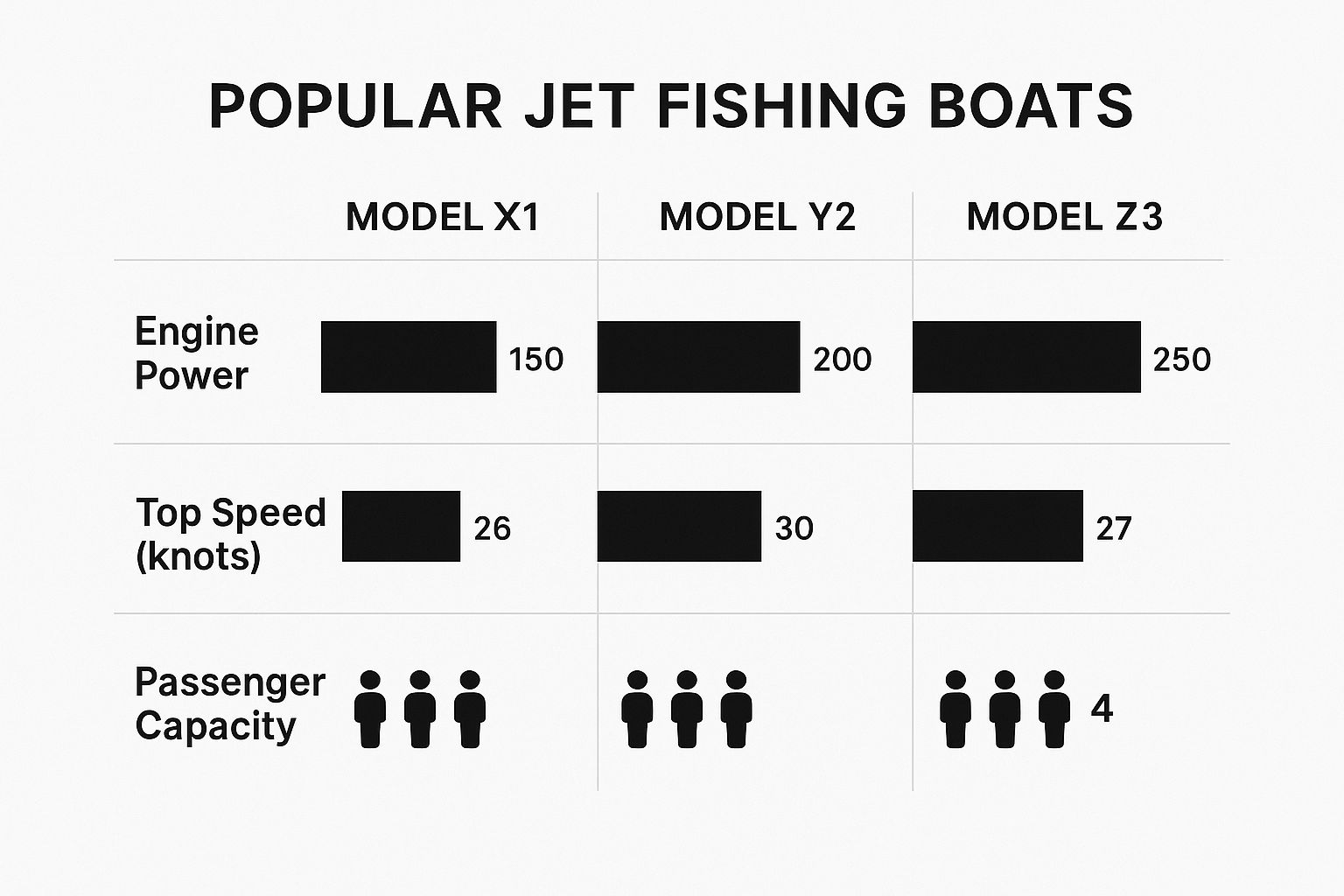
This image gives you a quick visual on how some popular jet boat models stack up on key performance metrics.
The numbers highlight the constant balancing act manufacturers perform between horsepower, speed, and capacity to appeal to different kinds of boaters.
Onboard Features That Matter
Beyond the hull and the pump, the boat's layout and built-in features are what you'll live with every day. A smart storage layout is absolutely critical. You're looking for ample dry storage for your gear, dedicated rod lockers that protect those expensive setups, and tackle compartments you can actually reach without tripping over everything.
A quality livewell system is another must-have. A great livewell isn't just a tub to hold water; it needs proper aeration and circulation to keep your catch healthy and lively. Finally, look for pre-wiring for electronics like fish finders and trolling motors. This seemingly small detail makes future upgrades infinitely simpler and more affordable. You can see this kind of practical thinking when you explore listings for versatile Carolina Skiff models, which are known for prioritizing functional fishing layouts.
This focus on the boater's experience is reflected across the industry. The global jet boats market was valued at USD 2.07 billion in 2023 and is projected to hit USD 3.10 billion by 2032. Manufacturers are pouring money into new technology to improve both propulsion and safety, especially as North America's passion for recreational boating continues to drive innovation and growth.
Navigating Prices and Smart Financing Options
Alright, let's talk about the bottom line: money. Getting a clear picture of what a jet boat will actually cost you is probably the most important step in this whole process. When you first start looking at jet fishing boats for sale, the prices can feel like they’re all over the place, but there’s a method to the madness.
The first major fork in the road is deciding between new and used. A brand-new, entry-level jet fishing boat can start around the $30,000 mark. On the other end of the spectrum, you’ll find that top-tier models from premium manufacturers like the Beneteau Group or Brunswick Corporation can easily sail past $100,000. The used market is where things get really interesting, with potential for huge savings—but it also means you need to do your homework and inspect every detail carefully.
What Drives the Price Tag
So, what actually makes one boat cost more than another? It’s rarely just about the boat's length. The real value is tied up in the details you might not see at first glance.
Engine Size and Power: This is a big one. A high-horsepower engine built for speed and hauling heavy gear is always going to carry a bigger price tag than a more standard powerplant.
Brand Reputation: Well-known brands with a long history of quality and reliability don’t just cost more upfront; they often hold their value much better when it comes time to sell.
Features and Electronics: Think of it like buying a car. A base model is one price, but a fully-loaded version with top-of-the-line fish finders, GPS, and a beefy trolling motor will be in a completely different ballpark.
Build Materials: As we touched on earlier, a heavy-gauge welded aluminum river sled designed to bounce off rocks is a different beast than a standard fiberglass hull, and its price often reflects that durability.
Keeping these factors in mind helps you understand why two boats that look similar in size can be worlds apart in price.
Securing a Boat Loan Explained
For a lot of us, financing is what makes boat ownership possible. It might sound like a complicated financial hurdle, but a boat loan really isn't much different than a car or RV loan. It's a pretty straightforward process once you get the lingo down.
A boat loan is simply a tool that lets you buy your dream boat now by spreading the cost over time. The trick is finding terms that fit comfortably into your budget, so the boat remains a joy, not a burden.
Here are the three main pieces of any boat loan puzzle:
Down Payment: This is the cash you put down upfront. Most lenders want to see 10% to 20% of the boat's price. A bigger down payment is always better—it lowers your loan amount and often helps you lock in a lower interest rate.
Interest Rate: This is what the lender charges you to borrow their money. Your credit score is king here. The better your score, the lower your rate will be, which can save you thousands over the life of the loan.
Loan Term: This is how long you have to pay the loan back, typically anywhere from 5 to 20 years. A longer term gives you a lower monthly payment, but you'll end up paying more in total interest. It's a trade-off.
Budgeting for the Hidden Costs
The price you see on the sales listing is just your ticket to get in the game. Smart boaters know that the real cost of ownership includes all the ongoing expenses. Factoring these in from day one is the key to avoiding nasty surprises later.
Ongoing Ownership Expenses:
Insurance: This isn't optional; it's essential for protecting your new investment. The cost will depend on the boat's value, where you live, and your personal boating record.
Storage: Where will the boat live when you're not on the water? A trailer in the driveway is one cost, a slip at a marina is another, and a spot at a dedicated storage facility is a third.
Routine Maintenance: Things like engine oil changes, regular jet pump inspections, and proper winterization are crucial. I always recommend budgeting for a professional annual service—it pays for itself in the long run.
Fuel: Let's be honest, jet boats can be thirsty, especially the high-performance models. Make sure you build fuel costs into your regular budget for weekend trips.
Plan for these expenses right from the start, and your new jet fishing boat will be a source of fun and adventure, not financial stress.
How to Vet Dealers and Private Sellers Like a Pro
Finding the perfect jet fishing boat is a huge win, but it's only half the journey. The other half is making sure you’re buying it from someone trustworthy. A great boat from a sketchy seller can quickly turn into a nightmare of hidden problems and unexpected costs.
Whether you're shaking hands with a dealer in a polished showroom or meeting a private owner at the local boat ramp, your approach matters. Each requires a slightly different game plan, but the goal is the same: to protect your investment and ensure you’re getting a solid vessel for a fair price.
Evaluating a Boat Dealership
When you step into a dealership, you're on their home turf. Their job is to sell you a boat, so your job is to look past the gleaming fiberglass and assess the business itself. A truly great dealership doesn't just move inventory; they build relationships and stand behind their products long after the ink is dry.
Start your homework online before you even visit. Dig into reviews on Google, boating forums, and social media. Don’t just glance at the star rating—read the actual comments. A single bad review can happen, but a pattern of complaints about poor service after the sale or undisclosed issues is a massive red flag.
Once you’re there, ask some pointed questions about their process:
Pre-Delivery Inspection (PDI): What does their PDI actually involve? Ask to see the checklist. A solid PDI isn't just a quick wash and wax; it includes a full engine diagnostic, a thorough check of all electrical systems, and a proper water test.
Service Department: Look at their shop. Do they have certified technicians who specialize in the jet pump brand you’re looking at? A well-equipped, professional service department shows they’re in it for the long haul.
Reputation and History: How long have they been in business? A dealership that’s been around for years has likely built its success on happy, returning customers.
Doing this legwork helps you find a partner who will be there to support you, not just a salesperson looking to make a quick commission.
Questions for a Private Seller
Buying from a private seller means you have to put on your inspector's hat. It’s on you to ask direct questions and listen carefully—not just to what’s said, but to what’s left unsaid.
Here are the non-negotiable questions to start with:
Why are you selling the boat? You're listening for a straightforward answer. "We're upgrading to a bigger boat for the family" is a lot more reassuring than a vague or defensive response.
Can I see the maintenance records? A diligent owner will proudly hand over a folder stuffed with receipts for oil changes, winterization, and repairs. No records at all is a serious warning sign.
Has the boat ever had major repairs? Get specific. Ask directly about the engine, the jet pump, and any history of hull damage or fiberglass work.
Do you have the title, and is it clean and in your name? If the seller can't produce a clear title, walk away immediately. Title problems can become an absolute legal mess you don't want to inherit.
The seller’s attitude can tell you just as much as their answers. An owner who has genuinely cared for their boat will be happy to answer everything and will encourage a thorough inspection. Any hesitation or irritation is a tell-tale sign that they might be hiding something.
Your Red Flag Checklist
As you look for jet fishing boats for sale, keep this mental checklist handy to spot trouble before it becomes your problem. This is a booming market, expected to hit USD 4.6 billion by 2030. In 2021 alone, over 310,000 jet boats were sold in the U.S., and that kind of demand can attract some less-than-honest sellers. You can learn more about this growth in this detailed report.
Watch out for these classic warning signs:
The seller balks at the idea of a sea trial or a professional mechanical inspection.
The price is suspiciously low compared to other similar models—if it feels too good to be true, it almost always is.
The seller creates a false sense of urgency, pressuring you with a "cash only, today only" kind of deal.
The boat's physical condition (wear and tear, scuffs, etc.) doesn't seem to line up with the hours on the engine meter.
By vetting sellers with the same attention to detail you use to inspect the boat, you can buy with total confidence. This is especially important when you’re zeroing in on specific brands, and you can learn more about what to look for in Nitro boats to see how these exact principles apply.
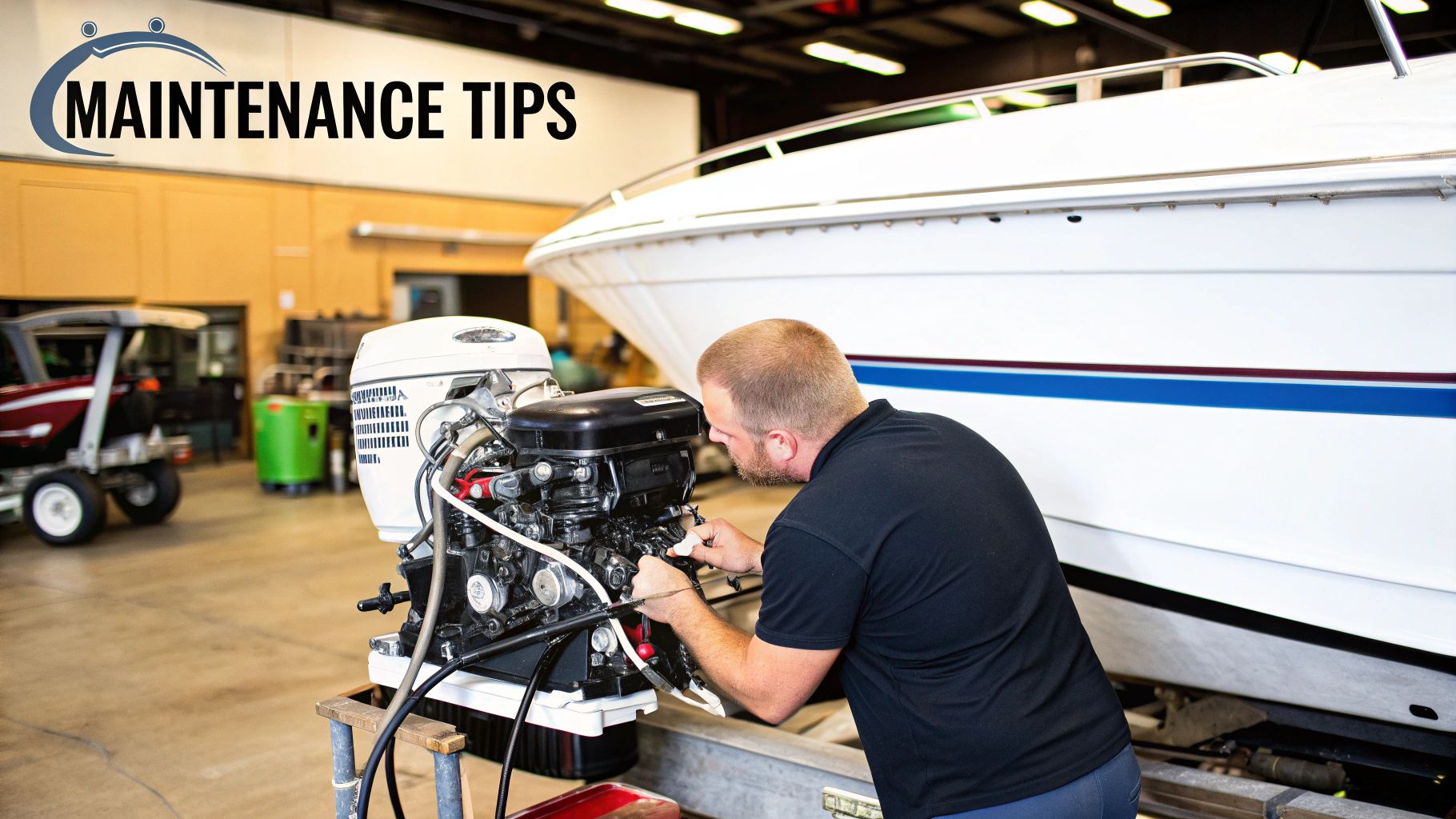
Protecting Your Investment with Essential Maintenance
So, you've got your new jet fishing boat. It's more than just a fun new toy; it's a serious investment in years of future adventures on the water. The good news is that protecting that investment doesn't mean you need to become a master mechanic overnight. It really just comes down to a few simple, consistent habits.
Think of it like owning a nice car or RV—you wouldn't dream of skipping oil changes or letting a warning light stay on for weeks. Your jet boat needs that same kind of attention. If you can get a few key routines down from day one, you'll prevent small issues from turning into expensive, trip-ruining headaches.
Your Post-Trip Routine
The most important maintenance you'll ever do happens the moment you pull your boat out of the water. Seriously. Creating a quick, non-negotiable checklist for after every trip is the single best thing you can do for your boat’s long-term health. These aren't just suggestions; they are the absolute essentials for protecting the heart of your boat—the jet drive.
This whole process only takes a few minutes, but the payoff is huge.
Essential Post-Trip Tasks:
Flush the Jet Pump: This is your #1 priority. You have to flush the engine and jet pump with fresh water after every single trip, especially if you've been in saltwater. Salt is incredibly corrosive and will eat away at internal components if you let it sit.
Clear the Intake Grate: While the boat is on the trailer, get underneath and take a look at the intake grate on the bottom of the hull. Pull out any weeds, stray fishing line, or small rocks that got sucked in. A clogged intake kills your performance and puts a lot of strain on the pump.
Wash and Dry: Give the entire boat—hull, deck, and trailer—a good rinse with fresh water. This gets rid of any salt, algae, or general grime. If you can, wipe it down with a towel. This prevents water spots and gives you a chance to spot any new scratches or dings.
A lot of new owners think flushing is only for saltwater. That's a mistake. Even freshwater has minerals, algae, and other gunk that can build up over time and cause problems. Make flushing a habit, no matter where you fish.
Professional Servicing and Winterization
While you've got the day-to-day care covered, some things are just better left to the pros. Your boat, just like your car or RV, needs an expert eye once in a while to make sure everything is running as it should.
The Importance of Annual Service
Don't skip your annual service. A certified marine technician will perform checks that go way beyond what you can see. They'll change the engine oil, inspect the sacrificial anodes (which prevent corrosion), check the driveline, and make sure the jet pump's bearings and impeller are in solid shape.
This kind of preventative care catches wear and tear before it leads to a major failure that leaves you stranded. Reputable manufacturers and dealers, like the ones you’d see at the Dubai International Boat Show, always stress how crucial it is to stick to the service schedule. It’s often required to keep your warranty valid and it definitely helps your resale value.
If you live where it freezes, proper winterization is another critical job for a professional. They'll drain all the water from the engine and plumbing, add antifreeze, and stabilize the fuel to protect everything during long-term storage. Skipping this can lead to a cracked engine block—a repair so expensive you don't even want to think about it.
Combine your own good habits with a little professional help, and you c
Combining good habits with professional winterization each year keeps your jet fishing boat in top condition and prevents the kind of costly damage that cuts a boat's life short. Find well-maintained jet fishing boats ready for your next season at SearchShop.com.