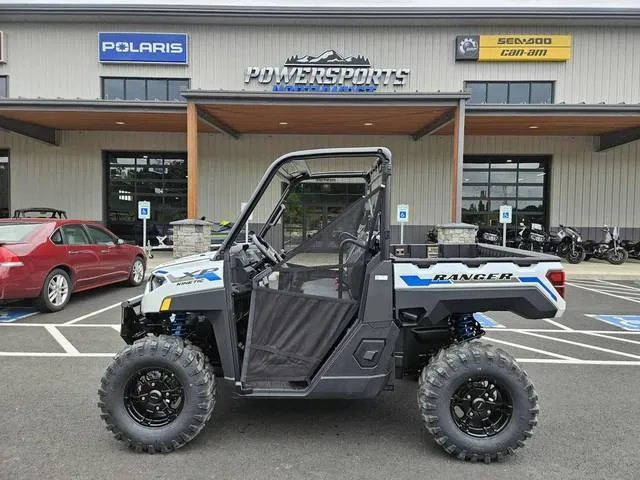
Electric vs gas UTV comes down to range, charging and price, not capability. Polaris builds the 2027 Ranger XP Kinetic and gas Ranger XP 1000 on the same platform with the same 1,500-lb payload and 2,500-lb towing rating, but the electric Kinetic costs $15,700 more and goes up to 80 miles per charge.
| 2027 spec (Polaris) |
Ranger XP Kinetic Ultimate (electric) |
Ranger XP 1000 Premium (gas) |
| MSRP, before $1,195 destination | $37,499 | $21,799 |
| Power source | 29.8 kWh lithium-ion battery | 999cc twin, 11.5-gal tank |
| Horsepower | 110 hp | 82 hp |
| Estimated range | Up to 80 miles | Not published |
| Payload capacity | 1,500 lb | 1,500 lb |
| Box capacity | 1,250 lb | 1,000 lb |
| Towing capacity | 2,500 lb | 2,500 lb |
| Estimated dry weight | 1,982 lb | 1,639 lb |
| Ground clearance | 14 in | 14 in |
| Factory winch | Not equipped | 4,500 lb |
All figures are Polaris's for the 2027 models, read on 29 October 2026. Prices are manufacturer's suggested retail prices and exclude the $1,195 destination charge, set-up, tax, title, license and registration. Dealers set actual prices. California versions of the Ranger XP 1000 Premium carry lower ratings (600-lb box, 1,100-lb payload).
Browse electric and gas side-by-sides for sale on Searchshop.
The comparison pairs one electric and one gas utility side-by-side from the same maker, so that the figures are measured and published the same way. Polaris says the Ranger XP Kinetic is built on the same architectural platform as the Ranger XP 1000, with the chassis adapted for the battery and electric powertrain, and it publishes both models' specifications in the same format.
Every figure comes from Polaris's own 2027 model pages, specification pages and Kinetic help-center articles, read on 29 October 2026, plus Searchshop's dealer listings on the same day. Nothing here comes from a test drive, and Polaris's figures were not re-measured. The Kinetic is offered in one 2027 trim, the Ultimate, so it is set against the Ranger XP 1000 Premium, the gas model's starting trim. Other makers' electric and gas UTVs are left out so that every figure in the comparison comes from one manufacturer's specification sheets.
The 2027 Ranger XP Kinetic Ultimate is rated by Polaris for up to 80 miles on a charge from its 29.8 kWh lithium-ion battery. Polaris bases that estimate on driving from a full charge at 25 mph on flat ground in moderate temperatures, and says range varies with weather, cargo loads, terrain, driving habits and state of charge.
Polaris also gives estimated ranges by type of use for the Ultimate:
- Property maintenance: 70 to 80 miles.
- Farming and ranching: 60 to 80 miles.
- Hunting: 50 to 70 miles.
- Trail riding: 40 to 60 miles.
Polaris does not publish a fuel economy or range figure for the gas Ranger XP 1000, so the two cannot be compared mile for mile. If your longest days fit inside the range for your type of use, with a margin for cold weather and heavy loads, the battery is not the limit. If you trail ride long distances or work far from an outlet, the gas model's 11.5-gallon tank can be refilled from a fuel can, away from any outlet.
A full charge on the 2027 Kinetic Ultimate takes about 20 hours from a 120V outlet or about 5 hours from a 240V outlet, according to Polaris's estimates for 0 to 100 percent with the standard 6 kW onboard charger. An accessory charger that adds 3 kW (9 kW total) cuts the 240V time to about 3.5 hours; it does not speed up charging from a 120V outlet.
Polaris says the Kinetic ships with a 20-foot combined Level 1 and Level 2 charge cord that plugs into a 120V or 240V outlet, and its J1772-style port also works with Level 1 and Level 2 public stations. Other charging rules Polaris lists:
- No DC fast charging: the Kinetic is not compatible with Level 3 public charging stations.
- Outlet: for 240V charging, Polaris recommends a 50A GFCI circuit breaker and a NEMA 14-50 outlet. Any charging circuit must have GFCI protection, be rated for at least 15 amps and carry no other loads.
- No extension cords: Polaris says never to use an extension cord, power strip, plug adapter or surge protector.
- Temperature: charging slows when the battery pack is below 50°F or above 104°F inside, and stops above 122°F. In the cold, slowed or paused charging is temporary while the battery heaters warm the pack, and Polaris shows no charging at all at or below -40°F.
Polaris recommends leaving the Kinetic plugged in between frequent uses and topping up whenever possible rather than running the battery low. If you have no 240V outlet where the machine is parked, plan on overnight charging from 120V, and check with a qualified electrician before adding a 240V circuit for the 5-hour charge.
The electric Kinetic matches the gas Ranger XP 1000 on payload and towing and carries more in its box. Polaris rates both 2027 models at 1,500 lb of payload and 2,500 lb of towing through a standard 2-inch receiver, and both have a gas-assist dump box measuring 36.7 by 54.2 by 12.5 inches on the Kinetic and 36.75 by 54.25 by 12.5 inches on the XP 1000.
The box capacity differs: 1,250 lb on the Kinetic against 1,000 lb on the XP 1000 Premium. Polaris also says the Kinetic is compatible with 95 percent of Ranger XP 1000 accessories, including Pro Shield cab systems, Pro HD winches, Lock & Ride storage and select plow models, and that you can plow snow with it with the proper accessories.
Polaris notes on both models' spec pages that payload and trailer weight affect the angle of hill on which the vehicle will hold. On the Kinetic, Polaris also lists cargo loads among the factors that reduce range, so plan heavy towing days with a margin.
The Kinetic has more power and torque but weighs more and comes with different standard equipment. Polaris rates its electric motor at 110 hp and 140 lb-ft of torque, against 82 hp for the XP 1000's 999cc twin. The Kinetic's estimated dry weight is 1,982 lb, 343 lb more than the XP 1000 Premium's 1,639 lb.
The two share their size: 120 inches long, 62.5 inches wide and 79.5 inches high, on an 81-inch wheelbase with 14 inches of ground clearance, 10 inches of suspension travel front and rear, and 29-inch Pro Armor X Terrain tires. Both have on-demand all-wheel drive with 2WD and VersaTrac Turf mode, high-output power steering, four-wheel hydraulic disc brakes and a roof.
- Kinetic Ultimate: a 7-inch RIDE COMMAND touch display with range and charging information, a factory rear camera, JBL audio and a three-year RIDE COMMAND+ connected services subscription.
- XP 1000 Premium: a factory 4,500-lb winch with synthetic rope and wireless remote. The Kinetic has no factory winch, though winches are available as accessories.
Body styles also differ. Polaris says the Kinetic is offered only as a three-seater and not in NorthStar trim, though cab systems and heater kits are sold as accessories. The gas Ranger XP 1000 comes in more versions, including a factory cab with heat and air conditioning.
The 2027 Kinetic Ultimate's $37,499 MSRP is $15,700 more than the $21,799 Ranger XP 1000 Premium, and both carry the same $1,195 destination charge. Polaris does not publish figures that show whether running costs close that gap; the answer depends on how much you use the machine and what you pay for fuel and electricity.
Polaris estimates scheduled maintenance costs for the Kinetic at 70 percent less than the average for similar gas-powered vehicles over five years. Without an engine or CVT, Polaris says there are no oil, spark plug, air filter or clutch replacements, though the gearbox, differentials, suspension and brakes still need periodic maintenance.
Multiply the Kinetic Ultimate's 29.8 kWh nominal battery capacity by your electricity rate per kWh to estimate the cost of a full charge, then allow extra for charging losses, which Polaris does not publish. Compare that with what an equivalent day of work costs you in gas. Polaris suggests charging during off-peak hours, when some utilities charge less.
Polaris lists a one-year factory warranty on both models. For the Kinetic it adds promotional battery coverage: a five-year battery warranty made up of the 12-month factory warranty plus an additional 48 months, under terms and conditions on Polaris's site. Polaris also offers promotional powertrain coverage on the Kinetic; check the current terms with the dealer.
Searchshop dealer listings give current asking prices for the gas Ranger XP 1000 Premium and show only a few electric Kinetics for sale. On 29 October 2026, six new 2026 Ranger XP 1000 Premium units (listings whose titles matched that model name, excluding NorthStar, Crew and Cab versions) had a median asking price of $20,311, rounded to the dollar, ranging from $19,499 to $21,699.
The same day, two new 2024 Ranger XP Kinetic Premium units were listed, each asking $29,999. The 2024 Premium is a different trim from the 2027 Ultimate: Polaris rates it at up to an estimated 45 miles of range. No new 2027 Kinetic Ultimate units were listed. Asking prices are what dealers advertise, before tax and fees, and change daily.
Polaris says the Ranger XP Kinetic is designed to operate below 0°F, like a gas machine, but range and charging both change in the cold. Polaris recommends keeping the Kinetic plugged in before use or during storage in cold weather so it can warm its batteries, and says performance may be reduced for a short period until the batteries warm up.
For water, Polaris says the Kinetic can be driven through water up to its floorboards, and warns never to drive it in fast-flowing water or water above floor level. It also warns against aiming a pressure washer at inner components. If you work in freezing weather, plan to park the Kinetic where it can stay plugged in.
Choose the electric Ranger XP Kinetic if your days fit inside its range, you can charge where you park it, and quiet running matters. Polaris says the quiet electric powertrain enables easy conversation, stealthy trips to hunting spots and convenient operation around livestock.
- Choose electric for property work, farm chores and hunting close to home, if you have or can add a 240V outlet, and if you value Polaris's estimate of lower scheduled maintenance costs.
- Choose gas for long trail rides, work far from power, a lower purchase price, a factory winch, or a factory cab with heat and air conditioning.
- Either one gives you the same 1,500-lb payload and 2,500-lb towing rating from Polaris.
For more on the gas side, see Polaris Ranger 570 vs Ranger 1000 and Polaris Ranger vs Can-Am Defender. If winter work is the main job, read best UTVs for plowing snow, and for recall histories see most reliable side-by-sides.
When you are ready, compare Ranger and other side-by-side listings from dealers on Searchshop.
An electric UTV can be worth it if its range fits your work and you value lower upkeep over a lower purchase price. The 2027 Ranger XP Kinetic Ultimate costs $15,700 more than the gas Ranger XP 1000 Premium. Polaris estimates its scheduled maintenance costs at 70 percent less than similar gas vehicles over five years, and it matches the gas model's payload and towing.
The 2027 Polaris Ranger XP Kinetic Ultimate goes up to an estimated 80 miles on a charge, based on driving at 25 mph on flat ground in moderate temperatures. Polaris estimates 70 to 80 miles for property maintenance, 60 to 80 for farming and ranching, 50 to 70 for hunting and 40 to 60 for trail riding.
The 2027 Ranger XP Kinetic Ultimate takes about 20 hours to charge fully from a 120V outlet and about 5 hours from a 240V outlet, by Polaris's estimates. With Polaris's accessory charger, the 240V time drops to about 3.5 hours. The Kinetic cannot use Level 3 DC fast chargers.
The electric Ranger XP Kinetic tows as much as its gas counterpart: Polaris rates both the 2027 Kinetic and the 2027 Ranger XP 1000 at 2,500 lb through a standard 2-inch receiver. Both carry a 1,500-lb payload, and the Kinetic's box is rated for 1,250 lb against 1,000 lb on the XP 1000 Premium.
These are the primary sources used for every figure in this article, all read on 29 October 2026.