So, you’re thinking about buying an RV. Welcome to the club! Before you get lost in the sea of listings for an rv for sale, the very first thing you need to do is figure out your "why."
Are you picturing weekend getaways to nearby state parks? Or maybe you're dreaming of an epic, cross-country journey with the family. Perhaps you're even ready to embrace the full-time RV lifestyle. Your answer to that question is the foundation for every single decision you'll make from here on out.
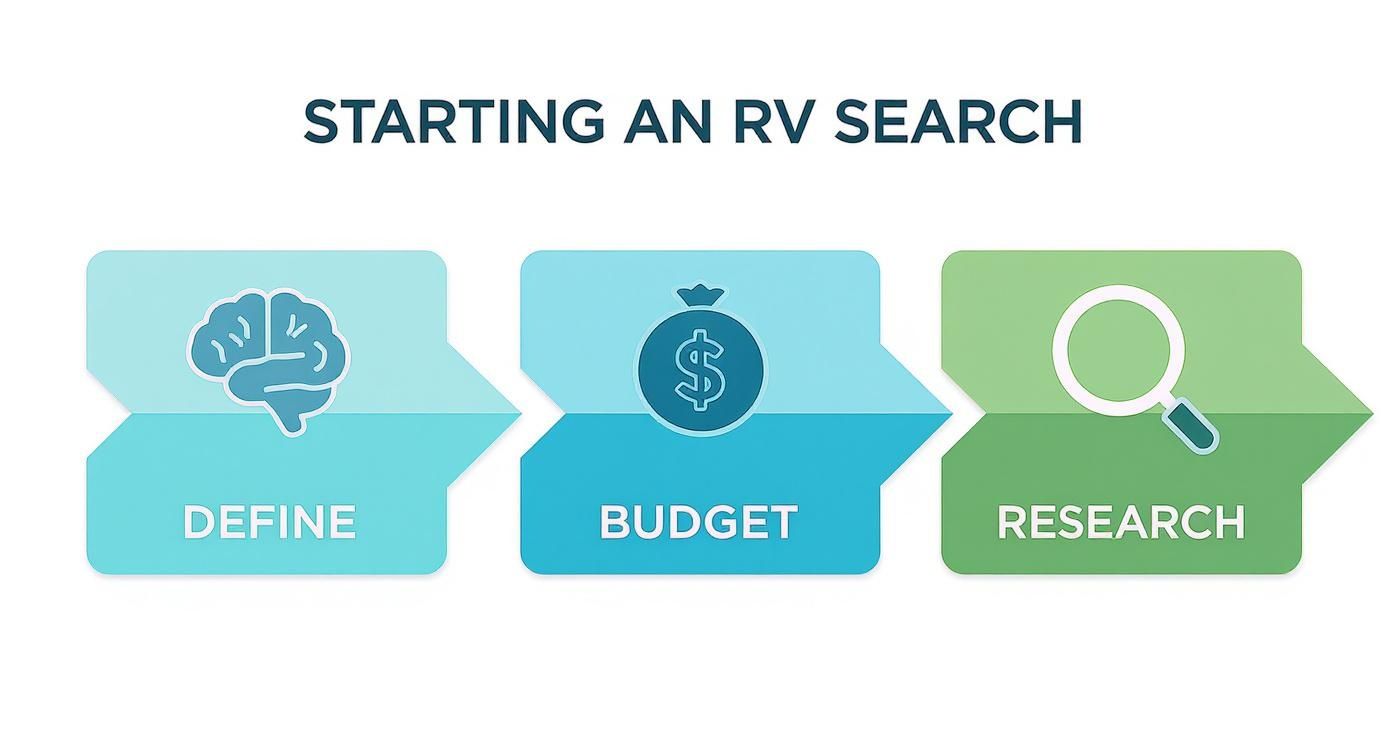
Starting Your RV Search The Right Way
Think of this guide as your roadmap. We're here to take you from that initial spark of an idea to confidently holding the keys to your new rig. It all starts with understanding what’s out there and how to find the perfect fit for you.
We'll walk through the whole process, covering everything from the different types of RVs to setting a realistic budget (it's more than just the price tag!). You'll also learn how to inspect a potential purchase like a pro and, finally, how to seal the deal without any last-minute surprises.
The Growing Appeal of RV Travel
You're not alone in feeling the call of the open road. The RV market is booming as more people discover the freedom of outdoor travel and flexible living. The global market was valued at around USD 56.35 billion in 2026 and is on track to hit USD 97.86 billion by 2033. That’s a lot of happy campers!
This growth is driven by a real shift in how people want to travel, combined with some seriously cool tech advancements in modern RVs.
As you can see, a smart purchase starts way before you ever step foot on a dealer's lot. It begins with you, your needs, and your budget.
Defining Your Travel Style
Before you even think about floor plans or slide-outs, get real about how you'll actually use your RV. A family of five planning to spend the summer on the road has completely different requirements than a solo adventurer looking for a nimble rig for weekend escapes.
Your travel style is the single most important factor in determining the right RV. Mismatching your needs with the vehicle's capabilities is a common and costly error for new buyers.
This is a big decision, so we've put together a handy table to give you a quick overview of the main RV classes. It’s a great starting point for figuring out which category to focus on.
Quick Guide to RV Classes and Use Cases
RV Class
Description
Best For
Class A
The largest, bus-style motorhomes.
Full-time living, large families, luxury travel.
Class B
Also known as camper vans. Compact and easy to drive.
Solo travelers, couples, weekend trips, stealth camping.
Class C
Mid-sized motorhomes with an over-cab sleeping area.
Families, first-time owners, long-term travel.
Travel Trailer
Towed behind a truck or SUV. Huge variety of sizes.
And if you want to get a head start, it's always a good idea to learn how to avoid common mistakes new RV campers make. A little research now can save you a ton of headaches later.
Deciding Between a New or Used RV
This is one of the first major forks in the road you'll hit when looking for the perfect RV. It's the classic head-versus-heart debate, pitting the shiny allure of a brand-new rig against the practical savings of a pre-owned model. Your decision here doesn't just shape your initial budget—it sets the tone for your entire ownership experience.
There's no single right answer. The best path for you depends entirely on your financial comfort zone, your stomach for risk, and just how hands-on you want to be with maintenance and repairs. Let's dig into the real-world pros and cons of both so you can make a choice with total confidence.
The Appeal of a Brand-New RV
There's no denying the magic of walking into a brand-new RV for the first time. You get that "new rig" smell, the latest gadgets, and pristine surfaces that are all yours. For a lot of buyers, this peace of mind is what seals the deal.
A new rig comes with a full factory warranty, which is a massive plus. It covers manufacturing defects or system failures that tend to pop up in the first year or two. If the water heater goes on the fritz or a slide-out motor dies, it's the manufacturer's headache, not yours.
You also get to pick the exact floor plan, interior design, and features you want without having to compromise. But all that perfection comes at a steep price: depreciation. A new RV can lose 20% to 30% of its value the second you drive it off the lot.
Understanding the Used RV Market
This is where the savvy shoppers find incredible deals. On the used market, that brutal first-year depreciation works in your favor. The original owner took that huge financial hit, which means you can often buy an RV that's just a few years old for a fraction of what it cost new.
Many used RVs also come with valuable upgrades already installed by the previous owner. Things like solar panels, better battery systems, or suspension enhancements can cost thousands to add to a new rig. You’re essentially getting more bang for your buck.
Buying a used RV lets you skip the steepest part of the depreciation curve. A well-maintained, two-year-old model offers a sweet spot of modern features and significant savings, letting a previous owner pay for the initial value drop.
Of course, the used market demands a lot more due diligence. There’s no factory warranty to fall back on, and you're inheriting the RV's entire history—the good and the bad. Hidden problems like water damage or failing appliances can quickly turn a great deal into a money pit.
Key Factors to Weigh
As you start browsing RVs for sale, it helps to compare your options side-by-side. This isn't just about the sticker price; it's about the total value and potential risks over the long haul. For an even more detailed breakdown, our New vs. Used RV: Your Ultimate Buying Guide can give you deeper insights.
Here’s a look at how they stack up:
Feature
New RV
Used RV
Initial Cost
Highest purchase price.
Significantly lower, often 30-50% less.
Warranty
Full manufacturer warranty.
Typically sold "as-is" with no warranty.
Condition
Perfect, untouched condition.
Varies greatly; requires thorough inspection.
Depreciation
Steepest in the first 1-3 years.
Much slower rate of value loss.
Upgrades
You pay extra for all add-ons.
Often includes aftermarket upgrades.
Maintenance
Minimal initial "shakedown" repairs.
Potential for immediate maintenance needs.
This really highlights the fundamental trade-off: you're either paying a premium for peace of mind or accepting more risk for substantial savings. A family might save $20,000 on a lightly used model, while another could get hit with an unexpected $8,000 repair bill on a private-party sale that had hidden water damage.
The current market adds another layer to this decision. In 2024, total RV registrations in the U.S. were 356,518 units, a decrease of nearly 7% from the previous year. With manufacturers producing fewer units than were sold, dealers have been working to clear out built-up inventory. This means that by mid-2025, there could still be thousands of unsold 2024 and even 2023 models on dealer lots, creating potential negotiating power for buyers looking at "new-old-stock." You can discover more about recent RV sales trends on Bishs.com to see how these dynamics might affect your purchase.
Ultimately, this choice comes down to you. If you have the budget and really value a worry-free start to your RV life, a new rig is a fantastic way to go. But if you're a bit handy, patient, and want to get the absolute best value for your dollar, a carefully inspected used RV can be an incredibly smart move.
Creating Your Realistic RV Budget
It’s easy to get swept up in the excitement of finding the perfect RV. But that initial thrill can wear off fast if you’re not ready for the real-world cost of ownership. The sticker price you see is just the tip of the iceberg, and smart buyers know that a solid budget covers everything from the day you sign the papers to your first year on the road.
Honestly, this is the single most important financial step you can take. Getting this right from the start prevents those nasty surprise expenses that turn a dream adventure into a source of stress. Let's dig into what you actually need to account for beyond that initial price tag.
Accounting for Immediate Costs
Just like buying a car, the final bill for an RV is always higher than the price you agreed on. Before you even fantasize about your first trip, you're going to face a handful of significant one-time expenses.
Don't be surprised if these immediate costs tack on an extra 10% or more to the purchase price.
Sales Tax: This varies wildly by state, but it’s always a big chunk of change. On a $50,000 RV, a 7% sales tax immediately adds $3,500 to your total. Ouch.
Registration and Titling Fees: Every state has them. They can be less than a hundred bucks or run you several hundred dollars, but they are unavoidable.
Dealer Fees: You’ll see these listed as "doc fees" or "prep fees." They cover the dealership's paperwork and prep work. They can often be negotiated, so don't be afraid to ask.
Planning for Ongoing Ownership Expenses
This is where so many new owners get caught off guard. The spending doesn't stop once you've parked the rig in your driveway. A truly realistic budget includes all the monthly and annual costs that are now part of your life.
The most successful RV owners I've met treat their rig like a second home, not just a vehicle. That means budgeting for insurance, maintenance, and even "rent" for its parking spot, whether that's a campground or a storage lot.
Here are the big recurring costs you need to plan for:
Insurance: RV insurance is a specialized, mandatory expense. Your rate will depend on the RV's class, its value, and your driving record, but you can expect to pay anywhere from $800 to over $2,500 annually.
Storage: Can't park it at home? You'll need to rent a spot. This can cost anything from $50 a month for a basic outdoor lot to $300+ for covered or climate-controlled storage.
Maintenance and Repairs: Things break. It's just a fact of RV life. A good rule of thumb is to set aside 1-2% of the RV's purchase price annually for upkeep. For a $75,000 rig, that’s $750-$1,500 per year for everything from resealing the roof to fixing a finicky water heater. For a deeper dive, our guide on how much an RV costs provides essential budget tips and breaks down these long-term expenses in much more detail.
Securing the Right Financing
Unless you're paying in cash, your loan is going to be your biggest monthly RV expense. Getting a handle on your financing options before you even start shopping puts you in the driver's seat during negotiations.
You generally have three main sources for an RV loan:
Credit Unions: They are my first stop. They often have the most competitive interest rates and better terms, especially if you're already a member.
Banks: A solid, traditional option. If you have a strong relationship with your bank, you can get some great rates here.
Dealership Financing: This is the most convenient option, but you often pay for that convenience with higher interest rates. Their biggest plus is that they work with a network of lenders, which can help if you're having trouble getting an approval elsewhere.
Here's a pro tip: Get pre-approved for a loan from your bank or credit union before you walk into a dealership. It proves you're a serious buyer and lets you negotiate the price of the RV, not the monthly payment.
And be wary of super long loan terms. Sure, a 20-year loan will have a temptingly low monthly payment, but you'll pay a staggering amount of extra interest over time. Always look at the total cost of the loan, not just that monthly number.
How to Properly Inspect an RV Before You Buy
Whether you’re eyeing a brand-new model at a dealership or a used rv for sale from a private owner, the inspection is your single most important line of defense. This is where you put aside the excitement and become a detective.
Getting hands-on is non-negotiable. You need to poke, prod, and test every system and feature to uncover the problems that might be lurking just out of sight. A thorough walkthrough is what separates a dream purchase from an inherited nightmare.
Start With the Big-Ticket Items
Some RV problems are minor annoyances; others are financial catastrophes. You need to focus on the expensive stuff first. Water damage is the silent killer of RVs, so the roof and all exterior seals should be at the very top of your list.
The Roof: If it’s safe, get up there and walk around. You're looking for any cracks, bubbling, or failing sealant around every vent, skylight, and seam. Any soft spots under your feet are a massive red flag, pointing directly to water intrusion and rot in the structure below.
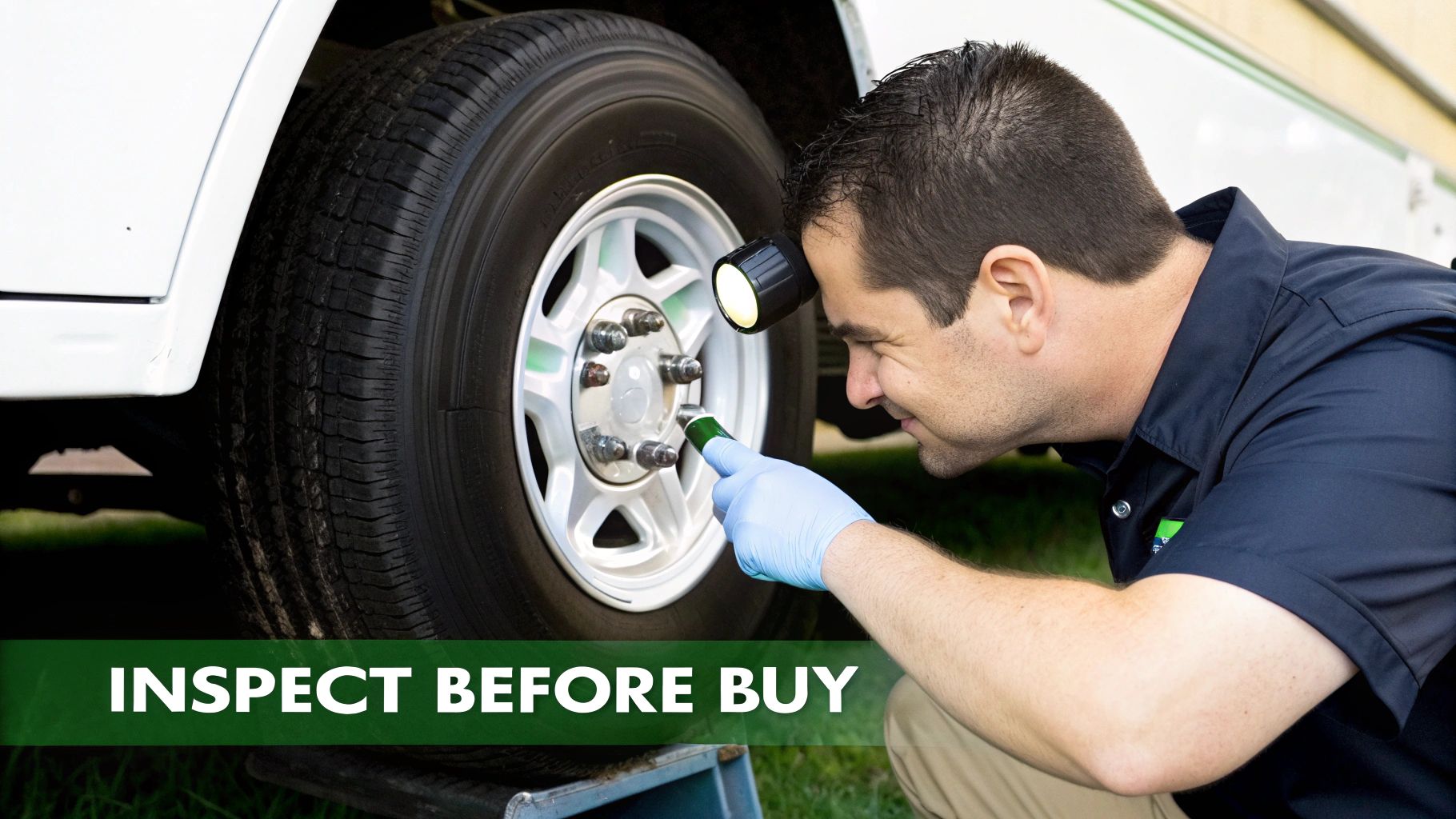
The Tires: Don't just kick the tires. RV tires almost always age out before their tread wears down. Find the DOT code stamped on the sidewall to check their manufacturing date. Any tire older than five to seven years is a blowout waiting to happen and needs immediate replacement, no matter how good it looks.
The Chassis and Frame: Crawl underneath the rig and look for rust. A little surface rust is usually fine, but deep, flaking corrosion, especially around welds or suspension parts, can signal a compromised frame.
While you're checking systems, don't forget the electrical setup. If the rig has solar, you'll want to have a basic understanding of its components. Knowing what to look for with things like MPPT charge controllers for caravans and campervans helps you gauge whether the system is healthy and well-maintained.
Test Every Single Thing
Okay, time to head inside and start flipping switches. The goal is to test every single system that can be turned on, opened, or flushed. Don't take the seller's word for anything. If they're confident in their RV, they won't mind you putting it through its paces.
If possible, have the RV connected to shore power and a city water connection. Fire up the air conditioner and then the furnace. Check the water heater. Turn on every light, test every outlet, and run every appliance—fridge, microwave, stove. Flush the toilet and look for any leaks in the plumbing below. It feels tedious, but finding a dead $1,500 refrigerator before you sign the papers is a huge win.
Your inspection is your primary negotiating tool. Every issue you find, from a leaky faucet to a non-working slide-out, is a valid reason to either ask for a repair or a reduction in the asking price.
This hands-on approach is critical, especially given the size of the market. The North American RV industry was valued at around USD 21.8 billion in 2025 and is only growing. With countless options out there, a detailed inspection ensures you pick a winner.
The Critical RV Inspection Checklist
To keep things organized, it helps to have a checklist. This isn't exhaustive, but it covers the absolute non-negotiables you must examine before making an offer.
Area of Inspection
Key Things to Check
Red Flags
Roof & Exterior Seals
Cracks, bubbles, soft spots, failing sealant
Any sign of water intrusion, delamination
Tires
DOT date code (under 5-7 years), cracks, uneven wear
Old age, weather cracking, mismatched brands
Chassis & Frame
Deep, flaking rust; bent or cracked frame members
Significant corrosion, signs of major accidents
Slide-Outs
Smooth operation (in and out), good seal alignment
Jerky movement, grinding noises, water stains
Appliances
Fridge/freezer gets cold, A/C blows cold, furnace blows hot
Any appliance not working on all power sources
Plumbing
Water pump cycles properly, no leaks at fixtures/toilet
Water stains, soft floors, constant pump cycling
Electrical System
All lights work, outlets have power, battery health
Flickering lights, dead outlets, corroded battery terminals
Think of this table as your first pass. If the RV fails on any of these major points, it might be best to walk away unless you're prepared for a serious project.
Don't Skip the Test Drive
For any motorhome, the test drive is make-or-break. You need to feel how it performs on an actual road, not just in a parking lot. Get it up to highway speeds if you can.
Listen for weird noises from the engine, suspension, or brakes. Does it pull to one side? Does the transmission shift hard or slip? This is your chance to see if the dash A/C, cruise control, and radio all work as they should. You can learn a lot about a rig's history in a 20-minute drive.
When to Call in a Professional
Feeling in over your head? That’s okay. If you're serious about a used rv for sale but aren't a mechanic, hiring a certified NRVIA (National RV Inspectors Association) inspector is the best money you will ever spend.
A professional inspector will spend hours combing through the RV, testing things you didn't even know existed and providing a detailed report with photos and fluid analysis. That few-hundred-dollar inspection fee can easily save you thousands in hidden repairs and gives you incredible leverage for negotiating the final price.
Negotiating Your Price and Closing the Deal
Alright, you’ve done the hard work. You’ve crawled on the roof, tested every appliance, and taken that rig for a good, long drive. Now comes the part that can make a massive difference to your bank account: the negotiation.
This is your moment to turn everything you've learned into real savings. Walking into this conversation armed with data is what separates a good deal from a bad one. Whether you're standing on a shiny dealership lot or in a private seller's driveway, the goal is the same: make a fair offer that reflects what that RV is truly worth.
Research Fair Market Value
Before you throw out a single number, you need to know what that RV should cost. Guessing is a surefire way to overpay, sometimes by thousands. The asking price is just that—what the seller is asking. It's a starting point, not the finish line.
Your research should start online with a couple of key resources.
NADAguides: This is the bible for RV values. It’s what banks and insurance companies use, so when you bring it up, it carries serious weight. Look up the specific year, make, and model to get a solid baseline.
Recent Sales Data: Hop on sites like RV Trader and even Facebook Marketplace. The trick here is to look for what similar models have actually sold for, not just their current listing prices. This real-world data is pure gold in a negotiation.
Armed with a realistic price range, you can now craft your opening offer. The smart play is to start below your target price, but not so low that you insult the seller and shut down the conversation. An informed, respectful offer always gets the best results.
Using Your Inspection as Leverage
Remember that list of dings, dents, and issues you found during your inspection? The cracked vent cover, the six-year-old tires, that little water stain under the sink? Now’s the time to put that checklist to work.
Every single problem you found represents a future cost to you, and it’s perfectly fair to ask for the price to reflect that.
A professional inspection report is your single greatest negotiating asset. Handing a seller a detailed, third-party assessment of needed repairs is infinitely more powerful than just saying, "it needs some work."
For example, if you know a new set of tires is going to run you $1,200, you can use that exact number to justify a lower offer. This isn't about being picky; it's about making sure the price is fair for the RV's actual condition. You can either ask the seller to fix the issues before you buy or, more commonly, ask for a direct price reduction.
Navigating Dealership Negotiations
Negotiating with a dealership is a completely different ballgame than buying from a private owner. Dealers are seasoned pros with sales targets, and their job is to maximize profit on every sale. Your job is to focus on one thing and one thing only: the "out-the-door" price.
Don't get sidetracked by conversations about what your monthly payment might be. That’s a classic tactic to obscure the true cost. Settle on the total price for the RV first. Only after that number is locked in should you even begin to discuss financing.
And then comes the finance office. Be ready to politely—but firmly—say "no" to the endless stream of add-ons. This is where dealers make a ton of money, pitching things like:
Extended Warranties
Tire and Wheel Protection
Fabric Protection
GAP Insurance
Some of these might be useful, but they are almost always overpriced. If you think you want a warranty, research third-party options before you go to the dealer. Never let them pressure you into buying these on the spot.
Closing the Deal with Confidence
Once you’ve shaken hands on a price, don't let your excitement cause you to rush through the final, critical step: the paperwork. Getting this wrong can turn your dream into a disaster.
First, always get a bill of sale. This document is your proof of purchase and should clearly list the price, date, the RV's Vehicle Identification Number (VIN), and have the names and signatures of both you and the seller.
Next, and this is non-negotiable, you must scrutinize the title. The name on the title has to match the seller's ID. Most importantly, look for any liens. If a bank is listed as a lienholder, you need ironclad proof that the loan is paid off. The best proof is a "lien release letter" from that financial institution.
Never, ever hand over a dime until you have a clean, signed title in your hand. A missing or problematic title can trap you in a legal and financial nightmare that can take months, and a lot of money, to fix.
By being methodical and informed, you can close the deal with total confidence, ensuring your new adventure starts on the right foot.
Jumping into the world of RVs can feel overwhelming, and it's natural to have a lot of questions, especially if this is your first time. Getting straight answers to these common concerns is the key to buying with confidence.
Think of this as a conversation with a seasoned RVer. We'll walk through the best time of year to buy, what ownership really costs, and the age-old debate of dealerships versus private sellers. Let's clear the air on some of the biggest hurdles in the RV buying process.
What Is the Best Time of Year to Buy an RV?
If you want to save some serious cash, timing is everything. The best deals on an RV for sale almost always pop up in the fall and early winter, usually between October and February.
Once the peak summer camping season is over, demand drops off a cliff. Dealerships are looking to move last year's models off the lot to make room for the new inventory. This puts you in the driver's seat and gives you a ton of negotiating power.
On the flip side, spring is hands-down the most expensive time to buy. The weather gets nice, people start dreaming of summer road trips, and that demand surge sends prices soaring. A little patience here can translate into thousands of dollars in savings.
How Much Does RV Insurance Typically Cost?
This is one of those "it depends" answers, because RV insurance costs are all over the map. The final price tag hinges on a few big factors: the RV's class and value, your personal driving history, and even how you plan to use it.
A small, older travel trailer might only set you back a few hundred dollars a year. But a brand-new, top-of-the-line Class A motorhome? That could easily run you several thousand dollars annually.
The only real way to nail down your cost is to get quotes—and lots of them. Make sure you talk to companies that specialize in RV insurance. They understand the unique coverage you'll need for things like personal belongings, full-time living liability, and roadside assistance for a massive vehicle.