For families ready to trade screen time for campfire time, the best travel trailers usually come down to three things: a smart bunkhouse layout, lightweight construction, and tons of storage. Brands like Jayco, Grand Design, and Forest River consistently deliver on these fronts, building a reputation for durable, family-friendly designs. The real trick is finding the one that fits how your family likes to travel.
Finding the right travel trailer is more than just a purchase; it's the first step toward creating those family memories you'll talk about for years. With so many options out there, it's easy to get overwhelmed. This guide is designed to cut through the noise and help you pinpoint the perfect rig for your crew, whether you're planning short weekend trips or a massive cross-country journey. Travel trailers really do hit that sweet spot of freedom, comfort, and affordability for family vacations.
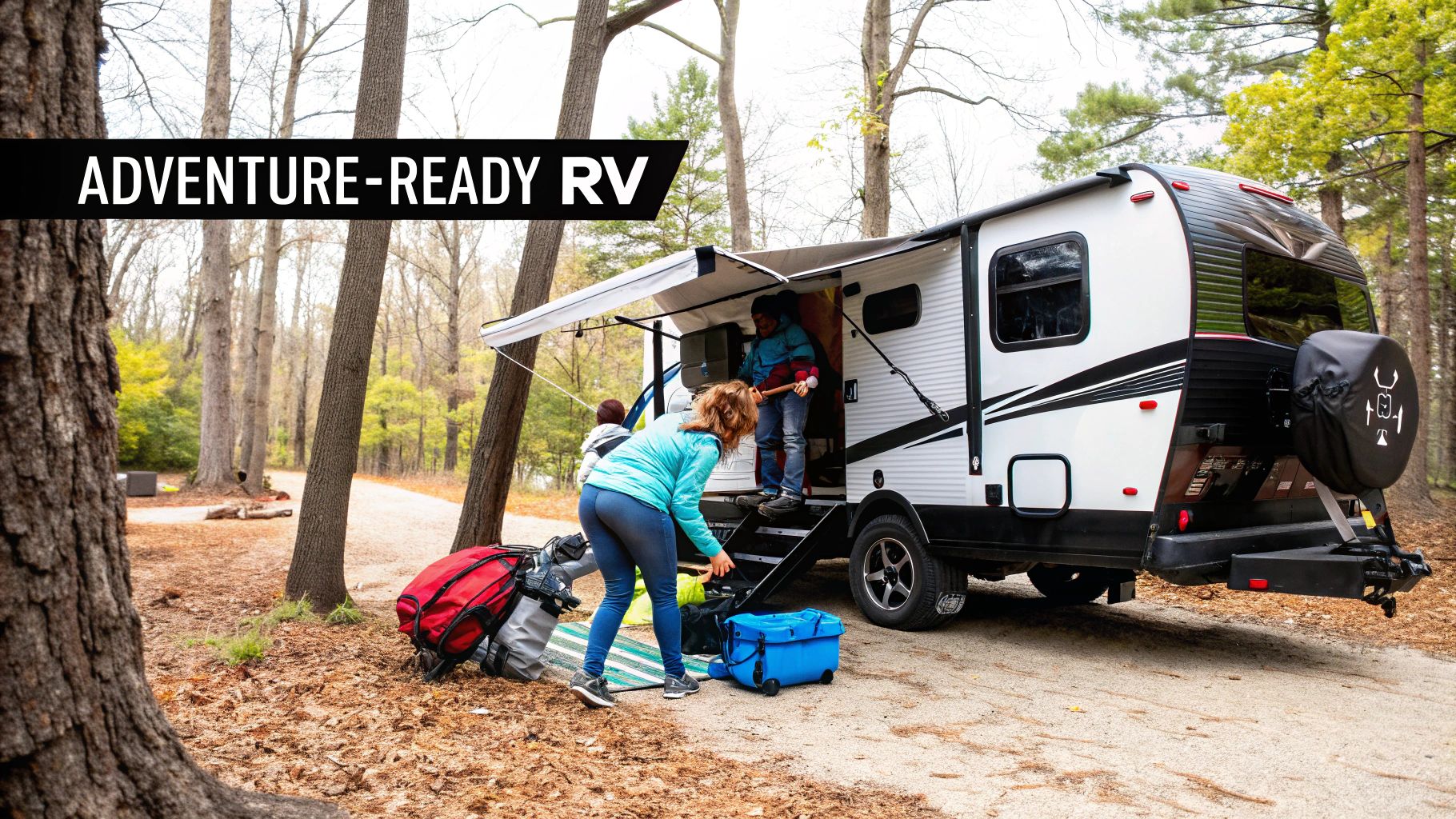
It's no secret this lifestyle is booming. The global travel trailer market is expected to jump from $15.1 billion in 2025 to $21.3 billion by 2035—proof that more families than ever are hitting the road. To make sure you get the right rig, let's focus on what really matters for keeping everyone happy and comfortable.
- Smart Bunkhouse Layouts: Dedicated kid zones are a total game-changer. Look for models with separate bunk rooms or smartly designed double-over-double bunks. Giving the kids their own little space makes a world of difference.
- Durable Construction: Let's be honest, family adventures can be rough on a camper. Prioritize trailers built to last, with features like aluminum framing and fiberglass exteriors that can handle the wear and tear of an active family.
- Ample Storage: Families don't travel light. Between bikes, toys, extra clothes, and camping gear, you need space. Scrutinize both the interior cabinets and the exterior pass-through storage to make sure there's a spot for everything.
Before you get too attached to a floor plan, there's a critical reality check: can your vehicle actually tow it safely? This is arguably the most important technical detail. Understanding tow ratings and vehicle capacity isn't just a suggestion—it's essential for safety on the road.
To dig deeper into the specifics, check out our complete guide to RV trailer sizes for towing and travel. It will walk you through everything you need to know to make a safe match.
The best travel trailer isn't just about the features inside; it's about how it makes your family's adventures easier and more fun. Focus on floor plans that solve daily problems—like a second door that leads right into the bathroom or a functional outdoor kitchen. Those are the details that truly elevate your camping experience.
When you start shopping for a family travel trailer, it’s easy to get lost in the spec sheets. But the truth is, the features that really make or break a family trip are the ones that make life on the road easier and more comfortable for everyone. A great family adventure often comes down to the practical stuff: a smart floor plan, enough storage for all the gear, and a trailer that your vehicle can safely tow.
Choosing the right travel trailer is a big decision, and it’s one that more and more families are making. The travel trailer market in North America is booming, projected to hit USD 28.6 billion in 2025 and an incredible USD 57.3 billion by 2035. This growth is fueled by families just like yours looking for a more flexible way to see the country.
So, let's cut through the marketing noise and talk about the features that actually matter in the real world.
The first question every family asks is, "Where will everyone sleep?" This single decision shapes the entire layout and feel of your trailer.
For families with a couple of kids, a dedicated bunk room is often the holy grail. It gives the children their own zone to sleep, play, and just be kids, which in turn gives the parents some much-needed private space. That separation can be a real lifesaver, especially on rainy days or during extended trips.
On the other hand, convertible sleeping areas—like a dinette or sofa that folds down into a bed—maximize your living space during the day. This is a solid choice for smaller families or those who want a more open feel in a shorter trailer. The trade-off? You'll be setting up and breaking down beds every single day, which can get old pretty fast.
The real magic of a bunkhouse isn't just about the extra beds. It's about creating separate living zones. When the kids have their own space, the main living area stays cleaner and feels a lot more like a relaxing retreat for the adults.
This chart shows the relationship between sleeping capacity, storage, and weight—three factors that are always in a delicate balance.
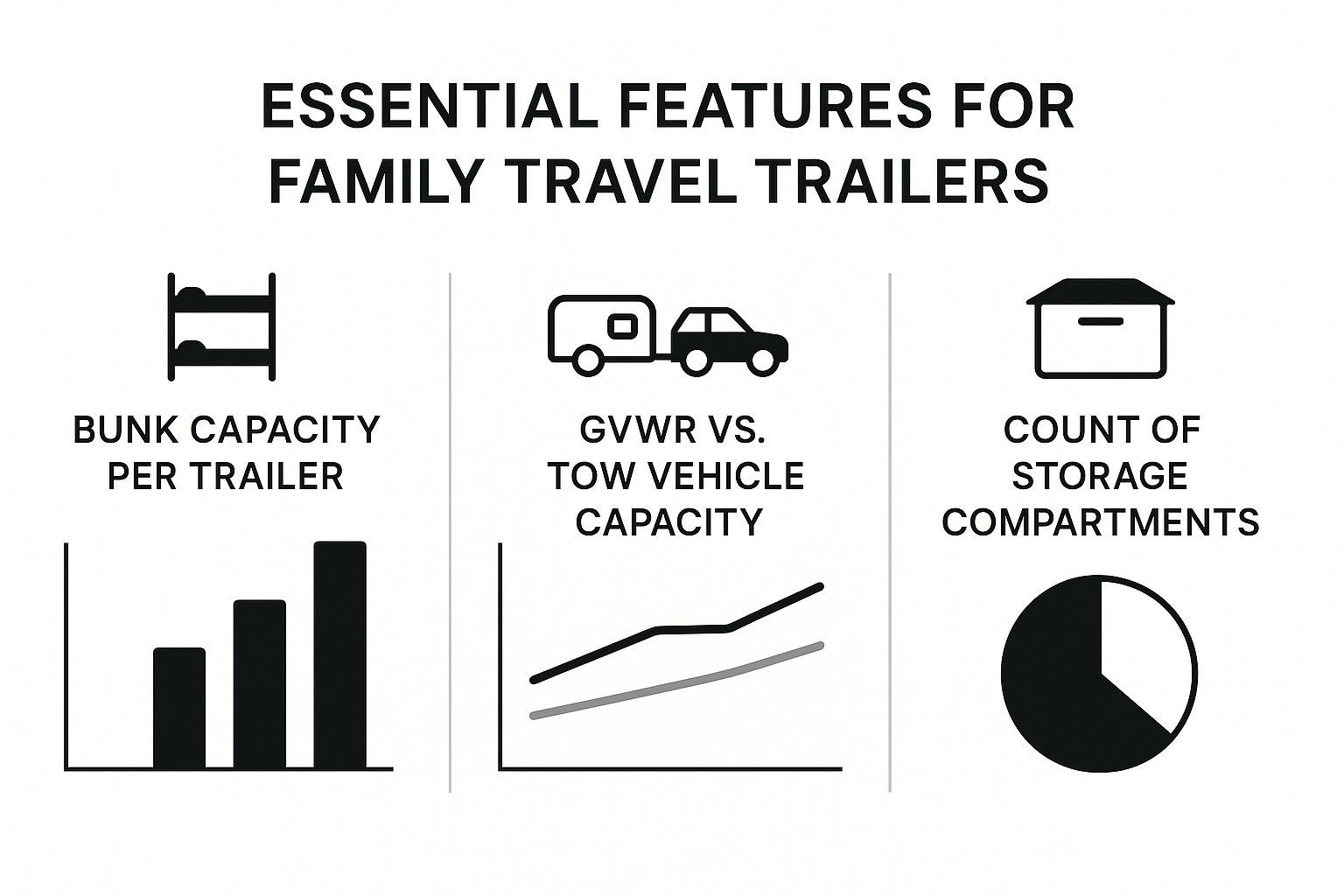
As you can see, trailers that sleep more people usually offer more storage, but they also weigh more. This is a perfect illustration of why it’s so important to make sure your tow vehicle can handle the trailer you have your eye on.
Here’s a quick reference table to help you zero in on what's most important as you compare different models.
| Feature Category |
What to Prioritize |
Impact on Family Camping |
| Floor Plan |
Dedicated bunk rooms or flexible multi-use spaces |
Defines personal space, privacy, and daily flow. A good layout prevents feeling cramped. |
| Kitchen |
Counter space, pantry size, outdoor kitchen option |
Makes meal prep manageable and keeps cooking messes (and smells) out of the living area. |
| Bathroom |
Exterior access door, tub for small children |
Prevents dirt from being tracked through the trailer and makes bath time easier for little ones. |
| Storage |
Large pass-through bays, deep interior cabinets |
Ensures you have room for essentials like chairs, toys, and gear without cluttering the inside. |
| Weight (GVWR) |
Compatibility with your tow vehicle's capacity |
This is a non-negotiable safety factor. Overloading your vehicle is dangerous. |
Ultimately, the best features are the ones that solve the real-life challenges of camping with kids.
A functional kitchen is non-negotiable. Look past the shiny appliances and check for actual counter space. Can you realistically make a sandwich or prep dinner without everything falling on the floor? An outdoor kitchen can also be a fantastic addition, perfect for grilling burgers and keeping the interior clean.
The bathroom layout is another detail that can make a huge difference. Some trailers have a second exterior door that opens directly into the bathroom—a brilliant feature that stops kids from trekking dirt through the whole camper. And if you have little ones, a small bathtub is often far more practical than a stand-up shower.
Let's be honest: you can never have enough storage when you're traveling with family. You need to look at both the inside and outside storage options carefully.
- Inside, seek out trailers with deep pantries, plenty of overhead cabinets, and decent-sized wardrobes. Storage under the bunks is also a perfect spot for stashing toys and games.
- Outside, a large pass-through compartment is a must for bulky gear like camping chairs, outdoor rugs, and portable grills.
Finally, you absolutely have to understand the trailer's Gross Vehicle Weight Rating (GVWR). This is the maximum weight the trailer can be when it's fully loaded with all your gear, water, and supplies. Your tow vehicle must be rated to pull this weight safely, ideally with a 15-20% buffer. Our guide on the top RV features to consider when buying a new RV dives deeper into this and other crucial considerations.
Choosing the right travel trailer for your family is about more than just counting beds. It's about picturing your life on the road—how the layout flows, whether it can take a few knocks from the kids, and if the features actually make your trips easier. Here, we’re going beyond the spec sheets to give you a real, head-to-head analysis of the best family models on the market.
We're going to break down the top contenders from brands you can trust, looking at them through the lens of a real family. That means analyzing layouts, storage, and build quality with an eye for how they'll hold up when someone tracks mud inside or you're stuck cooking dinner on a rainy day.
Despite what's happening in the market, travel trailers are still the heart and soul of family adventures. The global camper trailer market is on track to hit $86 billion in 2025, and it’s expected to grow at a rate of 9.2% a year through 2033. This boom is all about families looking for flexible, sustainable ways to get out and explore. You can find more great data on this trend in various RV industry reports.
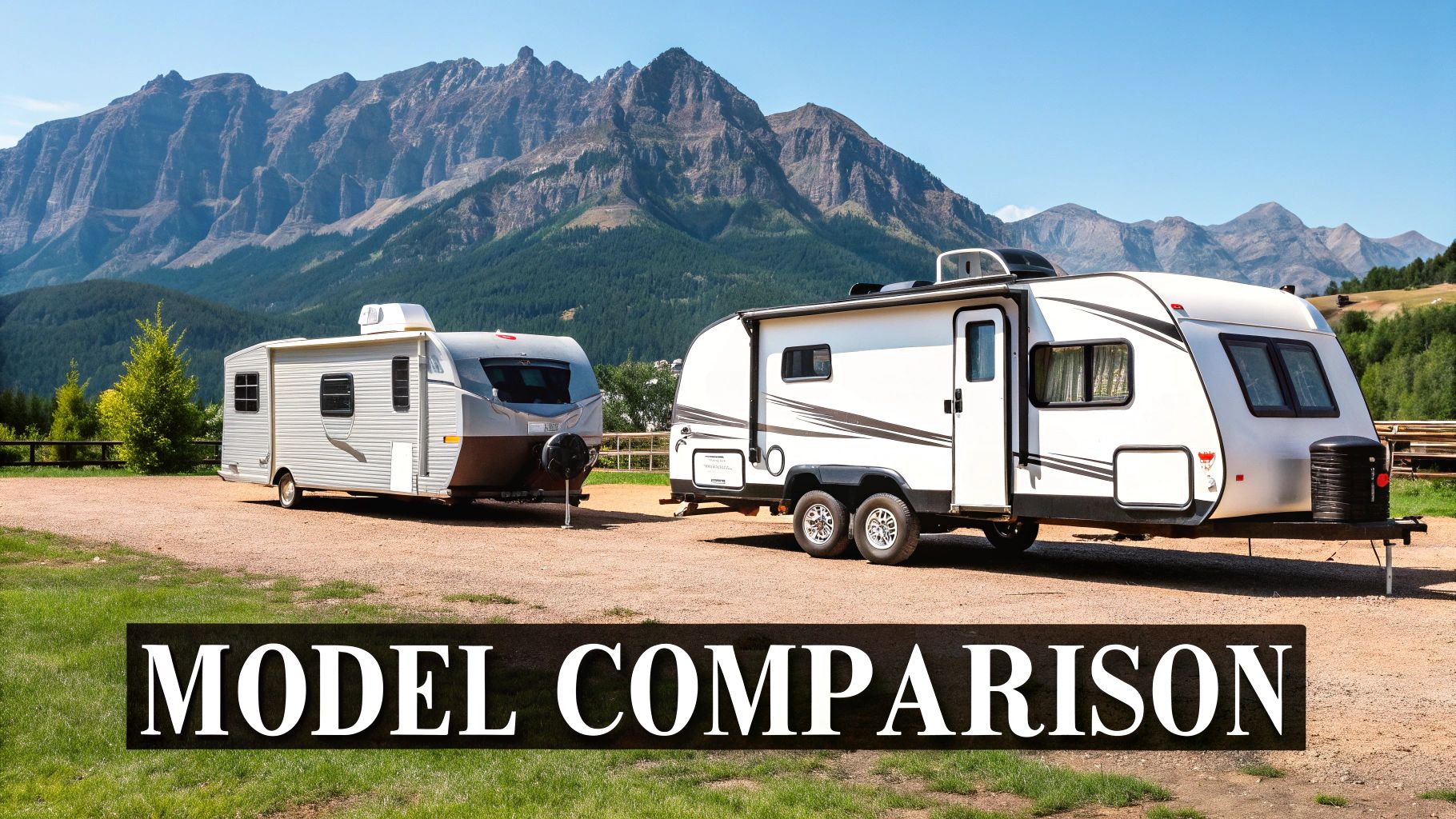
The Jayco Jay Flight is practically an institution in the family camping world, and for good reason. It’s built on a bedrock of reliability and common sense, earning a reputation as a workhorse that can handle the chaos of family life, year after year. This is the trailer many families start with—and many never leave.
Its construction is a huge part of its appeal. With an integrated A-frame and the Magnum Truss Roof System, the Jay Flight is simply built to last. That sturdy build gives you incredible peace of mind when you're miles from civilization, knowing your rig can handle bumpy backroads and a sudden storm.
The trade-off? The Jay Flight’s design is definitely traditional. While other brands are chasing modern farmhouse sinks and sleek, minimalist interiors, Jayco sticks to a proven, function-over-form approach. Some will see it as dated; others will see it as comforting and timeless.
Real-World Scenario
You’re a family of four heading to a state park for a long weekend. You've got to pack bikes, a big cooler, camp chairs, and a portable grill. The Jay Flight’s huge pass-through storage swallows it all with room to spare. Inside, the double-over-double bunks give the kids their own sturdy space, and the bathroom’s tub makes hosing them down after a muddy hike a whole lot easier than a tiny stand-up shower.
Key Differentiator: The Jayco Jay Flight’s true advantage lies in its proven durability and practical, family-first design. Little things like the standard tub/shower combo and plywood-decked beds aren't flashy, but they show a deep understanding of what families actually need.
Best For: Families who put reliability and solid construction ahead of cutting-edge design. It's a fantastic choice for first-time buyers and anyone who plans on putting their trailer through its paces at state and national parks.
Grand Design has shot to the top of many wish lists by focusing on higher-end finishes and smart, residential-style features. The Imagine series, in particular, nails that sweet spot between lightweight towability and the comforts of home, making it a powerful contender for today's family.
Step inside an Imagine, and it just feels different. The lighter wood tones, massive panoramic windows, and quality hardware make it feel less like a camper and more like a small, modern apartment on wheels. That attention to aesthetics makes a huge difference on longer trips or those rainy days when everyone’s stuck inside.
Grand Design also sweats the small stuff, and it shows. You’ll find details like pet food bowls built into drawers, motion-sensor lights in key spots, and USB ports everywhere you look. These thoughtful touches reveal a keen sense of how modern families actually live and travel.
Real-World Scenario
Think of a family with two teenagers who need their own space and their devices charged at all times. The Imagine’s bunkhouse models often come with separate storage cubbies and USB ports for each bunk. The huge U-shaped dinette gives everyone room for game night, and the well-designed kitchen—often with a deep, single-basin sink—makes cooking feel like less of a chore.
Key Differentiator: The Grand Design Imagine stands out with its residential-quality interior and innovative, user-friendly features. The blend of modern style with practical perks like their 4-season protection package creates a living space that’s both comfortable and incredibly functional.
Best For: Families who believe interior comfort and modern design are just as important as what's on the outside. It’s perfect for those planning longer journeys or who simply want their travel trailer to feel like a true home away from home.
To help you see the differences at a glance, we've put together a quick comparison of our top picks.
This table offers a clear visual breakdown of our top-rated models, focusing on the metrics that matter most to families.
| Model |
Ideal For |
Sleeps Up To |
Unloaded Vehicle Weight |
Standout Family Feature |
| Jayco Jay Flight |
Rugged, reliable camping |
10 |
5,500 - 7,500 lbs |
Magnum Truss Roof & rock-solid construction |
| Grand Design Imagine |
Modern comfort & extended trips |
8 |
5,800 - 7,000 lbs |
Residential finishes & panoramic windows |
| Forest River Salem |
Budget-conscious versatility |
10 |
6,000 - 8,000 lbs |
Versa-Lounge seating & large slide-outs |
As you can see, each model brings something unique to the campsite, catering to different priorities and travel styles.
Forest River is a giant in the RV industry, and its Salem lineup is famous for packing in a ton of features and space for the money. If your main goal is to get the most living area and sleeping capacity without emptying your bank account, the Salem is where you should start your search.
The killer feature in many Salem models is the Versa-Lounge. This brilliant seating system can be reconfigured in multiple ways, transforming from a huge L-shaped sofa into a massive bed. For families, this flexibility is a game-changer, letting the main living area adapt to whatever you need—lounging, dining, or sleeping.
Of course, to hit that attractive price point, there are some trade-offs in materials compared to more premium brands. You might notice simpler finishes or less robust cabinet hardware. But Forest River more than makes up for it by loading these trailers with features people want, like large slide-outs, outdoor kitchens, and oversized refrigerators.
Real-World Scenario
Picture a big family or one that loves bringing friends along. A model like the Salem 31KQTSX has opposing slides in the rear bunk room, creating a massive, dedicated kids' lounge that feels like a separate apartment. That separation of space is priceless. During the day, the main Versa-Lounge provides seating for the whole crew, and at night, it easily converts to sleep extra guests.
Key Differentiator: The Forest River Salem's superpower is its ability to deliver maximum space and versatile layouts at a price that’s hard to beat. The Versa-Lounge, in particular, offers a level of floor plan flexibility you just don't see in other trailers.
Best For: Large families or anyone on a budget who needs to maximize every square inch of interior space. Its innovative layouts make it a fantastic choice for those who want a big, adaptable living area above all else.
Before you fall in love with a floor plan, let's talk about the most important part of buying a family travel trailer: the real cost. The sticker price is just the starting point. I've seen too many families get in over their heads because they only planned for the monthly payment, not the total cost of ownership. The best RV for your family is one you can actually afford to use.
The initial price tag can swing wildly. You might see a brand-new, entry-level bunkhouse model for around $25,000, which sounds great. But a slightly larger model with a few more creature comforts can easily jump to $45,000 and beyond. Going with a used travel trailer can definitely save you a chunk of cash upfront, but you have to be ready for potential repairs—that fridge or water heater might be on its last legs.
Getting the keys is one thing; getting on the road is another. The real budget needs to account for all the extra expenses that pop up before your first trip. First-time buyers often get blindsided by these, so let's lay them out.
- Financing and Insurance: Most people don't buy an RV with cash, so you'll have a loan, typically for 10 to 15 years. What you pay in interest depends on your credit. On top of that, RV insurance is a must-have, and it usually runs between $500 to $1,500 per year, based on the trailer's value and your driving history.
- Taxes and Fees: Get ready for sales tax, title and registration fees, and whatever "documentation" fee the dealership adds on. These can easily tack on a few thousand dollars to the final bill, so ask about them upfront.
Here's a solid piece of advice I always give new buyers: plan to spend an extra 10-20% of the RV's purchase price just on initial gear and setup costs. Having that cushion means you won't be stressed and can hit the road with everything you need.
Once the trailer is yours, the expenses shift from one-time costs to ongoing ones. This is just part of the RV lifestyle, so building these into your budget is key. For a deeper dive, check out our guide on how much an RV costs with essential budget tips.
Annual and Trip-Related Costs:
- Maintenance: A good rule of thumb is to budget 1-2% of the RV's value each year for upkeep. This is for things like resealing the roof, checking tires, and winterizing the plumbing—all critical tasks you can't ignore.
- Campground Fees: This is a big one. A spot at a state park might be $30 a night, but a fancy RV resort could be over $100. Those nights add up fast on a long trip.
- Storage: If you don't have space at home, you'll need to pay for storage. Depending on where you live, that could be anywhere from $50 to $200 a month during the off-season.
Finally, there's the gear. You can't just hitch up and go; you need to outfit your rig for it to be safe and comfortable.
Essential Gear Budget:
- Safety First: Don't even think about skipping this. A quality weight distribution hitch with sway control is non-negotiable for safe towing. Expect to spend $500 - $1,000.
- Setup Essentials: You'll need the basics to get parked and hooked up. This means leveling blocks, wheel chocks, a sewer hose kit, a dedicated freshwater hose, and a surge protector. Budget another $300 - $600 for this stuff.
- Interior Furnishings: Now for the inside—all the kitchen gear, bedding, towels, and bathroom supplies. This can add up faster than you think, so make a list and price it out.
Picking the best travel trailer for your family goes way beyond just the floor plan. It’s really about finding a rig that fits how you actually travel. The perfect camper for a family that loves quick weekend getaways is almost always the wrong choice for one planning epic, cross-country treks or off-grid adventures. When a trailer’s features line up with your travel habits, you've found the key to happy camping.
Knowing your family's travel profile helps you cut through the noise of hundreds of models and zero in on the ones that will actually work for you. Let's look at three common travel styles and the features that really matter for each.
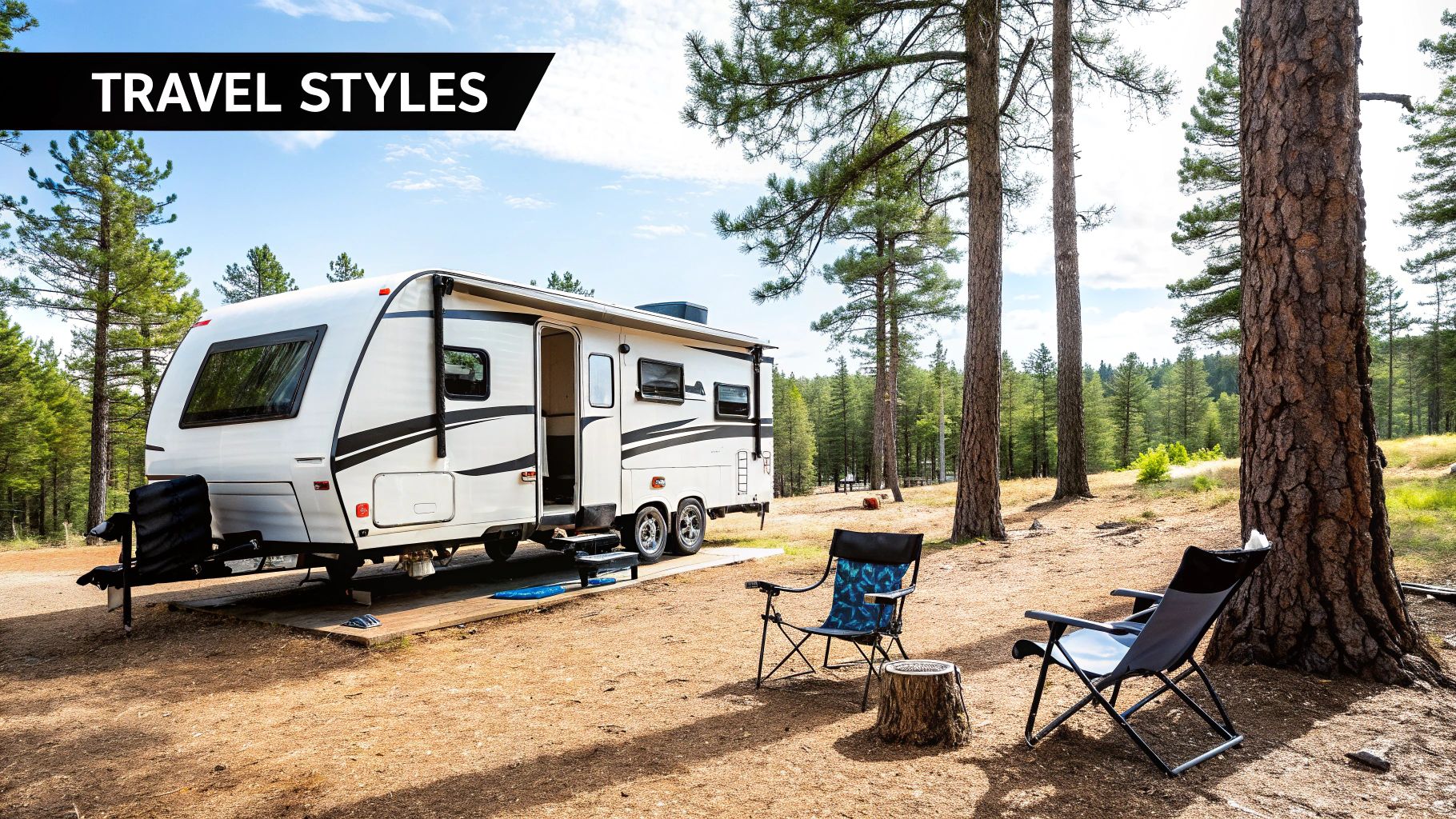
This is the family that’s always ready to hit the road for a short, action-packed trip. You’re likely heading out Friday after work and coming back Sunday evening, which means efficiency is the name of the game. Your time is limited, so you don't want to spend it wrestling with a complicated setup or dragging a huge trailer for just two nights.
For this kind of travel, a lightweight build is your best friend. A trailer with a lower dry weight, typically under 5,000 pounds, is much easier to hitch up and pull, especially with a mid-size SUV or a smaller truck. A simple setup process is just as important. Look for models without a bunch of complex slide-outs to dramatically cut down your setup and takedown time.
Key features for Weekend Warriors:
- Lightweight Build: Go for a trailer that's easy to tow. It saves on fuel and makes the whole travel day less stressful.
- Efficient Setup: Models with manual awnings and fewer slides get you from parked to relaxing in minutes.
- Functional Outdoor Kitchen: An outdoor griddle and mini-fridge mean less mess inside and more time enjoying the fresh air.
- Simple Bunkhouse: Basic double-over-double or single bunks are perfect for short trips and don't require a dedicated, walled-off room.
If your family is dreaming of coast-to-coast road trips or spending an entire month exploring a national park, your needs are totally different. Comfort, storage, and solid construction become the top priorities. You're not just camping anymore—you're living in this trailer for weeks or months at a time.
For these marathon journeys, you'll want all the comforts of home. That means searching for trailers with larger refrigerators (at least 10 cubic feet), a truly comfortable sofa or theater seating, and a private main bedroom with a real queen or king bed. Storage is everything. You'll need deep pantries, big wardrobes, and cavernous exterior pass-through compartments to hold all the gear a long trip demands.
When you're on the road for a while, the feel of the trailer is just as important as the features. I always recommend looking for models with big panoramic windows and lighter interior colors. It makes the space feel open and keeps you from feeling cooped up on rainy days.
For families who want to escape the crowds and find true solitude, boondocking is the ultimate adventure. This off-grid style of camping requires a trailer that can take care of itself and handle some rougher terrain. You're giving up campground hookups for total freedom, so your RV has to be ready for the challenge.
The single most important feature for a boondocking rig is its water capacity. You should be looking for a fresh water tank that holds at least 50 gallons. Solar power is a close second. While many trailers come with "solar prep," what you really want is a factory-installed system with at least a 200-watt panel and an inverter to keep your batteries topped off.
Finally, think about the build itself. Boondocking often means bumping down unpaved roads. Higher ground clearance and beefier, all-terrain tires are incredibly valuable—they’ll protect your trailer's underbelly and give you the confidence to explore those amazing, out-of-the-way spots.
Picking the right travel trailer for your family can bring up a lot of questions. As you get closer to making a choice, you're probably drilling down into the practical details that will make or break your trips. Let’s clear up some of the most common things families ask so you can choose with total confidence.
Think of this as your final gut-check before you hitch up and hit the road.
For a family of four or five, the sweet spot is almost always a travel trailer between 25 and 35 feet long. This range hits that perfect balance between having enough living space and not being a total beast to tow.
A trailer in this size category usually has room for a dedicated bunk area for the kids, a separate main bedroom for the parents, and a living space that doesn't feel cramped. Just as important, it's still a manageable size for towing without needing a heavy-duty truck, and it will fit into most campsites at state and national parks, which often have length restrictions.
Don't get fixated on length alone. The layout is what truly matters. A smartly designed 28-foot trailer can feel way more spacious and functional for a family than a poorly planned 32-foot model.
This is easily the most critical safety question you need to answer, and the information is waiting for you in your vehicle's owner's manual. Find the maximum towing capacity, but understand that number is the absolute limit in perfect conditions.
The safest rule of thumb—and one you’ll hear from experienced RVers everywhere—is to make sure your trailer's Gross Vehicle Weight Rating (GVWR) is no more than 80% of your vehicle's max tow rating. The GVWR isn't the empty weight; it's the maximum weight of the trailer fully loaded with water, gear, food, and everything else. That 20% buffer is your safety margin for handling steep grades, strong crosswinds, and sudden stops.
Bunkhouses are, by far, the most popular choice for families, and for good reason. They give kids their own dedicated space, which is a huge win for privacy and keeping the peace. But no, they aren't your only option.
Depending on how

