When you're trying to pick the best RV, the conversation almost always lands on a few heavy hitters. You've got Winnebago pushing the envelope with clever designs, Airstream with its legendary durability, and Grand Design earning fans for its focus on what customers actually want. The right brand for you really boils down to how you travel, what you're willing to spend, and what you value most.
Before we get into the nitty-gritty of specific models, it’s important to pull back the curtain on the RV industry itself. It’s not a scattered landscape of independent shops. Instead, a handful of massive parent companies own most of the brands you see on the dealership lot. This setup has a huge impact on everything from how an RV is built to the kind of service you get after the sale.
The two giants in the room are Thor Industries (the parent company of Airstream, Jayco, and Keystone) and Forest River (owned by Berkshire Hathaway). Once you know who owns who, you start to see the family resemblances in build quality, features, and even how warranty claims are handled across different brand names.
| Parent Company |
Notable Brands Owned |
Primary Market Focus |
| Thor Industries |
Airstream, Jayco, Keystone, Dutchmen |
A massive portfolio covering everything from starter travel trailers to high-end Class A motorhomes. |
| Forest River Inc. |
Rockwood, Flagstaff, Coachmen, Puma |
Dominates the market with an enormous selection of towable and motorized RVs. |
| Winnebago Industries |
Winnebago, Grand Design, Newmar |
Known for innovation, solid construction, and building intense customer loyalty. |
So, what does this all mean for you? Well, brands under the same corporate umbrella often share parts, building techniques, and even customer service systems. You might find two travel trailers that look completely different but are built on the exact same frame or use the identical slide-out mechanism. This isn't a bad thing, just something to be aware of as you shop around.
The RV market has absolutely exploded, driven by a huge wave of interest in getting outdoors and traveling more flexibly. It's clear the industry has grown far beyond its old-school roots.
This boom isn’t just a fad; it’s tied to major shifts in how we live and work, like the rise of remote jobs and a renewed love for exploring our own backyards. The industry's valuation is on track to hit $21.8 billion in 2025, with sales revenue projected at $35.9 billion for that same year. Looking ahead, the global market is expected to reach a staggering $69 billion by 2032. You can dig deeper into these RV marketing statistics on amraandelma.com.
Understanding this backdrop helps you see past the glossy brochures and get a real sense of where each brand fits. It makes the comparisons that follow a whole lot more meaningful.
Picking a great RV goes way beyond comparing sticker prices or being wowed by flashy features at a trade show. To give you a genuinely useful guide, we've developed a clear framework that cuts through the marketing fluff and hones in on what actually matters when you're out on the road.
Think of this as your personal checklist. It’s a method for looking at any RV with a critical, experienced eye and knowing exactly what questions to ask the dealer.
To help you get started, here's a quick look at the core factors we use in every one of our evaluations.
| Evaluation Criterion |
What to Look For |
Why It Matters |
| Build Quality & Construction |
Frame integrity, wall/roof materials, insulation type, component quality. |
Determines long-term durability, safety, and how well the rig holds up to travel and weather. |
| Floorplan Design & Usability |
Traffic flow, accessibility with slides in, storage solutions, kitchen prep space. |
A well-designed floorplan makes daily living comfortable and practical, not just functional. |
| Post-Purchase Support |
Warranty length and terms, manufacturer's reputation for honoring claims. |
Problems will happen. Good support means less stress and faster repairs, getting you back on the road. |
| Owner Satisfaction & Reliability |
Real-world owner reviews, forums, and dealer satisfaction awards. |
The collective experience of thousands of owners provides the best insight into long-term reliability. |
This table is your starting point. Now, let’s dig a little deeper into what each of these criteria really means for you as a buyer.
The foundation of any good RV is how it’s put together. We're not talking about the fancy backsplash or the plush sofa; we're talking about the bones. It's the stuff you can't always see that determines whether your investment will last for a few seasons or for decades.
Here’s what we zero in on:
- Frame and Chassis: Is it a solid, well-welded frame? We look for clean welds and proper rust protection. The chassis is quite literally the backbone of your home on wheels, and it's no place to cut corners.
- Wall and Roof Construction: How are the walls made? Laminated or hung fiberglass? What kind of insulation is inside—block foam or cheaper fiberglass batting? The roof material is just as crucial, whether it's TPO, EPDM, or fiberglass.
- Component Quality: This is where the details matter. We inspect everything from the grade of the PEX plumbing and the guts of the slide-out mechanisms to the feel of the cabinet hardware.
A well-built RV just feels different. The floor is firm when you walk on it. Cabinet doors don't feel flimsy. Those little things add up to a much more satisfying—and less frustrating—ownership experience.
A great floorplan can make a tiny trailer feel spacious, while a poorly designed one can make even a 40-foot motorhome feel cramped and awkward. We look past the simple bed count and evaluate how the layout actually works in the real world.
We ask the practical questions. Can you get to the fridge and the bathroom with the slides pulled in for a quick roadside stop? Is there enough counter space to actually cook a meal? Does the living area feel like a place you want to relax, or is it just furniture crammed into a box?
A great floorplan is more than a diagram—it's a thoughtful design that anticipates the rhythm of daily life on the road. It understands that storage needs to be accessible, traffic flow must be natural, and living spaces need to be truly livable.
Post-Purchase Support and Warranty
What happens after you sign the papers and drive away is just as important as the sale itself. An RV is a house on wheels, full of complex systems, and things will eventually need fixing. This is where a manufacturer's true colors show.
We evaluate brands on their reputation for handling warranty claims. Do they stand behind their product, or do owners get stuck in a bureaucratic nightmare? We also look closely at the warranty itself. Brands like Jayco, for instance, are known for their two-year limited plus three-year structural warranty, which offers a lot more peace of mind than the one-year standard common across the industry.
Finally, we turn to the real experts: the people who own these RVs. We comb through long-term owner satisfaction data, dig into forum discussions, and check feedback from across the RV community. Official honors like the Recreational Vehicle Dealers Association (RVDA) Quality Circle Awards are also a fantastic resource, as they reflect how happy dealers are with a brand's quality and support.
This collective wisdom is invaluable. It quickly reveals which brands consistently build a reliable product and which ones seem to have recurring problems. By blending our own analysis with thousands of real-world experiences, we get a complete picture of what you can truly expect from any RV brand.
Now that we know what to look for, let's put the industry's biggest names under the microscope. This is where the rubber meets the road, moving from checklists to a real-world look at how the best RV brands actually stack up. We'll get into what truly sets each manufacturer apart and connect their core philosophies to the kind of travel you want to do.
The goal here is to see past the glossy brochures and pinpoint the brand that genuinely clicks with your vision for quality, comfort, and long-term enjoyment. Let’s dive into the distinct personalities of these top contenders.
You can spot an Airstream from a mile away. It's easily the most recognizable RV on the planet, but that polished aluminum "silver bullet" design is about more than just stunning looks—it’s the foundation of its legendary durability. The semi-monocoque shell is incredibly tough, which helps explain the incredible statistic that an estimated 75% of all Airstreams ever built are still on the road.
Of course, that kind of longevity comes with a premium price tag. Every Airstream is handcrafted in Jackson Center, Ohio, with an obsessive focus on high-quality materials and construction. The result is a travel trailer or touring coach that fights off leaks like a champ and holds its value far better than almost anything else on the market. The tradeoff? That iconic curved body means you'll sacrifice a bit of interior space compared to a standard box-shaped trailer.
- Ideal Buyer Profile: The design-conscious traveler who sees their RV as a long-term investment. It's perfect for couples or solo adventurers who put timeless style and bulletproof build quality ahead of maximizing every last square inch of living space.
- Situational Recommendation: If you plan to keep your RV for decades, maybe even pass it down, Airstream's proven track record is second to none.
For generations, the name Winnebago has been synonymous with the RV lifestyle itself. While they offer a full lineup of towables, the company's heart and soul is in its motorized RVs—especially Class A, B, and C motorhomes. The brand built its reputation by constantly pushing the envelope with clever floorplans and genuinely useful features.
They were one of the first to apply automotive-style manufacturing to RV construction, leading to a more consistent and reliable final product. Winnebago is especially praised for its smart use of space. They somehow manage to create highly functional, livable layouts even in their most compact models, like the wildly popular Class B camper vans.
Winnebago’s magic lies in its ability to blend legacy brand trust with forward-thinking design. They consistently roll out floorplans and tech that solve the real-world problems of modern RVers, from better off-grid power systems to more versatile living spaces.
Their post-purchase support is another huge plus. With a massive, well-established dealer network, finding service or parts while you're thousands of miles from home is far less of a headache. They have a solid reputation for standing behind their products.
Grand Design RV is a great example of a newer company—founded in 2012 and now part of the Winnebago family—that absolutely rocketed to the top. How? By doing one thing exceptionally well: listening to what RV owners actually wanted. Their designs are born from countless hours of customer feedback, directly addressing the common annoyances and pain points that other brands seemed to ignore.
You can see this customer-first approach everywhere. They install more user-friendly universal docking stations, deeper kitchen sinks, and beefier insulation packages. Grand Design is also famous for its rigorous pre-delivery inspection (PDI) process, which is designed to catch flaws before an RV ever leaves the factory floor.
This dedication to quality control and customer satisfaction has earned them a shelf full of RVDA Quality Circle Awards, which are voted on by dealers. When the folks who sell and service the RVs have that much confidence in a brand, it speaks volumes.
This image shows how even a budget-friendly RV can create an incredible outdoor experience when it's set up in a beautiful spot.
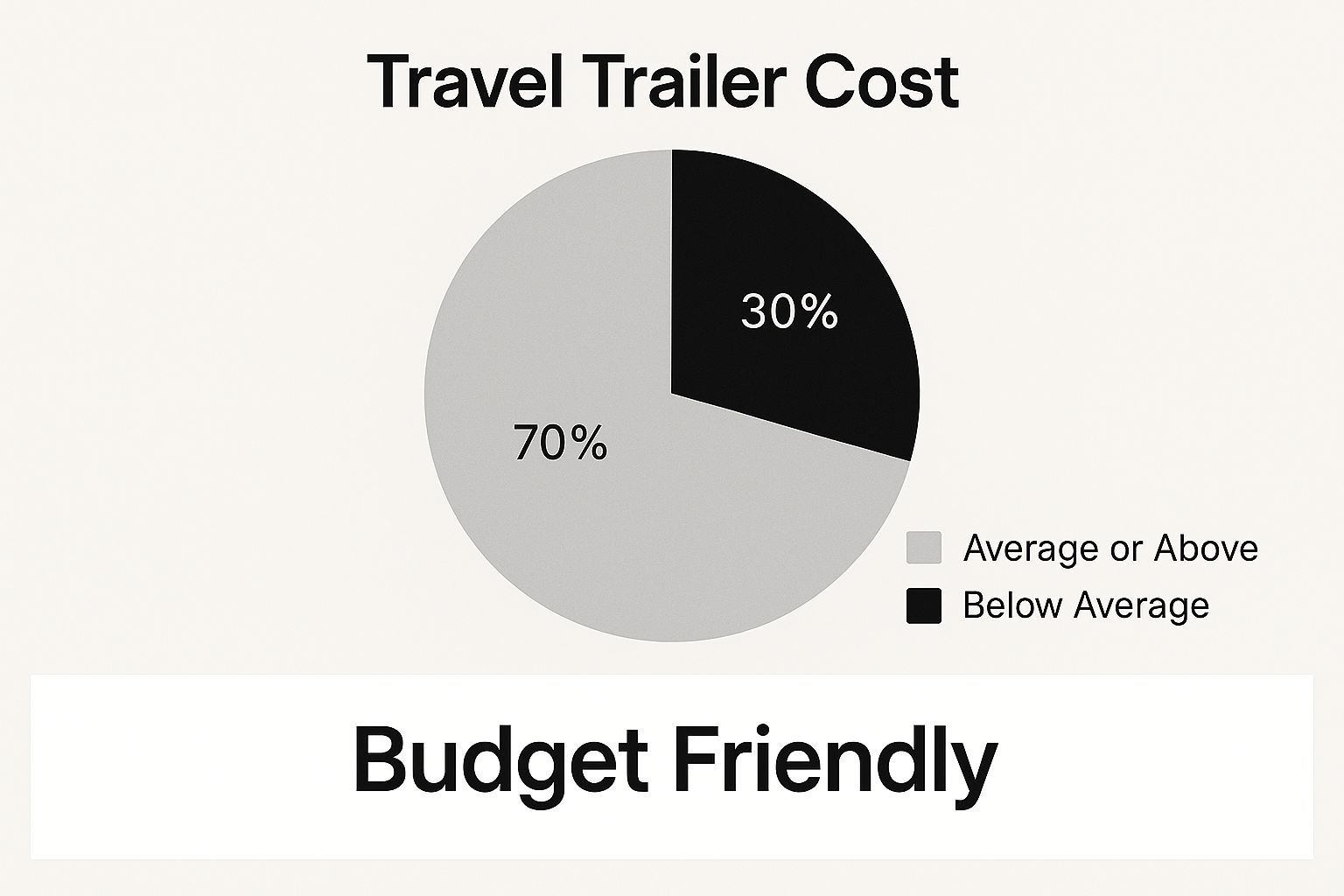
It’s a great reminder that the "best" RV isn't always the most expensive; it's the one that lets you have the adventures you've been dreaming of.
When you start talking about high-end Class A diesel pushers, the name Tiffin Motorhomes inevitably comes up. This family-owned company out of Red Bay, Alabama, is legendary for two things: incredible craftsmanship and customer service that feels more like joining a family. They even build their own chassis (the PowerGlide) and fabricate many of their own components, giving them tight control over quality from the ground up.
But what truly makes Tiffin special is its culture of owner support. The "Camp Tiffin" service center in Red Bay is an institution. Owners can bring their coaches for repairs and upgrades and often find themselves talking directly with members of the Tiffin family. This personal, hands-on approach has cultivated one of the most passionate and loyal owner communities in the industry.
While their main game is luxury Class A motorhomes, they've also brought that same commitment to quality to their Class C and "Super C" models.
Sitting at the very peak of the luxury RV market, Newmar has carved out a name for itself with uncompromising build quality and game-changing innovations. Like Tiffin, Newmar is a premium brand, but they set themselves apart with patented engineering and a much greater willingness to do factory customizations for buyers who know exactly what they want.
Newmar's engineering really stands out with features like:
- The STAR Foundation: This is a heavy-duty steel superstructure welded right to the chassis. It adds immense strength and stops the flexing and twisting that can plague other large motorhomes over time.
- Comfort Drive™ Steering: An exclusive piece of tech that makes driving a 45-foot coach feel surprisingly easy. It actively corrects for crosswinds and road crowning, which dramatically reduces driver fatigue on long trips.
- Full-Paint Masterpiece™ Finish: Instead of standard gel coats, Newmar uses a multi-stage, automotive-grade paint process. The result is a stunning, deep finish that’s far more durable and resistant to fading.
Newmar's focus on residential-grade construction and insulation makes their coaches a top choice for full-timers who need true four-season comfort.
You simply can't talk about the RV landscape without mentioning the 800-pound gorilla: Forest River Inc. As of 2025, Forest River is the undisputed sales leader in North America, capturing around 29.8% of the market by selling 80,946 units. Founded in 1996 by Peter Liegl and acquired by Berkshire Hathaway in 2005, the company has the financial muscle to dominate. You can learn more about the biggest players from this breakdown of top RV manufacturers on Bishs.com.
That massive scale means Forest River offers something for absolutely everyone. With dozens of sub-brands like Rockwood, Flagstaff, Cedar Creek, and Coachmen, they cover every RV type, floorplan, and price point imaginable. Their core strength is delivering incredible value and a dizzying array of choices. They may not build bespoke luxury coaches like Newmar or Tiffin, but they excel at producing feature-rich, reliable RVs that have made the lifestyle possible for millions of people.
To help pull all this together, here’s a simple table that gives you a quick snapshot of where each of these top manufacturers fits into the bigger picture.
| Brand |
Price Bracket |
Known For |
Ideal Buyer Profile |
| Airstream |
Premium to Luxury |
Iconic design, durability, high resale value |
The style-conscious buyer seeking a long-term investment. |
| Winnebago |
Mid-Range to Premium |
Innovation, reliable motorized RVs, strong dealer network |
The traveler who values modern features and proven reliability. |
| Grand Design |
Mid-Range to Premium |
Customer-driven design, quality control, excellent support |
The practical RVer who prioritizes livability and reliability. |
| Tiffin |
Premium to Luxury |
Class A craftsmanship, exceptional customer service |
The motorhome buyer seeking quality and a family-like support system. |
| Newmar |
Luxury |
Patented technology, residential quality, customization |
The full-timer or discerning buyer demanding the best in comfort and engineering. |
| Forest River |
Entry-Level to Premium |
Massive selection, market dominance, value for money |
The buyer seeking the best features and floorplan for their budget. |
In the end, choosing the right RV brand is a deeply personal decision. But by understanding the core strengths and philosophies of these industry leaders, you're in a much better position to find the perfect rig for your own unique adventure.
All the technical specs and brand reputations in the world are only half the battle. The best RV brand for you is the one that simply works with your life, letting you focus on the adventure itself. It’s really about finding the right tool for your specific job.
So, let's shift gears from a brand's general reputation to how its strengths actually line up with your travel habits. A manufacturer known for building massive, luxurious fifth wheels is probably a terrible fit for someone who loves spontaneous weekend trips to remote state parks. Let’s look at a few common RVer profiles to see how this plays out in the real world.
These are the folks who pack up and go. They’ve got a traditional job and use their RV for frequent, shorter getaways to state parks, national forests, and local campgrounds. For them, it’s all about the destination and the activities—not lounging inside the rig all day.
Maneuverability and a quick setup are everything. They need something that can squeeze into tight campsites, handle winding backroads, and be adventure-ready in minutes. Huge water tanks and cavernous storage aren't nearly as important as a reliable, nimble rig.
- Top Brand Considerations:Airstream, especially smaller models like the Basecamp or Bambi, brings incredible durability and easy towing to the table. Jayco is another fantastic choice, particularly its lightweight Jay Feather series, which offers solid reliability and a great two-year warranty for peace of mind.
- Key Features to Prioritize: Look for lightweight construction, smart, compact floorplans, and quick-connect utilities. An off-road package with better ground clearance can be a game-changer.
For a full-timer, the RV isn't a vacation vehicle—it's home, plain and simple. This completely changes the requirements, demanding a much higher standard for durability, four-season living, and residential comforts. The rig has to be built to handle the constant stress of daily life on the road.
Storage is king here. We’re talking a big pantry, a real wardrobe, and massive basement bays for tools and gear. Excellent insulation, dual-pane windows, and a powerful HVAC system are absolutely essential for staying comfortable in a Texas heatwave or a Colorado snowstorm. For this RVer, build quality isn’t a nice-to-have; it's the foundation of a sustainable lifestyle.
Choosing an RV for full-time living is less like buying a car and more like building a custom home. Every detail, from the chassis construction to the grade of the plumbing fixtures, has a direct impact on your daily quality of life and long-term costs.
- Top Brand Considerations:Grand Design has earned a loyal following in the full-time community. Their Solitude and Reflection fifth wheels are known for customer-focused designs, great insulation, and residential touches. For those wanting the best of the best, Newmar and Tiffin build Class A motorhomes with residential-grade construction engineered from the ground up for constant use.
- Key Features to Prioritize: You need high R-value insulation, large holding tanks, a robust suspension system, and tons of storage inside and out. Solar prep and a good generator are also critical for off-grid flexibility.
Families on the go have their own unique checklist, and it’s all about space, safety, and function. The perfect family rig has to sleep everyone comfortably without making you feel like you're stuck in a sardine can on a rainy day. This is where bunkhouse floorplans really shine.
Durability is a big deal, because kids and pets are tough on an interior. Systems also need to be user-friendly—parents have enough to worry about. Easy-to-operate awnings, simple control panels, and accessible storage make the whole experience smoother. Most importantly, safety features like sturdy entry steps and well-placed grab handles are non-negotiable.
- Top Brand Considerations:Keystone RV offers a huge lineup of family-friendly models like the Cougar and Outback, which are famous for their innovative bunkhouse layouts. In the same vein, Forest River brands like Rockwood and Flagstaff make dependable trailers and fifth wheels with dozens of floorplans designed specifically with families in mind.
- Key Features to Prioritize: Bunkhouse models are a must. Also look for a large refrigerator, an outdoor kitchen, durable upholstery, and a spacious living area. A second bathroom or a U-shaped dinette that can seat the whole crew can be a major win.
Picking out the perfect rig from one of the best RV brands is thrilling, but that's just the starting line. To truly enjoy life on the road without regrets, you need a clear-eyed view of what you're signing up for, both financially and practically. Getting a handle on the full picture from the get-go helps you budget realistically and sidestep the common traps that turn a dream adventure into a source of stress.
The sticker price is just the first number you'll see, and it's rarely the last. Think of it as your down payment on the lifestyle. The real cost of RVing comes from the ongoing expenses that keep you rolling.
The true cost of owning an RV isn't what you pay at the dealership; it's the sum of all the bills that come after. These aren't just small incidentals—they can add up to a serious chunk of your annual budget. Being ready for them is what separates a happy RVer from a frustrated one.
Here’s a rundown of the major costs you need to plan for:
- Insurance: This is non-negotiable. RV insurance is a unique blend of auto and home coverage, so it costs more than a standard car policy. The final price depends on your rig's class, its value, and your driving history.
- Maintenance: An RV is a rolling house, which means you have two sets of systems to maintain. You've got engine service and tire rotations on one hand, and roof seals, slide-out mechanisms, and appliance upkeep on the other. It's constant.
- Repairs: Things break. It's not a matter of if, but when. One day it's the water heater, the next it might be a slide-out motor. Having a dedicated repair fund isn't just smart; it's essential.
- Storage: If you don't have a place to park your RV at home, you'll be paying for storage, especially in the off-season. This can run anywhere from a few hundred to several thousand dollars a year, depending on where you live and whether you choose covered or uncovered options.
Depreciation is the silent killer of your RV's value. Unlike a house, an RV is a depreciating asset. It loses a huge chunk of its worth the second you drive it away, often dropping by 20% in the first year alone.
The RV market has its own rhythm, shifting with economic winds, supply chain hiccups, and what's popular at the moment. For example, the U.S. RV industry saw wholesale shipments drop by about 36.5% between 2023 and 2025 as the market corrected itself.
Even with those dips, the appeal of RVing is stronger than ever. As of 2021, 11.2 million American households owned an RV—that’s a massive 62% jump from 2001. You can find more RV industry statistics on ConsumerAffairs.com.
What this tells us is that while production numbers might bounce around, the core desire for the RV lifestyle is here to stay. Watching these market cycles can help you time your purchase for a better deal or prepare for limited inventory. By going in with a realistic understanding of everything—from depreciation and market trends to the nuts and bolts of maintenance—you're setting yourself up for an incredible journey.
Stepping into the world of RVs can feel overwhelming. With so many brands out there, it’s natural to have questions. Getting the right answers is the first step toward choosing a rig you’ll love for years to come.
Let's tackle some of the most common questions we hear from buyers trying to sort through the best RV brands on the market.
What Really Separates a Luxury RV from an Entry-Level One?
You might think the difference between a luxury brand and a budget-friendly one comes down to granite countertops and bigger TVs, but the real story is in what you can't see. High-end manufacturers like Newmar or Tiffin pour money into the foundation—things like a beefier chassis, better insulation, and a much more intensive quality control process. This translates to a quieter ride and a rig that’s genuinely built to withstand the rigors of full-time living.
Entry-level brands, on the other hand, are masters of packing in features at an accessible price point. They get you on the road and into the lifestyle

