When you start looking at Class C RV motorhomes for sale, you'll quickly realize they occupy a fantastic middle ground. They have enough space for the family but drive more like a truck than a bus, which makes them far less intimidating for newcomers. This guide will walk you through everything you need to know, from figuring out your budget to kicking the tires on your potential new home-on-wheels.
Diving into the market for a Class C motorhome is an exciting step toward adventure, but it's also easy to get bogged down by all the choices out there. The secret to a smart purchase is to break it down into smaller, more manageable steps. Before you even set foot on a dealer's lot or start scrolling through online listings, you need a solid grasp of what you truly need and, just as importantly, what you can actually afford.
This upfront planning is the most important part of the whole process. It's what keeps you from getting distracted by a shiny feature you'll never actually use or, worse, stretching your finances too thin. When you define your priorities from the get-go, you can cut through the clutter and zero in on the motorhomes that are a genuine fit for your travel style and budget.
Alright, let's get practical. A Class C RV isn't just a vehicle; it's a major investment in your future travels. Your budget needs to cover more than just the sticker price—think about the ongoing costs like insurance, regular maintenance, fuel, and even where you'll store it when you're not on the road.
At the same time, you have to be honest about how you plan to use the RV. The way you travel will dictate the features that matter most.
- Family Adventures: If you're bringing the kids along, you'll want to focus on bunkhouse models or floor plans that offer multiple, dedicated sleeping areas.
- Couples' Getaways: For two people, a layout with a comfortable primary bedroom and a cozy living space will probably be more appealing than a bunch of extra beds.
- Weekend Escapes: If you're mainly planning shorter trips, a smaller, more maneuverable Class C without massive storage tanks might be the perfect fit.
- Full-Time Living: For those dreaming of life on the road, things like maximum storage, heavy-duty construction, and residential-style appliances suddenly become non-negotiable.
A Class C motorhome is a compromise between the drivability of a van and the living space of a bus. Its signature cab-over bunk and truck-based chassis make it an incredibly adaptable platform for nearly any travel dream.
Getting a clear handle on these core needs turns your search for Class C RV motorhomes for sale from a massive, overwhelming task into a focused, efficient hunt. It’s the surest way to find the rig that’s ready for all your adventures ahead.
When you first start looking at Class C RV motorhomes for sale, it helps to think of them as the versatile SUVs of the motorhome world. They strike a great balance between space, comfort, and drivability, which is why they’re so popular with just about everyone—from families on weekend getaways to couples exploring the country full-time. A big part of their appeal is that they’re built on a foundation that feels surprisingly familiar.
Unlike the massive, bus-like Class A motorhomes, a Class C is built on a truck or a "cutaway" van chassis. This simply means the front end—the cab, the engine, the controls—is pretty much the same as a heavy-duty truck you’d recognize, like a Ford E-Series or a Mercedes-Benz Sprinter. For anyone new to RVing, that familiar setup is a huge confidence booster.
The most unmistakable feature of a Class C is that section that extends out over the driver's cab. This is the cab-over bunk, and it’s a brilliant use of space that visually defines the entire class. It’s what immediately sets them apart from a van-like Class B or a flat-fronted Class A.
This extra space is incredibly flexible. For families, it’s often the kids' favorite spot—a private, cozy sleeping loft. For couples or solo travelers, it becomes a massive storage area for bulky gear, which helps keep the main living space clutter-free. Some floor plans even turn this space into a slick entertainment center with a big-screen TV.
The type of chassis an RV is built on has a huge impact on the entire ownership experience. Since a Class C starts with a commercial truck foundation, driving one feels a lot more like handling a U-Haul than a city bus. The engine is out front, just like in your car, which makes routine maintenance and getting service much more straightforward.
The truck chassis is the real secret to the Class C’s success. It provides a reliable, powerful platform that’s easier to service and far less intimidating to drive. It gives owners the confidence to navigate everything from crowded highways to tight campground roads with ease.
This design also makes a real difference in how the RV handles on the road. Many owners find that a Class C offers a more predictable and stable ride, especially when dealing with crosswinds or winding back roads. The familiar feel of the cab—the seating position, the dashboard, the mirrors—is intuitive for anyone who has ever driven a truck or van.
This picture of a typical RV showroom really shows you the distinct profiles of different Class C models lined up next to each other.
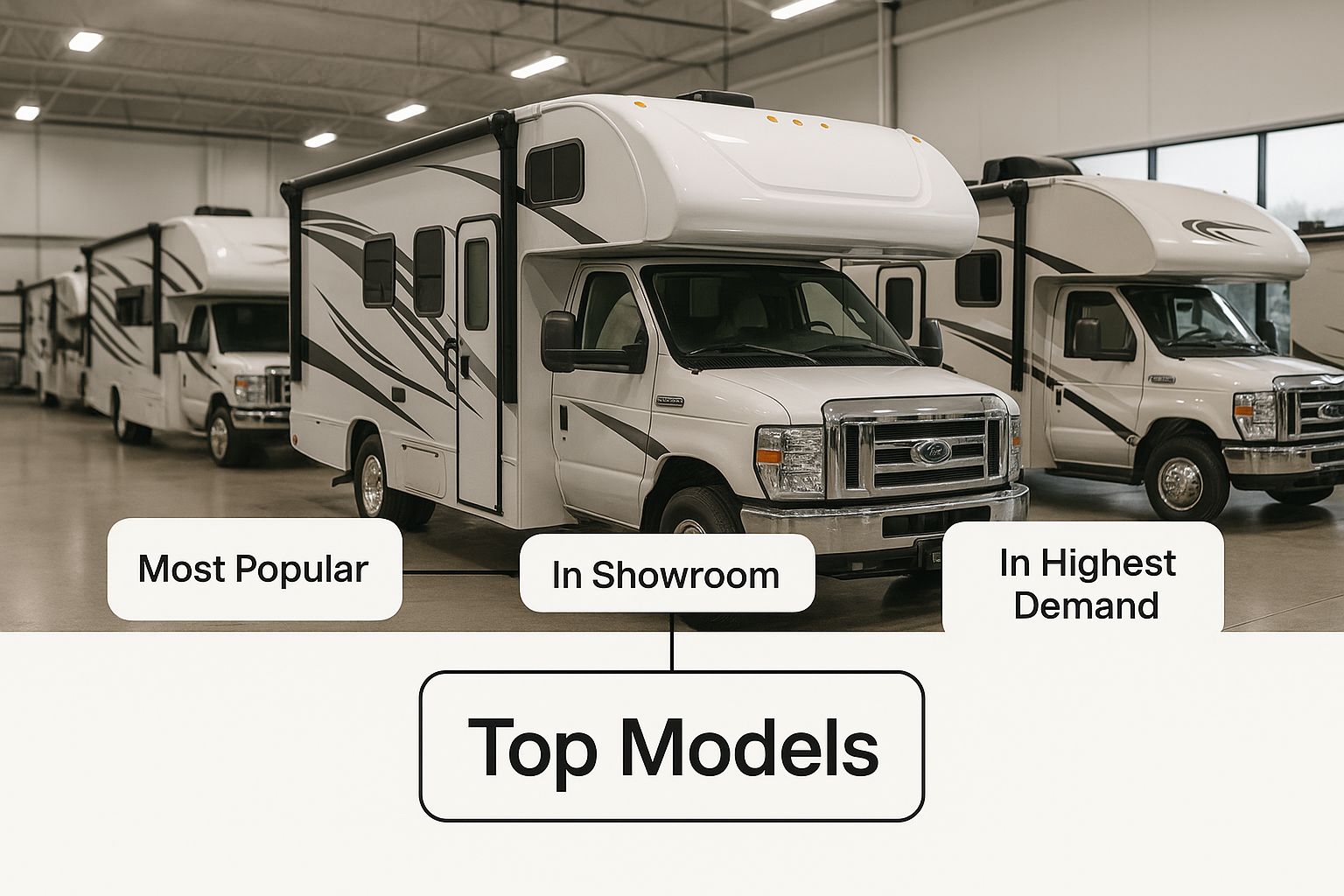
You can see the variety available, from more compact models built on a Sprinter chassis to larger, family-sized rigs on a beefy Ford frame.
Within the Class C family, there’s a more muscular cousin known as the Super C. Think of these as the heavy-duty pickup trucks of the RV world. They are built on even larger commercial chassis, like a Freightliner, and are almost always powered by a brawny diesel engine.
That step up delivers some serious advantages:
- Massive Towing Capacity: Super Cs can often tow well over 12,000 pounds. This makes them the go-to choice if you need to haul a large boat, a trailer full of ATVs, or even another car.
- Increased Power and Torque: The diesel engine provides the raw muscle needed to climb steep mountain passes without breaking a sweat, even when you're fully loaded.
- Greater Durability: These chassis are engineered for commercial work, giving you an incredibly robust platform designed to last for hundreds of thousands of miles.
While they are bigger and more expensive, a Super C offers a huge leap in capability for those who truly need it. Once you understand these core elements—the cab-over bunk, the truck chassis, and the Super C option—you'll be able to confidently figure out which type of Class C motorhome is the right fit for your adventures.
Once you’ve decided a Class C is your ticket to adventure, you hit a major fork in the road: do you buy a shiny new rig or a well-loved used one? There’s no easy answer here. The best choice really boils down to your budget, your priorities, and what you truly value in a motorhome. It’s a classic tug-of-war between the fresh-off-the-lot appeal of a new RV and the smart savings of a pre-owned model.
Think of it like buying a house. A new build is pristine, built to your specs, and comes with a builder’s warranty for total peace of mind. A previously-owned home, on the other hand, has already been lived in. The first owners likely worked out the initial kinks and maybe even added some nice upgrades, and you get all that for a much lower price.
There’s something special about being the very first owner. You get a motorhome with zero miles, untouched appliances, and that unmistakable “new RV” smell. If you value reliability above all else and want the latest and greatest, going new is probably your best bet.
The single biggest perk of buying new is the manufacturer's warranty. This is your safety net, protecting you from the stress and cost of unexpected major repairs during your first few years on the road.
Plus, new models are packed with the latest features:
- Modern Tech: Think integrated solar packages, slick infotainment systems, and high-efficiency appliances that sip power.
- Current Designs: You’ll get the newest interior styles, modern color palettes, and the most innovative floor plans on the market.
- Your Personal Touch: Ordering from the factory often means you can pick your own cabinetry, décor, and add-on features to make it truly yours.
Buying new offers a clean slate. You know the complete history of the vehicle because you are its history. This peace of mind is often the deciding factor for many shoppers exploring Class C RV motorhomes for sale.
Of course, all that comes with a higher price tag. New RVs, just like new cars, take their biggest depreciation hit in the first couple of years. You’re paying a premium for that factory-fresh experience.
For a lot of buyers, the smart money is on a pre-owned RV. The reason is simple: major cost savings. You can often snag a gently used Class C that’s only a few years old for tens of thousands of dollars less than a brand-new one.
How? You’re letting the first owner absorb that initial, steep drop in value. Their depreciation loss is your financial gain. This often means your budget can stretch further, allowing you to afford a bigger rig or a higher-end model than you could if you were buying new.
Another quiet benefit is that the “shakedown” period is over. Most new RVs have a few minor quirks that need to be ironed out. A good previous owner has likely already found and fixed those little issues, saving you a ton of time and hassle.
The value of any motorhome, new or used, is tied to the economy and what’s available on dealer lots. For instance, the motorhome market saw values climb in early 2025, which had a big impact on Class C RV pricing trends.
One Q1 2025 report showed the average selling price for motorhomes hit $62,412. That was a 15.1% jump from the month before and a huge leap from $53,896 just one year prior. You can dive deeper into these RV market trends to see what it means for your wallet.
This shows that in a strong market, a well-cared-for used RV can hold its value surprisingly well. When you start shopping, pay attention to these things. If demand for new rigs is high, used prices will follow. But if there’s a glut of inventory, you might find an incredible deal. Understanding these forces will help you time your purchase and get the best Class C for your money.
Once you’ve settled the new vs. used debate, you get to the most exciting part: picking the features and floor plan that turn a motorhome into your motorhome. This is about more than just cabinet colors and TV size. You're literally designing your life on the road, and every square foot needs to work for you.
Think of a floor plan as the blueprint for your adventures. A layout that feels open and brilliant to one RVer might feel cramped and awkward to another. The trick is to be brutally honest about how you and your travel crew will actually live, eat, sleep, and relax in the space.
One of the first big decisions you’ll face is about slide-outs. These are sections of the RV that motor out when you’re parked, and they can radically expand your living area. A Class C without slides might be nimble and easy to park, but one with a full-wall slide can make the main living area feel twice as big.
But, as with most things in life, slides are a trade-off. They add significant weight, introduce more complexity, and give you another mechanical system to look after. Think about your travel style. If you’re a mover and a shaker, constantly on the go and squeezing into tight spots, a "no-slide" model might be your best friend. But if you see yourself setting up camp for a week or more at a time, the extra elbow room from one or more slides is a luxury you won’t want to give up.
Figuring out where everyone will sleep is probably the single most important part of choosing a floor plan. What works perfectly for a couple can quickly turn into a nightmare for a family of five. Thankfully, Class Cs are masters of versatile sleeping arrangements.
- Bunkhouse Models: These are the gold standard for families. They offer dedicated bunk beds, often tucked into their own little area with a curtain or door for a bit of privacy.
- Cab-Over Bunk: This is the iconic space above the driver's cab. It can be a primary bed, a fantastic guest loft, or just a massive "attic" for stashing all your gear.
- Master Suites: Many larger Class Cs have a dedicated rear bedroom, often with a queen or even a king-sized walk-around bed. It’s your private retreat from the rest of the coach.
- Convertible Dinettes & Sofas: These are the space-saving heroes of the RV world. They serve as your dining or lounging spot by day and easily convert into extra beds at night.
- Murphy Beds: A truly brilliant design. The bed folds up into the wall during the day, revealing a sofa and opening up a huge amount of floor space right where you need it most.
Looking ahead to 2025, you’ll see popular models like the Thor Freedom Elite 28HZF, Forest River Forester 3011DSF, and Jayco Greyhawk 30Z really lean into this versatility. They're known for their spacious interiors and smart use of slide-outs and Murphy beds to give you maximum living space. To get a better feel for what's out there, you can explore some of the best-selling Class C RVs and see how the top manufacturers are pulling it all together.
The day-to-day comfort of your life on the road boils down to the kitchen and bathroom. As you look at different Class C RV motorhomes for sale, really spend some time in these areas. A well-designed kitchen with decent counter space, a good-sized fridge, and a capable stove means you can enjoy real, home-cooked meals instead of living on takeout.
When it comes to bathrooms, you’ll generally find two types:
Wet Bath: This is an all-in-one, waterproof room where the toilet and sink are located right inside the shower area. It’s an incredible space-saver.
Dry Bath: This is what you're used to at home—a traditional layout with a separate shower stall. It’s more spacious and convenient but takes up more of your precious floor plan.
Last but definitely not least: do not underestimate your need for storage. It’s one of the biggest regrets for first-time RV buyers. When you tour a motorhome, open every single cabinet, drawer, and outside compartment. Try to visualize where everything will go—your clothes, food, tools, camp chairs, and all the rest.
Keep an eye out for clever storage spots like deep overhead cabinets, space under the bed, and large exterior "basement" bays. Most importantly, find the sticker that lists the Occupant and Cargo Carrying Capacity (OCCC). That number tells you exactly how much weight you can safely add to the RV. A great floor plan doesn't just have space; it has a designated place for everything, keeping your rig organized and ready for whatever adventure comes next.
Whether you're eyeing a brand-new model fresh off the lot or a pre-loved road warrior, a meticulous inspection is your single best defense against buying a money pit. Think of it like being a home inspector and a car mechanic all at once. Spotting a small problem now can save you from a world of financial hurt later.
The best way to tackle this without getting overwhelmed is to split the job in two: first, you inspect the “house” (the coach), and then you inspect the “motor” (the chassis). This hands-on approach is non-negotiable. A test drive tells you how it handles on the highway, but this detailed walkthrough reveals how it’ll actually work as your home-on-wheels.
Before you even think about turning the key, you need to hunt for the number one killer of all RVs: water damage.
Water is the mortal enemy of any RV. It sneaks in silently, rotting out walls, floors, and insulation, leading to catastrophic structural damage and nasty mold problems. Your job is to find any evidence of it, past or present.
Start with a slow walk around the outside. Keep an eye out for delamination—those ugly bubbles or waves in the fiberglass siding. That’s a dead giveaway that water has gotten underneath and separated the layers. Get up close and personal with every seam and all the sealant around the windows, roof vents, and lights. If that sealant is cracked, peeling, or missing entirely, you're looking at a leak waiting to happen.
Now, head inside and trust your senses. Does it smell musty? That’s a huge red flag. Start pushing firmly on the walls and floors, especially in the corners, under windows, and inside cabinets. Any spot that feels soft or spongy means trouble. Don't forget to look up! Scan the ceiling for any stains or discoloration.
An RV inspection isn't about finding a "perfect" rig—they don't exist. It's about knowing exactly what you're buying. A few minor, fixable issues are totally normal. Major water damage or a neglected chassis? That's your signal to walk away.
Once you’ve given it a thorough water check, it's time to test every single thing. And I mean everything. Don't be timid. Pretend you’re already set up at a campground and put it all through its paces.
- Appliances: Fire up the fridge (on both gas and electric), nuke something in the microwave, and light every single burner on the stove.
- HVAC System: Crank the air conditioner and then switch over to the furnace. Let them both run for a while to make sure they're actually cooling and heating effectively.
- Plumbing: Turn on every faucet, both hot and cold. While they're running, look under the sinks for drips. Flush the toilet a few times.
- Electrical Systems: Test every outlet (a cheap outlet tester from a hardware store is great for this). Flip every light switch. Run the slide-outs in and out a couple of times and do the same with any power awnings.
Now for the "motor" part of the motorhome. The coach might be where you live, but the chassis is what gets you there safely.
Start with the tires. This is a big one. Find the four-digit date code on the sidewall—the first two numbers are the week, and the last two are the year. RV tires often die of old age, not a lack of tread. If they’re more than five or six years old, they need to be replaced, period. That's a significant expense to factor in.
Next, get down on the ground and look underneath (bring a flashlight!). You don't need to be a certified mechanic to spot obvious issues. Look for heavy rust on the frame, any signs of leaking fluids, or busted components. Check out the exhaust system and the suspension for anything that looks bent or broken.
Pop the hood. Check the fluid levels and look for signs of leaks around the engine block. Pull the oil and transmission dipsticks. The fluid should look clean, not sludgy or burnt-smelling. When you finally do start the engine, it should turn over easily and run smoothly without any clunks, squeals, or knocks.
Feeling a little out of your depth? That’s perfectly normal. If you're serious about a used Class C, the smartest money you'll ever spend is on a certified RV inspector.
Hiring an inspector from the NRVIA (National RV Inspectors Association) gives you a trained professional who knows exactly what to look for. They have tools like moisture meters to find hidden water damage and the expertise to spot electrical or mechanical issues you’d never notice.
An unbiased, professional report gives you incredible negotiating power. It either confirms you’ve found a great rig or gives you the hard evidence you need to walk away. This is especially crucial when you're looking at class c rv motorhomes for sale from a private party who might not know (or disclose) the full history.
Finding the right Class C is exciting, but the sticker price you see at the dealership? That's just the beginning of the story. To enjoy your new rig without financial stress, you need to be honest about the real cost of keeping it on the road.
Think of the purchase price as your down payment on future adventures. The ongoing costs are what keep your home-on-wheels safe, comfortable, and ready to roll. Ignoring them is probably the biggest rookie mistake you can make.
To build a budget that actually works, you have to look past the monthly loan payment. Here’s a breakdown of the other costs you'll need to account for every year:
- Insurance: This one’s not optional. RV insurance is a special kind of policy that covers you both as a vehicle and as a living space. Your driving record, the RV's value, and whether you're a weekend warrior or a full-timer will all impact your premium.
- Storage: Unless you’ve got a massive driveway or dedicated RV pad, you'll need a place to park it. This can run from a couple of hundred bucks a year for a basic outdoor spot to a few thousand for a fancy climate-controlled garage.
- Maintenance: Remember, you’re maintaining a truck and a house. You've got oil changes and tire rotations on the chassis side, plus roof seals, plumbing, and appliances on the house side. A solid rule of thumb is to budget 1-2% of the RV's value every single year for upkeep and repairs.
- Fuel & Campground Fees: These are your "on the road" costs. Fuel is the wild card, obviously, but campground fees can also add up fast. Expect to pay anywhere from $30 a night for a simple spot to over $100 for a resort-style park with all the bells and whistles.
For most buyers, financing is the key to getting the keys. Getting a handle on how these loans work will help you land a good deal and keep your payments manageable.
Your credit score is the undisputed king when it comes to getting a good interest rate. A strong score can literally save you thousands over the life of the loan. Do yourself a favor and get a copy of your report before you even step on a lot.
RV loans aren't quite like car loans. The terms are often much longer—it's not uncommon to see loans for 15 or even 20 years. This makes the monthly payment look pretty attractive, but you’ll definitely pay more in total interest.
You can get financing straight from the dealer or come with a pre-approval from your own bank or credit union. We always recommend doing both. Let them compete for your business; you might be surprised who offers the better rate.
The wider economy plays a role, too. For example, back in May 2025, RV shipments dropped 15.1% compared to the year before as people got nervous about inflation. Market shifts like that can affect interest rates and how willing dealers are to negotiate. Keeping an eye on these RV industry trends can give you a bit of an edge and help you plan your purchase with confidence.
Diving into the world of Class C RVs for sale can feel like learning a new language. It's totally normal to have a few last-minute questions pop up. Let's tackle some of the most common ones we hear from shoppers so you can feel confident in your purchase decision.
If you're hunting for a deal, think fall and winter. Once the peak camping season wraps up, dealers get very motivated to move last year's models off the lot to make room for the new stuff.
It's the same story with private sellers. They're often looking at a long winter of storage fees and become much more open to negotiation. Conversely, spring and early summer are when demand skyrockets, and prices follow suit. Patience can literally save you thousands.
This is a great question, and the answer isn't as simple as it is with a car. An RV's odometer reading doesn't tell the whole story. In our experience, a well-cared-for Class C with 75,000 miles and a thick stack of service records is a much better buy than one with only 25,000 miles that has been sitting neglected.
Here’s a little secret from the road: RVs that just sit around often develop more issues than ones that are used regularly. Seals dry out, engines get gummed up, and systems seize. Consistent use and meticulous maintenance are far more important than a low number on the odometer.
While we'll always say that the previous owner's care is the #1 factor in reliability, a few brands have consistently earned a reputation for solid construction and good support over the years.
- Winnebago: They're one of the original names in the game for a reason. Known for durable builds and smart, user-friendly designs.
- Jayco: These guys get a lot of praise for their wide variety of floorplans and for offering a great two-year warranty on new models, which says a lot about their confidence in their product.
- Tiffin: Generally seen as a more premium option, Tiffin focuses heavily on craftsmanship and has a fiercely loyal following thanks to their top-notch customer service.
Our best advice? Once you narrow down your search to a few models, jump into the online owner forums for those specific RVs. That's where you'll get the real, unfiltered feedback from people who live with them every day.
Your next big adventure is just out there waiting for you. Over at SearchShop.com, we've got all the tools and listings you need to find that perfect Class C. You can analyze prices, check out reviews, and browse through thousands of new and used RVs with complete confidence. Get your search started today at https://www.searchshop.com.