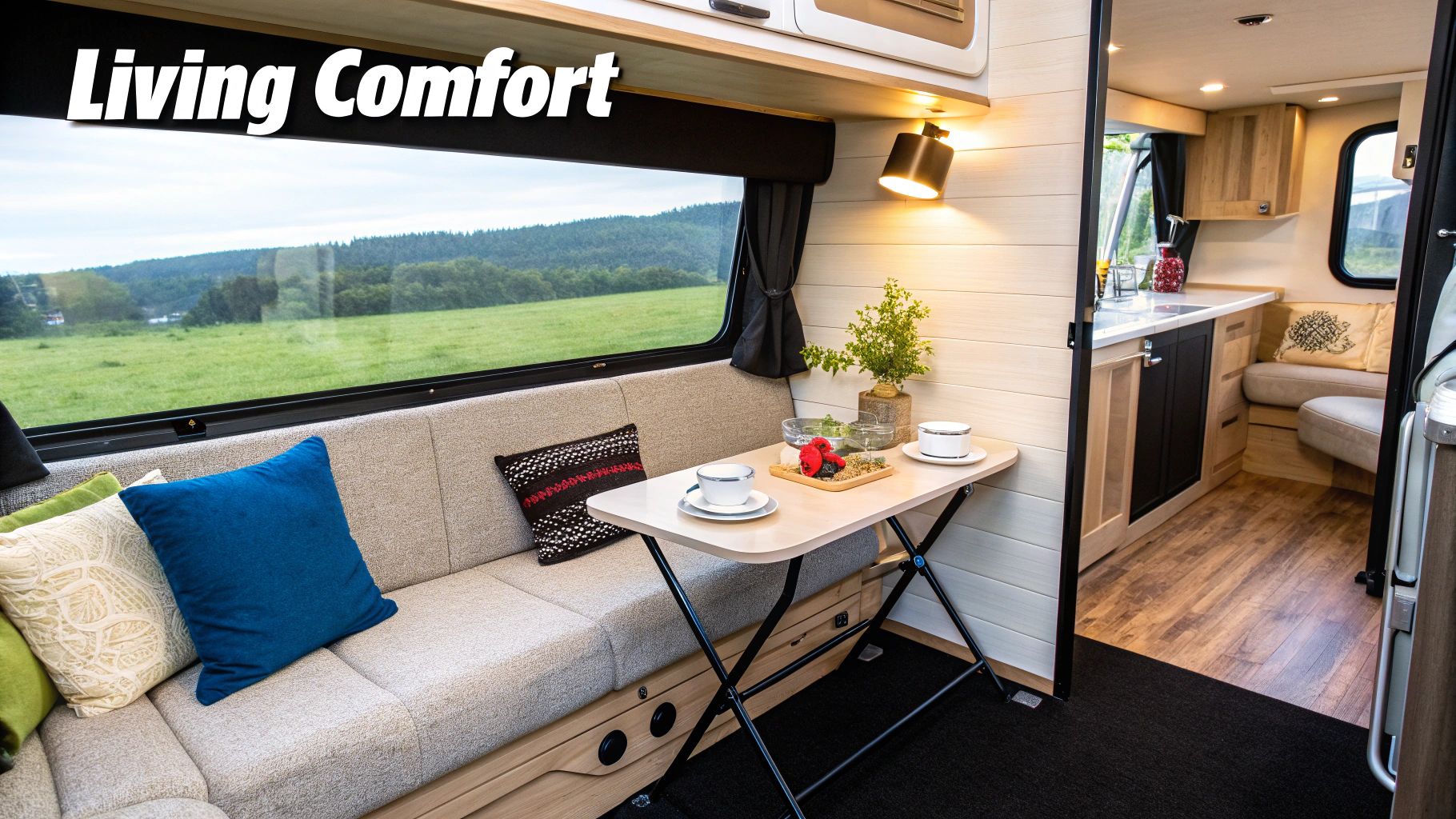
When you boil it down, the motorhome vs. travel trailer debate really comes down to convenience versus flexibility. A motorhome is your all-in-one road trip machine, ready to go at a moment's notice. A travel trailer, on the other hand, is a detachable home base, freeing up your truck for local adventures. The right choice for you hinges on which of those two travel styles sounds more appealing.
Understanding the Core Differences
Picking your first RV is a huge step, and it all starts with grasping the fundamental trade-offs between a motorized rig and a towable one. A motorhome is a single, self-contained vehicle—the living space and the engine are one and the same. In contrast, a travel trailer is an unpowered camper that needs a capable truck or SUV to pull it down the road.
This single distinction ripples through every part of the RV experience, from the price tag on the lot to what your daily life looks like at the campground.
Mobility and Setup: Motorhomes are the undisputed champions of a quick setup. You just pull into your spot, level it out, and hook up. This makes them perfect for people who are always on the move or take long cross-country trips with lots of one-night stops.
Flexibility at Your Destination: This is where travel trailers really shine. Once you're parked, you can unhitch your tow vehicle and suddenly you have a regular car again. It's perfect for running into town for groceries, sightseeing, or exploring tight roads where a big RV just can't go.
The Financial Investment: The initial cost is often the biggest deciding factor. Motorhomes come with a much higher price tag because you're buying an engine and drivetrain along with the living space. Travel trailers are significantly more affordable right out of the gate.
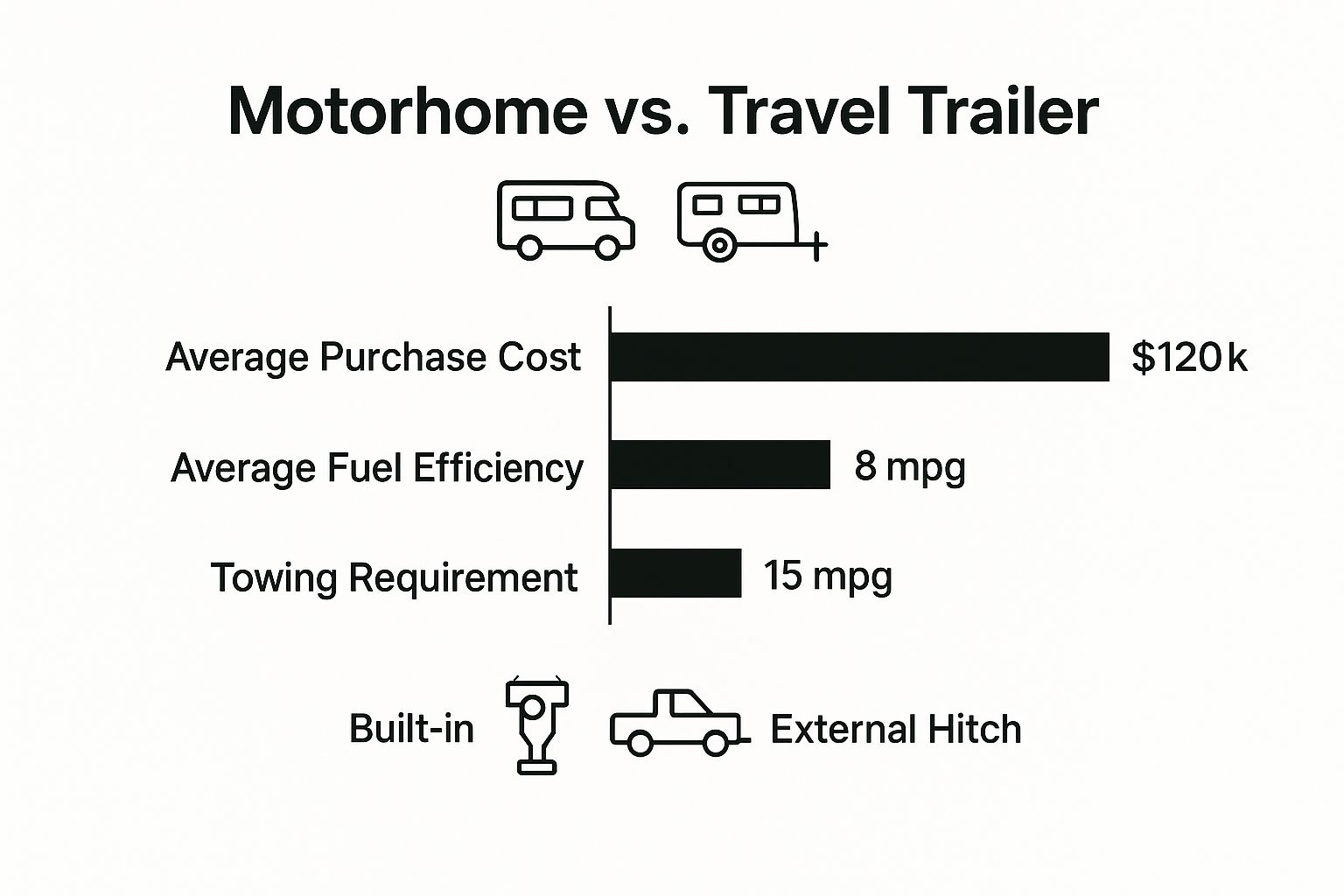
This graphic gives you a great visual breakdown of the key numbers you need to consider—from cost and efficiency to what’s required to get started.
As you can see, the financial and logistical demands for each RV type are worlds apart from day one. To help you sort through it all, here's a quick side-by-side comparison.
Motorhome vs Travel Trailer At a Glance
The table below offers a high-level summary of the key differences between motorhomes and travel trailers, helping you quickly see the primary trade-offs at a glance.
Factor
Motorhome
Travel Trailer
Upfront Cost
Significantly higher (contains engine and chassis)
Lower and more budget-friendly
Setup Speed
Faster; park and you're mostly done
Slower; requires unhitching and leveling
Local Mobility
Limited; requires towing a separate car or breaking camp
Excellent; unhitch your truck for local trips
Driving Ease
Simpler for beginners (one vehicle)
Requires learning to tow and back up
Maintenance
Higher; includes engine, drivetrain, and RV systems
Lower; focused on axles, tires, and RV systems
Total Length
The length you see is what you drive
Overall length includes trailer and tow vehicle
Ultimately, this quick look shows that motorhomes are built for seamless travel from point A to B, while travel trailers excel at creating a comfortable, flexible basecamp for deeper exploration.
Analyzing the True Cost of RV Ownership
When you’re weighing a motorhome vs. a travel trailer, the number on the price tag is only the first chapter of the story. The real cost of ownership reveals itself over years of fuel stops, insurance payments, and unexpected repairs. Getting a handle on this long-term financial picture is the only way to choose an RV that truly fits your life and your budget.
The initial purchase is obviously the biggest hurdle. Motorhomes, with their built-in engine and drivetrain, carry a much higher price from the get-go. On the other hand, travel trailers are far more accessible, often costing tens of thousands less for the same amount of living space.
It all comes down to a simple distinction: with a motorhome, you're buying a vehicle and a home all in one. With a travel trailer, you're just buying the home—assuming you already have a truck that can pull it.
Deconstructing the Initial Investment
That upfront cost is more than just the sticker price; you have to account for taxes, registration, and dealer fees. For a motorhome, these percentages are calculated on a much bigger number, making the initial cash you need to hand over significantly higher.
A travel trailer’s lower price means all those associated costs are smaller, too. But here's the catch: if you don't already own a capable tow vehicle, the math gets a lot more complicated. The price of a new or even used truck powerful enough to safely haul your trailer can easily close the gap, sometimes bringing your total investment into the same ballpark as a Class C motorhome.
The booming RV market really throws these costs into sharp relief. Projections show the North American recreational vehicle market hitting $35.94 billion in 2025 and growing to an incredible $53.17 billion by 2030. In this landscape, travel trailers are the go-to for budget-conscious buyers, while motorhomes attract those who are willing to pay a premium for all-in-one convenience. You can find more insights about RV market trends and see how they impact these financial decisions.
Ongoing Expenses: Motorhome vs. Travel Trailer
Once you drive off the lot, the recurring costs are what truly shape your budget. This is where the financial paths of a motorhome and a travel trailer really start to diverge.
The biggest financial differentiator over time isn't the purchase price—it's the maintenance. A motorhome is a second vehicle requiring complex engine, transmission, and chassis service. A travel trailer's maintenance is simpler, but it accelerates wear and tear on your primary tow vehicle.
Let's break down where your money will be going.
Insurance: A motorhome is almost always more expensive to insure. Since it's a motorized vehicle, your policy has to cover everything a car does—liability, collision, comprehensive—but for a much more valuable asset. Trailer insurance is usually much cheaper because it just covers the unit itself; liability is typically handled by your tow vehicle’s policy.
Maintenance and Repairs: This is a huge one. Motorhome owners are on the hook for all the standard vehicle upkeep: oil changes, new tires, brake jobs, and potentially massive engine or transmission repairs. And good luck finding a mechanic who can handle a 40-foot rig on short notice—it’s not easy, or cheap.
Tow Vehicle Costs: For trailer owners, these costs don't disappear—they just shift to the tow vehicle. Hauling thousands of pounds puts a serious strain on a truck’s engine, transmission, and brakes, meaning you’ll be seeing your mechanic more often for services that can get pricey.
The Long-Term Financial Impact: A 5-Year Outlook
Over five years, all these little expenses add up to paint a very clear picture. Fuel is a constant drain, and a motorhome's typical 8-10 MPG is a tough pill to swallow compared to the 12-15 MPG a truck might get while towing a trailer.
Depreciation is another major factor. Motorhomes lose value fast, just like any other vehicle. It’s not uncommon to see a 20-30% drop in the first couple of years, with value tied directly to mileage and mechanical health. Travel trailers, on the other hand, depreciate much more slowly because their worth is based on their condition and features, not an engine with 50,000 miles on it.
When you add it all up—maintenance, insurance, fuel, and depreciation—the five-year cost of owning a motorhome is almost always substantially higher than that of a comparable travel trailer.
Driving and Setting Up Camp: A Tale of Two Experiences
This is where the rubber really meets the road in the motorhome vs travel trailer debate. How you get from one place to the next—and what you have to do when you get there—will define your day-to-day life as an RVer. It’s one of the biggest practical differences you’ll face.
With a motorhome, you're driving a single, self-contained unit. The house is part of the vehicle. For a lot of people, this feels less intimidating. There’s no pivot point, no trailer swinging behind you, and the whole process of getting on the road seems simpler.
Shop RVs For Sale
Browse current rvs from dealers near you — updated daily.
And when you pull into your campsite? The motorhome truly shines. Setting up is often as easy as parking, hitting a button for the auto-leveling jacks, and connecting your shore power and water. You can go from road-weary to kicking back with a cold drink in just a few minutes.
Behind the Wheel of a Motorhome
Driving a Class C or B motorhome often feels like handling a large van or a U-Haul truck. You sit up high, the visibility is great, and you don’t have to think about a trailer when changing lanes or pulling into a gas station. It’s this ease of travel that makes motorhomes so appealing for people who plan on moving from place to place frequently.
But that convenience comes at a price. Once you're parked and set up, your motorhome is your only vehicle—unless you tow a small car behind it, often called a "toad." A simple run to the grocery store means unplugging everything, stowing your gear, and driving your entire house into town for a carton of milk.
The big trade-off with a motorhome is local mobility. Every time you want to go anywhere, you're faced with a decision: break down your entire camp or stay put.
This gets old fast, especially in national parks with narrow roads or old towns with tiny parking spots. While towing a separate car is a popular solution, it reintroduces the hassle and fuel economy hit of towing that many motorhome owners were hoping to escape in the first place.
The Art and Science of Towing a Trailer
The travel trailer experience is completely different. Here, your driving life and your camping life are two separate things. Getting on the road involves a distinct learning curve. You have to get comfortable with managing trailer sway, taking wide turns, and the skill that gives new RVers nightmares: backing into a tight campsite.
Hitching and unhitching also adds a few more steps to your arrival and departure routine. It’s not as quick as a motorhome, no question. For newcomers, that initial period of learning the ropes can feel like a real barrier.
But here’s the thing: towing is a skill, and like any skill, it can be learned. After a few weekends of practice in an empty parking lot, what once seemed impossible becomes second nature. It just takes a little patience.
Your Basecamp is Set: The Freedom of a Trailer
The moment you unhitch that trailer, everything changes. This is the travel trailer’s superpower. Your trailer becomes a stable, comfortable home base, and your truck or SUV is free to be your daily driver.
This freedom completely transforms how you can travel.
Explore Without Limits: Want to drive into town for dinner, find a trailhead down a bumpy dirt road, or squeeze into a tight parking spot at a popular viewpoint? No problem.
Simple Supply Runs: Realize you forgot firewood? Just hop in the truck. It’s a five-minute errand, not a major operation.
Your Campsite Stays Put: Your chairs, grill, and outdoor mat can stay right where they are. You don't have to pack everything up just to explore for the afternoon.
Ultimately, it comes down to choosing your preferred challenge. A motorhome makes the journey and the initial setup simpler. A travel trailer complicates that part of the process but gives you incredible freedom and flexibility once you've arrived at your destination.
Comparing Interior Layouts and Livability
Your RV isn't just a vehicle; it's your home on wheels. The layout, the flow, and the general "feel" of the space will make or break your trips. When it comes to the motorhome vs travel trailer debate, the design of the living space is a fundamental difference, and it all boils down to one simple fact: one has a cockpit, and the other doesn't.
Motorhomes are built around an integrated driver's area. The captain's chairs up front are part of the living room—they often swivel around to join the conversation once you’re parked. This creates a unified, open feeling from the panoramic windshield all the way to the back bedroom, especially in the big Class A rigs.
This all-in-one design is where a motorhome truly shines on travel days. Need a snack from the fridge or a quick trip to the bathroom while your partner is driving? No problem. You can move about freely without ever having to step outside. It’s a seamless transition from road mode to living mode.
Motorhome Layouts: The Unified Space
The entire design philosophy of a motorhome is about maximizing a single, continuous space. The cockpit flows right into the living area, which then moves into the galley, bathroom, and finally, the bedroom in the rear. It creates a really intuitive environment, especially if you're doing a lot of quick overnight stops where you don't want a complicated setup.
Of course, slide-outs are what make these rigs feel truly livable. With the push of a button, the walls extend and dramatically open up the living room or bedroom. But here's a pro tip: always check how the motorhome functions with the slides in. Some floorplans become so narrow that you can barely squeeze past the galley to get to the bathroom—a real pain during a quick roadside lunch break.
The end result is a floor plan that feels incredibly efficient and purpose-built for the journey itself. Every inch is designed to blend the act of driving with the act of living.
Travel Trailer Floorplans: Residential Freedom
A travel trailer, on the other hand, is liberated from the need to accommodate an engine, drivetrain, and cockpit. This freedom opens up a world of creative floor plan possibilities. Without a driver’s area dictating the design up front, manufacturers can create layouts that feel much more like a small apartment than a vehicle. This is where trailers often pull ahead in sheer livability.
You’ll find an incredible variety of designs that cater to specific needs.
Rear Living: These are hugely popular for a reason. They place a big sofa or comfy recliners against a massive picture window at the back, creating a dedicated and relaxing living room.
Front Bedroom: By putting the master bedroom at the very front, these layouts create a nice separation from the main living space, offering a bit more privacy.
Bunkhouse Models: A lifesaver for families. Trailers excel at offering dedicated bunk rooms—sometimes with their own half-bath—giving kids their own zone to sleep and play.
Rear Kitchen: This layout can open up the entire center of the trailer, resulting in an exceptionally spacious and airy living and dining area.
This design flexibility means that if you take a 30-foot motorhome and a 30-foot travel trailer, the trailer will almost always feel more spacious and offer a more residential-style layout. That space otherwise taken by the engine and cab is pure living area in a trailer.
The core trade-off is on-the-go access versus at-camp livability. A motorhome offers seamless access to amenities while driving, but a travel trailer often provides a more spacious, separated, and home-like environment once you’re parked and unhitched.
Situational Livability: Which Is Right For You?
So, which one is better? It really comes down to how you camp.
If you’re a cross-country road-tripper who makes frequent one-night stops, the integrated convenience of a motorhome is tough to beat. Pulling into a rest stop or a Walmart parking lot for the night and having immediate access to your entire home is a massive advantage.
But if you’re a family or a couple who likes to set up a basecamp for a week or more at a time, the travel trailer’s strengths become crystal clear. The separation of spaces, the bigger kitchens, the option for a dedicated bunk room—it all adds up to a more comfortable long-term stay. Picture yourself set up for a week at a state park; the wide-open feel of a rear-living trailer creates a far more relaxing home base.
Ultimately, you have to visualize your daily routine. Do you care more about convenience on the road, or comfort at the campsite? Answering that question will point you directly to the layout that fits your travel style. To get a better feel, you can explore different models on a platform like Searchshop to find RVs that match the specific floor plans you're looking for.
Which RV Fits Your Travel Style?
The best RV isn't a specific model—it's the one that feels like a natural extension of the adventures you want to have. The whole motorhome vs travel trailer debate gets a lot simpler when you stop getting bogged down in feature lists and start picturing your ideal trip.
Honestly, your travel style is the most important piece of the puzzle. Are you the type to be constantly on the move, eating up miles of highway? Or do you prefer to find a beautiful spot, settle in for a while, and really explore the area?
The Cross-Country Voyager
If your goal is to see as much of the country as possible, a motorhome is almost always the right call. This travel style means long driving days and lots of one-night stops at places like Harvest Hosts, rest areas, or simple overnight campsites. The ability to just pull over, hit a button to level out, and be done for the night is priceless.
Think about it: you've been driving all day, you're tired, and you pull into your spot after dark. With a motorhome, you just park, turn off the engine, and walk to the back to make dinner or fall into bed. You don't have to get out in the rain or cold to unhitch, level, and stabilize a whole separate rig. That convenience makes a multi-state road trip feel less like a chore and more like the adventure it's supposed to be.
The National Park Basecamper
On the flip side, the travel trailer is the undisputed champion for anyone who likes to set up a home base. This is the RVer who plans to spend a full week camped just outside Zion National Park, using their site as a launchpad for daily excursions.
The real magic of a travel trailer is its "drop-and-go" nature. You set up your comfortable camp once, unhitch, and then you have your truck or SUV free for hassle-free exploration of tight park roads, local towns, and trailheads that are miles away.
With a trailer, you can just hop in your truck to drive into Springdale for groceries or navigate the scenic switchbacks on the Zion-Mount Carmel Highway. Trying to pilot a 35-foot motorhome through that same stuff would be a logistical nightmare, and it would seriously cramp your freedom to explore beyond the campground gates.
Which Archetype Are You?
Beyond those two main styles, a few other traveler types can help point you in the right direction:
Weekend Warriors: Families taking short, frequent trips often find a travel trailer is the perfect fit. It gives them more living space for the kids at the campsite and frees up their daily driver for quick runs to the store or beach.
Seasonal Snowbirds: If you head south for the winter and plant yourself in one RV park for months, a travel trailer's residential feel and lower long-term cost make a lot of sense.
Full-Time Digital Nomads: This group is pretty split. The ones who are constantly moving tend to love a motorhome's simplicity. Those who prefer to stay put for weeks or months at a time usually opt for the massive space and flexibility of a fifth wheel or a large travel trailer.
It's also worth noting how market trends can influence your choice. Dealer lots are currently sitting on a lot of leftover inventory—including over 10,000 unsold new 2024 campers. This glut means buyers, especially those looking at towable units, might have some real negotiating power. You can get a better sense of the landscape by checking out a detailed analysis of the current RV sales market and inventory levels.
At the end of the day, matching your travel dreams to the right type of RV is the key to setting yourself up for years of amazing trips.
Deciding between a motorhome and a travel trailer often boils down to a handful of specific questions. These are the practical, real-world concerns that pop up right before you’re ready to make a move. Getting straight answers can give you the confidence you need to pick the right rig for you.
We've pulled together some of the most common questions we hear from buyers, touching on everything from family trips to long-term value. Let's tackle these final uncertainties head-on.
Which Is Better for a Family With Young Children?
This really comes down to your family’s travel style. For the journey itself, a motorhome often wins. On long drives, having access to a bathroom or the fridge without stopping is a game-changer, especially with little ones (as long as they remain safely buckled in where legally required). It just simplifies the whole road trip experience.
But once you've parked, a travel trailer can be the better setup. Many trailers have fantastic bunkhouse floorplans that create a separate "kids' zone," giving everyone a bit more breathing room and privacy. It makes a huge difference in keeping the peace.
The real trump card for a travel trailer is leaving it behind at the campsite. Being able to unhitch your truck for a quick run to the grocery store, a trip to the beach, or to find a local playground is a massive plus when you're traveling with kids.
For many families, the freedom of having a separate vehicle for day-to-day exploring easily outweighs the on-the-road convenience of a motorhome.
How Does Depreciation Compare Between RV Types?
Look, both types of RVs lose value. But motorhomes tend to depreciate much faster in terms of actual dollars lost. Because it’s a vehicle, its value is tied directly to the engine, transmission, and mileage—all things that wear out over time.
It’s not unusual for a motorhome to drop 20-30% of its value in the first year alone. That's a steep hit, reflecting the combined depreciation of the vehicle parts and the living space.
Travel trailers, on the other hand, don't have an engine, so they depreciate far more slowly. Their value is based on condition, features, and age, not how many miles are on an odometer. While they still lose value, the total dollar amount lost is almost always significantly less than what you’d see with a similarly priced motorhome over the same period. From a purely financial standpoint, a trailer usually holds its value better.
Is Finding a Campsite Easier for One Type?
This is a common worry, but the answer has less to do with the type of RV and more to do with its size. Most modern campgrounds are built to accommodate both motorhomes and trailers of all shapes.
The real challenge is overall length. Some older state and national parks have strict length restrictions that can make it tough for a massive Class A motorhome or an extra-long travel trailer to fit. The key is to know your RV's total length—bumper to bumper for a motorhome, or bumper to hitch for a trailer—and always check the campground's rules before booking.
Where you'll notice a difference is in maneuverability. A motorhome driver might find it a breeze to pull into a simple pull-through site. On the flip side, backing a 35-foot travel trailer into a tight, tree-lined spot takes a fair bit of practice and patience. Neither has a clear advantage; it’s all about the specific site and the rig's length.
What Are the Main Maintenance Differences?
The single biggest maintenance difference is the engine. A motorhome has all the upkeep needs of a large vehicle, and that can get complicated and expensive. You’re talking about routine oil changes, transmission servicing, and replacing pricey, specialized tires. You are essentially maintaining a second truck or bus.
With a travel trailer, those mechanical costs don’t just disappear—they shift over to your tow vehicle. Pulling a heavy trailer puts a lot of strain on your truck's engine, brakes, and transmission, which often means more frequent and potentially more expensive service appointments.
Beyond the drivetrain, the upkeep for the living quarters is pretty similar for both.
Appliance Care: Both have refrigerators, water heaters, and furnaces that need regular attention.
Roof and Seal Maintenance: Preventing leaks is priority number one for any RV, so you'll need to inspect and reseal roof seams and windows regularly.
Trailer-Specific Upkeep: Travel trailers have a few unique tasks, like lubricating the wheel bearings and inspecting the hitch system.
While both require you to stay on top of maintenance, the motorhome’s integrated engine and chassis are easily the biggest and most expensive variable in the motorhome vs travel trailer debate.
Ready to find the RV that fits your life? At Searchshop, you can explore thousands of new and used motorhomes and travel trailers. Use our unique Vehiscore quiz to get matched with models that fit your specific needs and budget. Start your adventure today at https://www.searchshop.com/rv.