If you’ve ever dreamed of taking your family on a road trip adventure, you know the biggest puzzle is often space. That’s where the best bunkhouse travel trailers come in. They aren’t just RVs; they're smartly designed mobile basecamps that give everyone a little breathing room. It's no wonder models from brands like Jayco and Keystone are perennial favorites—they just get what families need.
Why Bunkhouse Travel Trailers Are Perfect for Families
Think of a bunkhouse trailer as a cabin on wheels, but with a secret weapon: a dedicated zone just for the kids. The whole idea is to build in a set of bunk beds, often tucked away in their own corner or a separate room. This single design choice completely changes the dynamic of family camping.
The real magic isn't just about cramming in more sleeping spots. It’s about creating sanity. Giving the kids their own turf—a "bunk room"—means the main living area stays relatively calm and clutter-free. Bedtime squabbles are fewer, toys have a designated home, and parents get to enjoy a peaceful evening after a long day of exploring.
More Than Just Sleeping Space
What makes a bunkhouse so brilliant is how it uses every inch of space without compromise. Instead of constantly converting a dinette or sofa into a lumpy, temporary bed, you have permanent beds ready to go whenever someone needs a nap or it's time to turn in. This layout brings some serious perks to the table.
Sleeps a Crowd: You can comfortably sleep anywhere from six to ten people, making it a perfect fit for bigger families or for bringing a few friends along.
A Little Privacy: Many larger floorplans feature actual bunk rooms with a door you can close. For kids and especially teens, having that private space is a huge win.
Keeps Things Tidy: With the sleeping quarters contained, your kitchen and living area can stay, well, a kitchen and living area all day long.
This family-first approach has really struck a chord with campers. The demand for bunkhouse trailers has skyrocketed, holding strong even when the broader RV market ebbs and flows. You can see it in the consistent popularity of models like the Keystone Coleman 17BX and the Jayco Jay Flight SLX 175BHW—people are voting with their wallets for layouts that work for the whole family. If you want to dive deeper into market trends, check out this great analysis from RV Across America.
A bunkhouse trailer doesn't just add beds; it adds breathing room. It's the difference between simply coexisting in a small space and truly enjoying the journey together.
At the end of the day, picking a bunkhouse isn't just a practical decision; it’s an investment in a smoother, more enjoyable camping experience. It solves the real-world challenges of traveling with kids, ensuring everyone has their own spot to relax and recharge for whatever adventure tomorrow brings. For more advice on picking the perfect rig, our guide on how to find the best RV for families is packed with helpful tips.
Choosing The Right Bunkhouse Floorplan
The floorplan is the blueprint for your family's camping happiness. I always tell people it's so much more than a simple diagram of beds and sofas—it dictates the entire flow of your daily life on the road, from those chaotic mornings getting everyone ready to quiet evenings after a long day of hiking. Choosing the right layout is like designing a custom home on wheels; it has to fit your family’s unique rhythm.
Think of each floorplan as a different strategy for managing your space and your crew. Some are designed to give older kids a bit of privacy, while others are built to keep toddlers close by. Getting a handle on these different approaches is the key to finding a trailer that feels like it was made just for you.
The Classic Rear Bunkhouse
One of the most common and popular designs you'll see out there is the rear bunkhouse. This layout sticks the bunks at the very back of the trailer, creating a distinct "kids' zone" that's completely separate from the main living area and the parents' bedroom up front.
This separation is its greatest strength. It gives kids, and especially teenagers, a sense of their own space—a clubhouse on wheels where they can hang out without being right on top of everyone. For parents, it means the central living area stays a little cleaner and a lot quieter.
Pros: Fantastic separation between living and sleeping areas, which means more privacy for the kids. Larger models might even include a dedicated half-bath or entertainment center in the bunk room.
Cons: This layout almost always adds significant length and weight, which can make towing a bit more demanding and limit your options for smaller campsites.
For smaller, more lightweight travel trailers, the corner bunk layout is a brilliant space-saver. Instead of a whole separate room, the bunks—usually a set of two—are tucked neatly into a rear corner, often right next to the bathroom.
This design is the champion of efficiency. You get the dedicated beds you need for the kids without the extra length and weight of a separate room. This makes it a perfect choice for families with smaller tow vehicles or anyone who loves the nimble feel of a trailer that can squeeze into those coveted, tighter campsites at national parks.
A corner bunk layout is the smart solution for families who need the beds but want to keep their trailer compact. It’s all about maximizing utility in a smaller, more manageable package.
The Versatile Mid-Bunk Room
A newer design that's been gaining a ton of traction is the mid-bunk room. Just like it sounds, this layout puts a separate bunk room right in the middle of the trailer, usually sandwiched between the front master bedroom and the rear living area or kitchen.
This floorplan is unbelievably versatile. The mid-bunk room often has its own slide-out, creating a surprisingly spacious area that can transform throughout the day. It can be an office, a playroom on a rainy afternoon, or even a second lounge area. Many of these have a fold-out sofa below a flip-up bunk, so you can change the setup on the fly. This flexibility makes it a fantastic option for families who full-time or take extended trips.
Choosing the right floorplan really comes down to picturing how your family will use the space day-to-day. The table below breaks down the most common layouts to help you zero in on what might work best.
Bunkhouse Floorplan Comparison
Floorplan Type
Typical Sleeping Capacity
Best For
Key Advantage
Rear Bunkhouse
6-10
Families with teens or older kids
Maximum privacy and separation
Corner Bunks
4-6
Families with young children or small tow vehicles
Space and weight efficiency
Mid-Bunk Room
6-8
Full-time families or those needing flexible space
Multi-purpose functionality
Ultimately, the best way to decide is to physically walk through a few different models if you can. Ask yourself the practical questions: Where will the kids play if it rains? How much privacy do our teenagers really need? Answering those questions honestly will lead you straight to the perfect home base for countless adventures to come.
Features That Make or Break Your Family's Trip
A great floorplan is the foundation, but the features are what make your camper feel like a home. The best bunkhouse trailers are packed with smart amenities that just make life easier when you're on the road with kids. Think of these as the difference between just surviving a camping trip and actually enjoying it.
When you start looking at different models, it's easy to get overwhelmed by all the options. The key is to focus on features that solve the real problems families face. This isn't about luxury; it's about practicality.
The Outdoor Kitchen: Your Secret Weapon
An outdoor kitchen might sound like a frill, but trust me, it’s a total game-changer for families. We're talking about a small fridge, a sink, and a griddle or cooktop that slides right out of the side of your rig. It’s a simple concept that completely changes your daily routine.
Imagine this: you're cooking bacon and eggs on a beautiful morning without stinking up the entire trailer. Or the kids can grab their own juice boxes from the outdoor fridge a dozen times without tracking dirt through the main living area. It keeps the mess, the heat, and the foot traffic outside where they belong.
Shop RVs For Sale
Browse current rvs from dealers near you — updated daily.
Slide-outs are the sections of the camper wall that push outward with the touch of a button, and they are your best friend when it comes to interior space. A single slide in the main living area can take a cramped hallway and turn it into a real living room. That extra floor space is priceless on a rainy day when the kids need somewhere to play.
Yes, they add a bit of weight and another moving part to maintain, but the trade-off is almost always worth it. When you have a full crew, a bunkhouse with a slide feels exponentially bigger and more livable. Look for models where the slide holds the sofa or dinette, as this does the most to open up the main walkway.
Smart Storage for All That Gear
Let's be honest, families don't pack light. You've got bikes, fishing gear, strollers, toys, and a mountain of clothes. The best bunkhouses have storage solutions that go way beyond a few dinky overhead cabinets.
Keep an eye out for these high-value features:
Pass-Through Storage: This is a big compartment at the front of the trailer that you can access from both sides. It's the perfect spot for long, awkward items like camp chairs and fishing poles.
Under-Bunk "Garage": Many bunkhouses have a large exterior door that gives you access to the space under the bottom bunk. The bunk often flips up, creating a huge storage area for bikes or tote bins.
A Real Pantry: Having a dedicated, tall pantry in the kitchen makes a world of difference for keeping food organized and your counters clear.
Here’s a pro tip: a second exterior door, especially one that opens directly into the bathroom, is one of the most underrated features you can find. It lets the kids run in to use the restroom without dragging mud and leaves through the entire camper.
Tank Sizes and Bathroom Access
If you plan on camping anywhere besides paved RV parks with full hookups, tank capacity is critical. This is how much fresh water you can carry, and how much "gray water" (from sinks/showers) and "black water" (from the toilet) your tanks can hold. Bigger tanks mean more freedom.
A family of four can easily use 20-25 gallons of fresh water per day, so a small tank will have you packing up to find a dump station way sooner than you'd like.
These practical features are exactly why bunkhouses have exploded in popularity. The rental market shows it clearly: bunkhouse trailers recently made up nearly 30% of all travel trailer rentals in the U.S., a huge jump from just 22% a few years ago. People are catching on. To see which models are leading the pack, check out this insightful industry analysis on Bishs.com. Getting these details right ensures your trailer is more than just a place to sleep—it's your family's basecamp for adventure.
Picking out the perfect bunkhouse trailer is the fun part. Now comes the single most important decision you'll make in this whole process: making sure your vehicle can actually handle it.
Choosing a trailer that’s too heavy isn't a small goof-up; it's a dangerous and expensive mistake. It puts your family, your vehicle, and everyone else on the road at risk. The world of towing weights can feel like a mess of alphabet soup, but I'll break it down into simple, practical terms.
Think of your vehicle’s tow rating like a budget. The big number the manufacturer advertises is your total paycheck, but you can't spend every last dime on the trailer itself. You’ve got other "bills" to pay—passengers, gear in the truck bed, water in the tanks, and so on. Overspend that budget, and you'll put a massive strain on your truck’s engine, transmission, and brakes, which is a recipe for disaster.
Decoding the Weight Stickers
Every truck and trailer is plastered with stickers full of acronyms. Getting a handle on these is the key to a safe match. It’s not about memorizing definitions; it’s about knowing what these numbers really mean for your setup.
Unloaded Vehicle Weight (UVW) or Dry Weight: This is what the trailer weighed the day it rolled off the factory floor—completely empty. It's a nice starting point, but let's be real: you will never tow the trailer at this weight.
Gross Vehicle Weight Rating (GVWR): This is the absolute maximum the trailer is allowed to weigh once you’ve loaded it with all your gear, food, water, and propane. This is the number that truly matters on the trailer's sticker.
Hitch Weight or Tongue Weight: This is the downward pressure the trailer tongue puts on your tow vehicle's hitch. For safe towing without dangerous swaying, this needs to be 10-15% of the trailer's total loaded weight.
The biggest rookie mistake is getting fixated on the "dry weight." Always, always use the trailer's GVWR as your guide when you're shopping. It’s the only number that reflects what you'll actually be pulling down the highway.
Calculating Your Real Towing Capacity
That "max tow rating" advertised for your truck or SUV? It was probably calculated with an empty vehicle and perfect conditions. Your real-world capacity is always lower.
To figure out what you can actually tow, you have to account for everything you load into your tow vehicle. I’m talking about every passenger, your dog, the coolers, camping chairs in the truck bed, and the trailer’s hitch weight.
Every single pound you add to your vehicle reduces its ability to pull that trailer. The most critical number here is your vehicle's payload capacity, which you can find on a sticker inside the driver's side doorjamb. Your payload has to handle all your cargo plus the trailer's hitch weight. Overloading your payload is just as dangerous as exceeding your tow rating.
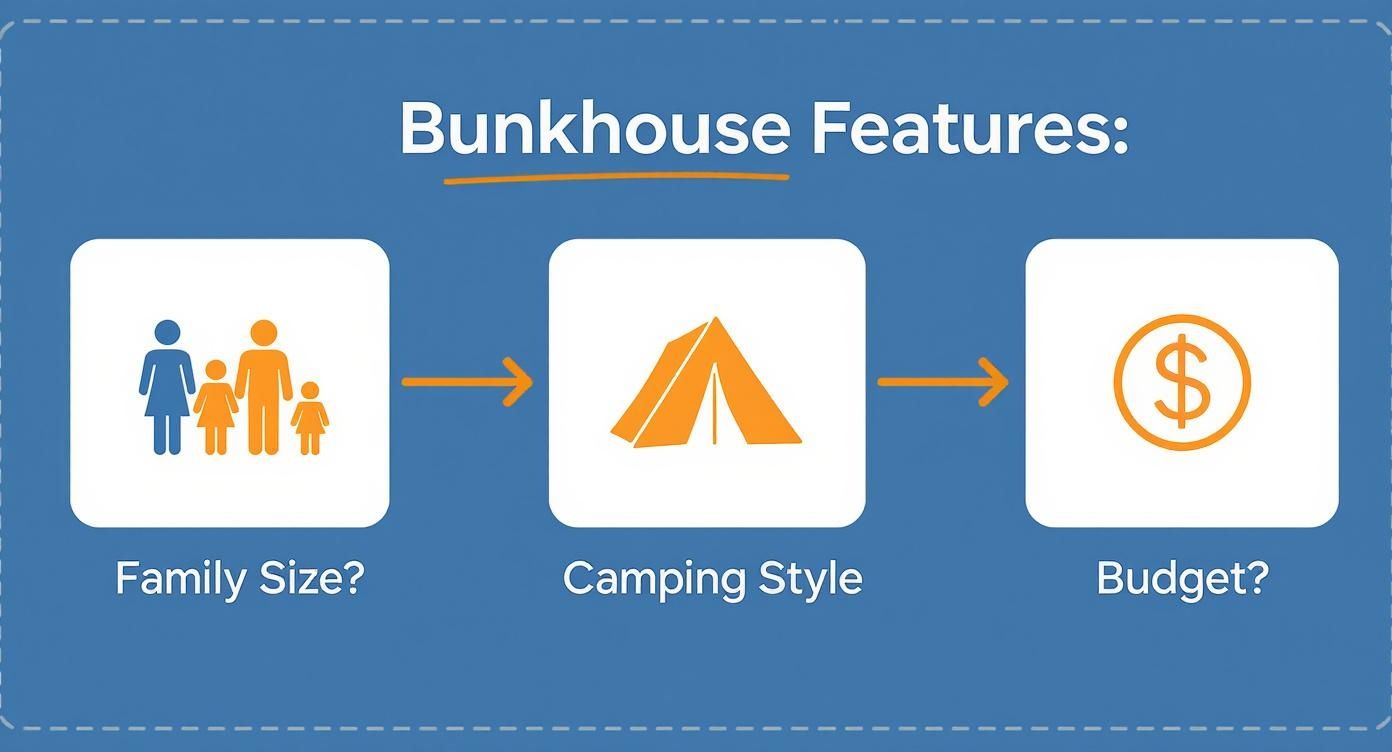
This decision tree infographic can help you see how your family size, camping style, and budget all connect to the features you should be looking for in a bunkhouse.
As the visual shows, those first few choices have a domino effect on the floorplans and features you'll need, helping you zero in on the perfect model.
Beyond just the numbers, your tow vehicle has to be in solid mechanical shape, especially when it comes to stopping all that weight. Regular checks and essential brake service for your tow vehicle are non-negotiable safety items.
If your current vehicle is already straining at the thought of a bigger bunkhouse, it might be time to look at an upgrade. Our guide on the /articles/top-picks-best-truck-for-towing-travel-trailer-in-2024 can point you toward a more capable and safer option. With this knowledge, you can confidently choose one of the best bunkhouse travel trailers and hit the road with peace of mind.
Top Bunkhouse Trailer Models for Every Family
Alright, let's put all that theory into practice. We’ve talked floorplans, features, and tow weights, but nothing beats seeing how it all comes together in a real-world camper. The sheer number of models out there can make your head spin, so I've picked out a few standouts to help you see what’s possible for your family.
Instead of just listing a bunch of trailers, I’ve grouped them into categories that match how people actually shop. Are you towing with the family SUV? Do you need to sleep a small army? Or are you looking for that perfect do-it-all model? This approach will help you connect the dots and figure out what to look for when you're on the dealer lot.
Best for Small SUVs and Easy Towing
If you don't have a big, beefy truck, don't worry—you can still get in on the fun. Lightweight bunkhouse trailers are specifically designed to give you all the family-friendly features you need in a package that’s much easier to tow.
A perfect example is the Jayco Jay Flight SLX 175BHW. It’s a classic for a reason. Tipping the scales at a dry weight of just 3,150 pounds, it’s a great match for many mid-size SUVs. Inside, you'll find a smart, no-fuss layout: a queen bed up front for the parents, cozy corner bunks for the kids, and a dinette for meals and game nights. It’s the kind of simple, effective design that has launched countless family camping adventures.
The demand for these nimble rigs is skyrocketing. In fact, industry reports show that sales for bunkhouse trailers under 3,000 pounds have jumped by 15% in the last two years alone. People just love the fuel efficiency and stress-free towing. You can dive deeper into affordable travel trailer options on Roamly.com to see more campers in this popular category.
Best for Large Families Needing Space
When you're camping with a big crew or letting the kids bring friends, space is everything. This is where the larger bunkhouse models, often stretching over 30 feet, really shine. They offer things like separate bunk rooms, tons of storage, and living areas that don't feel cramped, even with a full house.
Take a look at the Forest River Grey Wolf 26DBH. This thing is a space-maximizing machine, capable of sleeping up to ten people thanks to its oversized double-over-double bunks in the back. The huge U-shaped dinette sits in a slide-out, opening up the whole central living area. Add in an outdoor kitchen and a king-sized bed for the parents, and you’ve got a legitimate home on wheels.
A dedicated bunk room is more than just extra beds; it's a private retreat for kids and teens. This separation creates a more harmonious living environment, allowing parents to relax in the main area while the kids have their own space to play or unwind.
Best Mid-Size All-Rounder
Looking for that "just right" trailer? Mid-size models hit the sweet spot between easy towing and comfortable living. Usually between 25 and 30 feet long, they give you more elbow room and better features than the compacts without demanding a three-quarter-ton truck to pull them.
The Keystone Coleman 25B is a fantastic contender in this space. It has a private front bedroom with actual sliding doors—a small detail that parents will tell you is a huge deal. It also has oversized bunks in the rear and both a sofa and a dinette, giving you multiple places to hang out. On a rainy day, that extra seating is a family-saver. It’s this thoughtful balance of privacy, seating, and sleeping space that makes it so versatile.
Sample Bunkhouse Model Specifications
To give you a clearer picture, I've put together a quick comparison table. This isn't an exhaustive list, but it shows how different models stack up in terms of size, weight, and capacity. Think of it as a handy cheat sheet to reference as you start your search.
Model Name
Category
Dry Weight (lbs)
Length
Sleeps
Standout Feature
Jayco Jay Flight SLX 175BHW
Lightweight
3,150
21' 8"
5
Ultra-towable and efficient
Forest River Grey Wolf 26DBH
Large Family
5,795
31' 9"
10
Oversized bunks & U-dinette
Keystone Coleman 25B
Mid-Size
5,590
29' 7"
8
Private front bedroom w/ doors
Hopefully, seeing these real-world examples helps bring your wish list to life. Use these categories as a starting point. By focusing on the group that best fits your tow vehicle and family size, you can cut through the noise and find the perfect bunkhouse to get your adventures started.
Common Questions About Bunkhouse Travel Trailers
As you get closer to pulling the trigger, a few practical questions always seem to surface. It’s that final stage where you’re trying to nail down the last few details and quiet any lingering doubts before you make a confident choice. Think of this as your quick-reference guide for those common "what ifs" and "how-tos" that every new buyer runs into.
We'll tackle the most frequent concerns I hear from families, from figuring out the right size trailer to understanding the real-world limits of those bunk beds. The goal is to give you clear, straightforward answers so you can wrap up your research and get one step closer to hitting the open road.
What Is the Ideal Length for a Family Bunkhouse?
This is the classic "how big is too big" dilemma, and the honest-to-goodness answer is that there’s no magic number. Finding the ideal size is all about striking a balance between your family's desire for space and the practical realities of towing, parking, and navigating campgrounds.
For instance, a trailer under 25 feet is wonderfully nimble. It’s far less intimidating to tow and back into a tight spot, and it’ll fit into more campsites—especially at older state and national parks where sites can be notoriously small. The trade-off? The bunks in these models are often simple corner setups, and the overall living space will feel pretty cozy.
Once you move into trailers over 30 feet, the whole game changes. These larger rigs are where you find those fantastic, separate bunk rooms with actual doors, extra bathrooms, and more generous living areas. The catch is that they demand a more powerful tow vehicle and might be too big for some campgrounds. Finding your sweet spot means being realistic about how much space your family truly needs versus where you dream of camping.
The perfect length isn't a number on a spec sheet; it's the size that lets your family be comfortable without making your travel days a white-knuckle experience. For most families of four, that sweet spot often lands somewhere between 26 and 30 feet, offering a great mix of features without being a total beast to handle.
Are Bunkhouse Models Harder to Tow or Maintain?
This is a common myth, so let’s bust it right now. How difficult a trailer is to tow comes down to its length, weight, and balance—not whether it has bunk beds inside. A 28-foot bunkhouse model will tow just like any other 28-foot travel trailer of a similar weight. The key, as always, is to properly match the trailer’s GVWR to your vehicle's towing capacity.
As for maintenance, a bunkhouse is no more complicated than any other travel trailer. The core responsibilities are the same across the board.
Seal Checks: You'll still need to get on the roof and inspect the window seals regularly to prevent dreaded water leaks.
Tire Care: Keeping your tires properly inflated and checking for wear is a non-negotiable for any trailer.
Appliance Upkeep: The fridge, water heater, and furnace all need the same periodic checks, regardless of the floorplan.
The only real difference is that a trailer filled with a crew of active kids might need more frequent interior wipe-downs and a closer eye on the wear and tear of couches and cabinets. The fundamental upkeep, however, is exactly the same.
How Much Weight Can the Bunks Actually Hold?
This is an absolutely critical safety question, and the answer can vary quite a bit from one manufacturer to another. As a general rule of thumb, most RV bunk beds are rated to hold somewhere between 150 and 300 pounds. But you should never, ever rely on a general estimate.
Every travel trailer will have a sticker, usually on or near the bunk bed ladder, that clearly states the maximum weight capacity for that specific bunk. This is a non-negotiable safety limit set by the manufacturer. It's also pretty common for lower bunks to have a slightly higher weight rating than the upper ones. Always find this sticker before you buy and make sure it works for the kids (or adults) who will be using them.
Can Adults Comfortably Sleep in the Bunks?
Now, the answer to this one depends entirely on the bunkhouse layout you choose. In many smaller, more compact models, the bunks are narrow, single beds designed pretty much just for kids. An adult trying to cram into one of those would be in for a very long and uncomfortable night.
However, many of the best bunkhouse travel trailers are built with multi-generational camping in mind. Keep an eye out for floorplans that feature:
Double-Over-Double Bunks: These are full-size beds stacked on top of each other, providing plenty of room for two kids or one adult per bed.
Queen Bunks: Some high-end fifth wheels and larger travel trailers even offer queen-sized bunks in their bunk rooms.
Teddy Bear Bunks: This is a popular term for slightly oversized, plusher mattresses that offer more comfort and space.
The only way to know for sure is to try them out yourself. When you're touring a potential trailer at a dealership, don't be shy. Climb up that ladder and lie down for a minute. It’s the best way to figure out if it’s a realistic sleeping spot for anyone other than small children in your family.
Ready to find the perfect home base for your family's next adventure? At Searchshop, we make it easy to browse a huge selection of new and used bunkhouse travel trailers. Use our powerful search tools and expert reviews to compare floorplans, features, and prices to find the RV that’s just right for you. Start your search today on Searchshop.com and get on the road to making memories.