If you're on the hunt for a used Coachmen Mirada for sale, you're already on the right track. It's one of the smartest ways to get into a high-value Class A motorhome. These RVs hit a real sweet spot, blending comfort, features, and a price tag that won't make your wallet weep—especially when you let someone else take that initial depreciation hit.
Stepping into the world of Class A motorhomes can be a lot to take in. The options seem endless. But time and again, the Coachmen Mirada emerges as a solid, practical choice for both first-timers and road veterans. The appeal goes way beyond just a lower price; it’s about the incredible bang for your buck you get on the used RV market.
At its core, the Mirada is built on the legendary Ford F53 chassis. This thing is a beast—a true workhorse platform known for being tough and reliable. It gives you a stable, confident ride, which is exactly what you want whether you're cruising down the interstate or navigating a winding backroad. That peace of mind, knowing you've got a solid foundation under you, is priceless.
Coachmen isn't a newcomer to the RV game. They've been building a reputation for quality that lasts for decades. Since day one, the brand has focused on creating dependable RVs that deliver real value, and the Mirada line quickly became a fan favorite. It hit that perfect balance of being well-equipped without being overpriced. You can get a feel for the brand's history and what they stand for over at ParrisRV.com.
What does that history mean for you as an RV shopper? It means a well-cared-for used Mirada has tons of life and adventure left in it. It’s a testament to the fact that these RVs were built to be used, not just admired.
One area where the Mirada really shines is its livability. The floorplans are just plain smart. They're designed by people who clearly understand what it's like to actually live on the road, making them perfect for families or anyone who likes to bring friends along.
Here’s where that practical design comes through:
- Spacious Living Areas: Most models have multiple slide-outs. These aren't just for a little extra elbow room; they completely open up the living and dining areas, making it feel more like a small apartment than an RV.
- Functional Kitchens: Forget cramped galleys. You'll find kitchens with actual counter space, residential-style fridges, and enough cabinet space to stock up for a long trip. It makes cooking real meals on the road a breeze.
- Comfortable Sleeping Quarters: Whether you need a private master bedroom with a king bed or a clever bunkhouse model for the kids, there's a Mirada layout built for it.
The bottom line is this: a used Mirada gives you a premium Class A experience for a fraction of what it cost new. The first owner took the biggest depreciation hit, so you get to step into a feature-packed motorhome at a much more manageable price point.
This blend of a rock-solid chassis, thoughtful layouts, and a trusted brand name makes finding a used Coachmen Mirada for sale a genuinely great opportunity. You get all the freedom and comfort of a Class A rig without the sticker shock. As you start digging in, keeping these strengths in mind will help you spot a fantastic deal when it rolls by.
When you’re hunting for a used Coachmen Mirada for sale, the model year is often less important than the layout. The goal is to find a floorplan that feels like it was built just for you and your travel style. Before you even start scrolling through listings, take a second to picture your perfect RV trip. That vision is your best tool for finding the right rig.
Are you a couple planning weekend escapes? Or are you getting the whole family ready for a summer-long adventure across the country? Do you see yourself as the social hub of the campground, hosting new friends, or is your RV your quiet sanctuary after a day of exploring? Knowing the answers will immediately help you narrow down the options.
The Mirada lineup has layouts built for different types of RVers. Two of the most common floorplans you'll come across, the 35OS and the 35ES, are perfect examples of this. Thinking about who you travel with is the key to deciding which one fits.
The Mirada 35OS is often called the "entertainer's coach," and for good reason. Its layout is all about creating a spacious, social living area. You'll usually find theater seating or a huge sofa sitting directly across from the entertainment center, which often includes a cozy electric fireplace. It’s a setup that’s perfect for having people over or settling in for a movie night.
Then you have the Mirada 35ES, which is a true family hauler. This floorplan is designed to maximize sleeping space and create separate zones for adults and kids. The star of the show is almost always a dedicated bunkhouse, giving the kids their own spot to hang out without taking over the main living room.
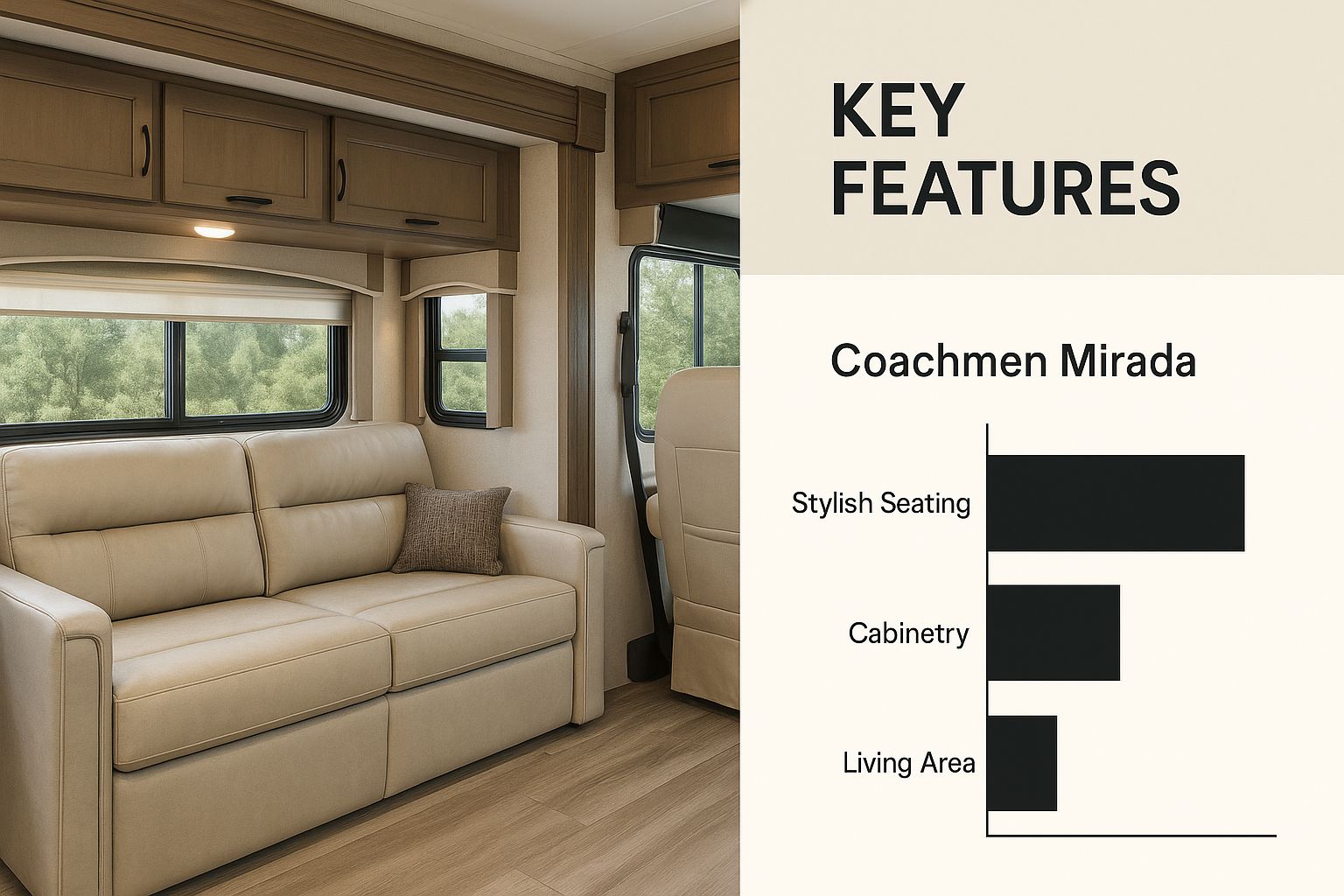
As the image shows, Coachmen really focuses on the details that make these spaces feel like home, from residential-style furniture to smart storage solutions that make life on the road so much easier.
To give you a clearer picture, here’s a quick comparison of how these two popular floorplans stack up for different travel needs. This should help you quickly identify which direction to lean in your search.
| Feature |
Mirada 35OS (Couples/Entertaining) |
Mirada 35ES (Family/Large Groups) |
| Primary Focus |
Open-concept living and social space |
Maximized sleeping capacity and separate zones |
| Key Living Area Feature |
Theater seating or large sofa opposite the TV/fireplace |
Often includes a dinette and sofa for versatile seating |
| Sleeping Capacity |
Typically sleeps 2-4 comfortably |
Can sleep up to 7 or more with bunks and drop-down beds |
| Unique Feature |
Expansive, "great room" feel perfect for hosting |
Dedicated bunkhouse area for kids |
| Best For |
Couples, solo travelers, or those who love to entertain friends |
Families with children or anyone traveling with a larger group |
This table isn't exhaustive, but it highlights the fundamental design philosophies behind these layouts. Your travel crew is the biggest factor in determining which one will feel like the perfect fit.
Looking beyond specific model numbers, a few design elements will make or break your day-to-day experience. As you look at photos and walk through potential RVs, keep a sharp eye on these three areas.
- Number of Slide-Outs: Slides are game-changers for interior space. A Mirada with two or three slides feels worlds apart from one with a single slide, especially on a rainy day when everyone is stuck inside.
- Kitchen Configuration: How do you cook? An L-shaped kitchen gives you more counter space for prep, while a galley-style layout can feel more open. Think about whether you need a full residential fridge or if a smaller one will do the job.
- Master Bedroom Design: Check for a walk-around bed—it’s so much easier than climbing over someone in the middle of the night. Also, open the closets. Is there enough room for your gear? Some layouts even include an ensuite master bath for extra privacy.
The Coachmen Mirada 35ES, for example, is well-known for its family-first versatility. With features designed to sleep up to seven people, including bunks and an overhead drop-down bunk, it’s a crowd-pleaser. Its dual slide-outs open up the living areas, and its larger 90-gallon gray and black water tanks are a huge plus for bigger groups. You can dive into the nitty-gritty of this popular family model with these in-depth Mirada 35ES details from CampersInn.com.
A floorplan is more than just a blueprint; it’s the framework for your adventures. Choosing the right one means you'll spend less time working around your RV and more time enjoying the journey.
By thinking through these practical details, you’ll be able to look past the sales sheet and really imagine how a specific layout will work for you. That’s how you find a used Mirada that truly feels like a home on wheels.
So you've found a promising online listing for a used Coachmen Mirada. That's the fun part. Now comes the real work—the part that protects your wallet and ensures you're buying a road-ready RV, not someone else's headache.
An in-person inspection is more than just a quick walkthrough. You need to become a detective, digging into the nooks and crannies to uncover the RV's true condition. A meticulous check can be the difference between hitting the road with a smile and getting hit with a surprise repair bill. We're going to go way beyond kicking the tires and admiring the floor plan. This is about spotting the deal-breakers and finding the little things you can use for negotiation.

Water is the number one enemy of any RV. A tiny, slow leak can quietly rot out floors and walls, leading to thousands in repairs and a nasty mold problem. Finding evidence of water damage means looking where most people don't think to.
Get on the roof. Don't just crane your neck from the ground—ask for a ladder and see it for yourself. You’re scanning for any sealant that's cracked, peeling, or pulling away from vents, skylights, and the front and rear caps. Every single crack is a potential floodgate.
Once inside, trust your nose first. A musty, damp smell is a dead giveaway that moisture is hiding somewhere. Then, get hands-on and check these common trouble spots:
- The Corners: Press firmly on the wall panels in all the corners, especially deep inside closets and cabinets. If it feels soft, spongy, or bubbly, water has been there.
- Windows and Vents: Look closely around every window frame and ceiling vent. You're searching for faint stains or delamination, which looks like the wallpaper is bubbling or pulling away from the wall structure.
- Under Sinks and in Bays: Grab a flashlight and check the plumbing under the kitchen and bathroom sinks. Don't forget to inspect the floors of the outside storage bays for any signs that water has leaked in from above.
A common mistake is seeing a clean interior and assuming everything is fine. Water damage often starts out of sight. Trust what your hands feel and what your nose smells far more than a surface-level glance.
Flipping a switch on and off doesn't tell you much. To really know if the systems work, you have to put them under a real-world load, just like you would on a camping trip. This is how you'll expose weaknesses that a simple on/off check would miss.
Before you go, arrange with the seller to have the Mirada plugged into shore power and, if possible, connected to a city water hookup. Once you're there, go through everything methodically.
- HVAC System: Crank the air conditioner and let it run for a solid 15 minutes. Is the air getting and staying cold? While it's still running, switch the thermostat over to the furnace. You should hear it ignite and feel hot air within a minute or two.
- Water Systems: If you're not on city water, turn on the water pump. It should pressurize the system and then shut off. If it keeps cycling on and off when no faucets are running, you've got a leak. Fire up the water heater (on both electric and propane, if it has both) and wait for the water to get hot at every single faucet.
- Appliances: Don't just look at them. Run the microwave, test every burner on the stove, and confirm the fridge gets cold on both its electric and propane settings.
It might feel a little tedious, but discovering a faulty $1,500 air conditioner or a dead water heater during your inspection gives you powerful negotiating leverage. Finding out after you've paid for it is just a bummer.
The "house" is only half of the motorhome. The chassis and mechanical systems are what actually get you to the campground, and they need just as much attention.
Slide-Outs Are Non-Negotiable
Run every single slide-out all the way out and all the way back in. Do this at least twice. As they move, listen closely to the motors. Any straining, grinding, or jerky movements are bad signs. Watch the slide itself to ensure it travels smoothly and seals evenly. A misaligned slide is a massive, and massively expensive, problem to fix.
Tires Tell a Deeper Story
RV tires are tricky. They almost always age out from sun exposure and lack of use long before their tread wears down. A tire can look brand new but be a blowout waiting to happen.
- Find the DOT Code: Look on the tire's sidewall for a string of letters and numbers that begins with "DOT."
- Read the Date: You only care about the last four digits. This is the date code. For example, if it says "2519," the tire was made in the 25th week of 2019.
- Assess the Age: Most RV experts agree that tires should be replaced every 5-7 years, no matter how good the tread looks. If the tires are in or nearing that window, you need to factor the cost of a full new set into your offer.
Finally, get down on the ground and look underneath the rig. Check the Ford F53 chassis for excessive rust—some surface rust is normal, but heavy, flaky corrosion on the frame is a red flag that it's seen harsh, salty roads. Look for any fluid leaks from the engine, transmission, or differentials. This thorough process will give you the confidence to make a smart offer and ensure your new-to-you Mirada is ready for adventure from day one.
So, you've decided a used Coachmen Mirada is the right RV for you. Great choice. Now comes the fun part: the hunt. Your perfect motorhome is out there, but you need to know where to look and, more importantly, what to look for. The search for the right RV can feel overwhelming at first, but it really boils down to a few key places.
Broadly speaking, you'll be looking at either dealerships or private sellers. Dealerships—whether they're big national chains or well-regarded local lots—offer a certain level of convenience. They usually have a decent selection, can help with financing, and might even throw in a limited warranty. For a first-time buyer, that peace of mind can be worth a lot.
Then you have the private market. Scouring sites like RV Trader or even Facebook Marketplace can uncover some real gems. You’re often buying from someone who loved and cared for their RV, and you can sometimes find a meticulously maintained coach for a fantastic price. The trade-off? It's on you to do the homework, because nearly every private sale is strictly "as-is."
Once you start scrolling, you'll see a massive difference in listing quality. Learning to read between the lines is a skill that will save you from chasing down duds and wasting weekends. A good listing paints a clear, honest picture of the RV; a bad one is often hiding something.
Photos are your first clue. A seller who takes the time to post 20+ bright, clear pictures of everything—the engine bay, the roof, inside cabinets, the undercarriage—is confident in what they're selling. They have nothing to hide.
Vague descriptions and a handful of blurry, distant photos are major red flags. If a seller can't be bothered to present their RV properly online, it makes you wonder how they handled crucial maintenance.
Be on the lookout for these tell-tale signs that a listing isn't worth your time:
- Stock Photos: If the pictures look like they were pulled from a Coachmen brochure, it’s a hard pass. The seller is almost certainly hiding the RV's actual condition. Demand current photos.
- Minimalist Descriptions: Phrases like "runs great" or "needs a little TLC" tell you absolutely nothing. A serious seller will list specific maintenance history, recent upgrades, and any known quirks.
- "Price is Firm" on Day One: While some sellers know their rig's value, slapping this on a brand-new listing can signal they're unreasonable or have an inflated idea of what it's worth.
Before you even think about driving to see a Mirada, a quick phone call can be the most productive ten minutes of your search. This is your initial screening process. You’re trying to disqualify listings and sellers so you don't waste a four-hour round trip on a rig that was never going to work.
A seller’s hesitation or evasiveness can be just as revealing as their answers.
Your Pre-Screening Checklist
- "Can you walk me through the maintenance history?" Don't settle for "it's been serviced." Ask for details. How old are the tires (check the DOT date code)? When was the roof last inspected and sealed? Do they have service records to back it up?
- "Have you ever had any leaks or water damage?" This is the big one. Ask it directly and listen to the pause before they answer. Water intrusion is a death sentence for an RV.
- "So, why are you selling it?" Their story can be very telling. Are they upgrading to a new model or getting out of RVing for health reasons? Or does it sound like they’re trying to unload it right before a huge repair bill is due?
- "Is the title clean and in your name?" You have to confirm there are no liens and that you're talking to the actual owner. Title problems can kill a deal at the last minute.
Asking these direct questions right away establishes you as a serious buyer. If the seller is open, honest, and happy to share the details, you can feel much more confident about scheduling that in-person inspection for that used Coachmen Mirada for sale.
You've done the hard part—the inspection. Now you have everything you need to make a smart offer on that used Coachmen Mirada. Getting the price right is what separates a good find from a truly great deal. This isn't about pulling a number out of thin air; it’s about using solid data to figure out a fair market value and then using your inspection findings to sharpen your pencil.
Before you can negotiate, you need a realistic starting point. The go-to resource for this has always been NADAguides. Make sure you're using their specific RV valuation tool, as it's built to understand the unique depreciation and features of motorhomes.
You'll plug in the Mirada's year, model, mileage, and any major options. NADA will spit back a few numbers: low retail, average retail, and sometimes a high retail. Don't treat these as gospel. Think of them as a ballpark estimate for a potential motorhome purchase. A garage-kept, impeccably maintained rig might lean toward high retail, while one showing its age and a few battle scars will naturally fall closer to the low end.
That NADA value is just a number on a screen. The real-world value of the specific Coachmen Mirada you're looking at is a different story. This is where your detailed inspection notes become your single most powerful negotiating tool.
Your job is to translate every issue you uncovered into a concrete dollar amount. This isn’t about being picky; it’s about calculating the real cost to get the RV into the condition you expect.
- Tires are a big one. If the tires are more than five years old (check the date codes!), you need to assume they require replacement for safety. A full set of six quality RV tires can easily run $3,000 - $4,000. That’s a massive chunk of change to factor into your offer.
- Appliances add up. Did the water heater refuse to fire up on propane? Was the rooftop A/C unit blowing cool, but not truly cold? Jump online and research the cost to repair or, more likely, replace those components. A new RV air conditioner, for instance, is a $1,500 job, installed.
- Don't ignore the cosmetics. Peeling decals, sun-faded upholstery, or scratched-up cabinet doors absolutely impact value. While they're harder to assign a specific number to, they fully justify an offer that's comfortably below the "average retail" price.
- Give credit where it's due. On the other hand, be fair. If the owner just installed brand-new house batteries, had the roof professionally resealed last year, or added a slick solar power system, that’s real, tangible value. Those upgrades can justify a price that’s closer to their asking price.
The whole point is to build a logical, fact-based case for your offer. When you can approach the seller and say, "The book value is X, but it's going to cost Y to replace the aging tires and fix the water heater," your offer suddenly sounds reasonable and justified, not like you're just trying to lowball them.
It also pays to know what's happening in the new RV market. For example, a brand-new Coachmen Mirada 35OS might carry an MSRP of $235,665, but a quick look at dealer listings reveals a more realistic "street price" around $169,997.
That’s a $65,668 drop right off the bat, which shows the steep, immediate depreciation new motorhomes face. This directly pushes down the value of a comparable used model. Knowing this helps you understand the pricing landscape and gives you context for what a two- or three-year-old model should be worth. You can get a feel for current new pricing by browsing listings for the Mirada 35OS on sites like CampersInn.com.
With your valuation solid, you can step up to the plate with confidence. How you play the game changes a bit depending on whether you're at a dealership or in a private seller's driveway.
Negotiating with a Dealership
Dealers have more wiggle room than you might think, but the negotiation is about more than the sticker price.
- Talk "Out-the-Door." Don't get distracted by monthly payment discussions. Your one and only focus should be the total, final price including all taxes, prep fees, and any other add-ons.
- Use Your Ammo. This is the time to pull out your inspection list. Politely walk them through the needed repairs. The conversation should be, "Are you going to fix these items before I sign, or are we going to deduct the cost from the price?"
- Be Willing to Walk. Your feet are your strongest negotiating tool. If the numbers just aren't adding up, thank them for their time and head for the door. It’s amazing how often a manager "finds" a little more room in the price a few minutes later.
Negotiating with a Private Seller
A private owner is often emotionally attached to their RV, so a respectful, person-to-person approach is key.
- Lead with a Compliment. Always start by mentioning what you genuinely like about their motorhome. It shows you’re a serious buyer who appreciates the care they've put into it and builds immediate rapport.
- Explain Your Number. When you make your offer, calmly explain how you got there. A simple script works wonders: "I really love the RV, and the NADA guide puts the average value right around here. I did factor in about $3,500 for the new tires it's going to need right away, so based on that, my offer is..."
- Expect a Counteroffer. The first offer is almost never the last. Go into the conversation with a firm "best and final" number in your head and stick to it.
Securing a great price on a used Mirada all comes down to being prepared. By doing your homework, trusting your inspection, and negotiating with confidence, you can drive away in the perfect motorhome knowing you made a smart, well-researched investment.
As you start zeroing in on a specific used coachmen mirada for sale, you're bound to have some lingering questions. This is totally normal. You’re moving past the big-picture research and getting into the nitty-gritty of making a major purchase. Getting these last few details ironed out will give you the peace of mind to move forward confidently.
Think of this as your final pre-purchase sanity check. We’ve pulled together some of the most common questions we hear from RV shoppers in your exact shoes, offering practical answers to help you navigate the home stretch.
This is the big one, isn't it? The good news is that these rigs are built to go the distance. A Coachmen Mirada, riding on that workhorse Ford F53 chassis, can easily reach 200,000 miles or more with consistent care. In terms of age, it's not at all surprising to see well-maintained Miradas still creating memories after 15 or even 20 years.
But mileage is only half the story. The real secret to a long-lasting RV lies in the upkeep.
- Engine & Chassis Service: Sticking to Ford’s recommended service schedule isn't just a suggestion—it's essential for any motorhome owner.
- Roof Maintenance: Water is the arch-nemesis of any RV. Regular inspections and sealing the roof are your best lines of defense against catastrophic leaks.
- System Upkeep: You have to use it to not lose it. This means properly winterizing plumbing and periodically running the generator and operating the slide-outs to keep everything in working order.
Honestly, no single model year of the Mirada has a widespread, "lemon" reputation. Coachmen has done a pretty good job of maintaining quality over the years. That said, it’s always a good idea for any prospective RV buyer to dig into the specifics of the year you're considering.
For instance, different model years might feature different slide-out mechanisms or come with appliances from different manufacturers. You can find this kind of invaluable, real-world intel on RV forums and owner groups. Hearing directly from people who own the exact model you're eyeing is priceless.
My advice? Worry less about the year on the title and more about the RV's actual condition and maintenance records. A ten-year-old Mirada that’s been pampered is a much smarter investment than a three-year-old one that’s been neglected.
This is a fantastic question. Even if an RV passes an inspection with flying colors, you should always budget for some initial expenses. It's just the nature of buying anything used. A smart move is to set aside a "settling-in" fund of $1,000 to $3,000.
Having this cushion means you can tackle common post-purchase items without any financial stress. This fund can cover things like:
- Tires: If the tires are more than five years old, replacing them should be your number one priority for safety.
- Batteries: You won't know the true condition of the house batteries until you've lived with them for a bit.
- Fluid Changes: Getting a fresh oil change and servicing the generator gives you a clean slate and peace of mind.
- Small Fixes:<