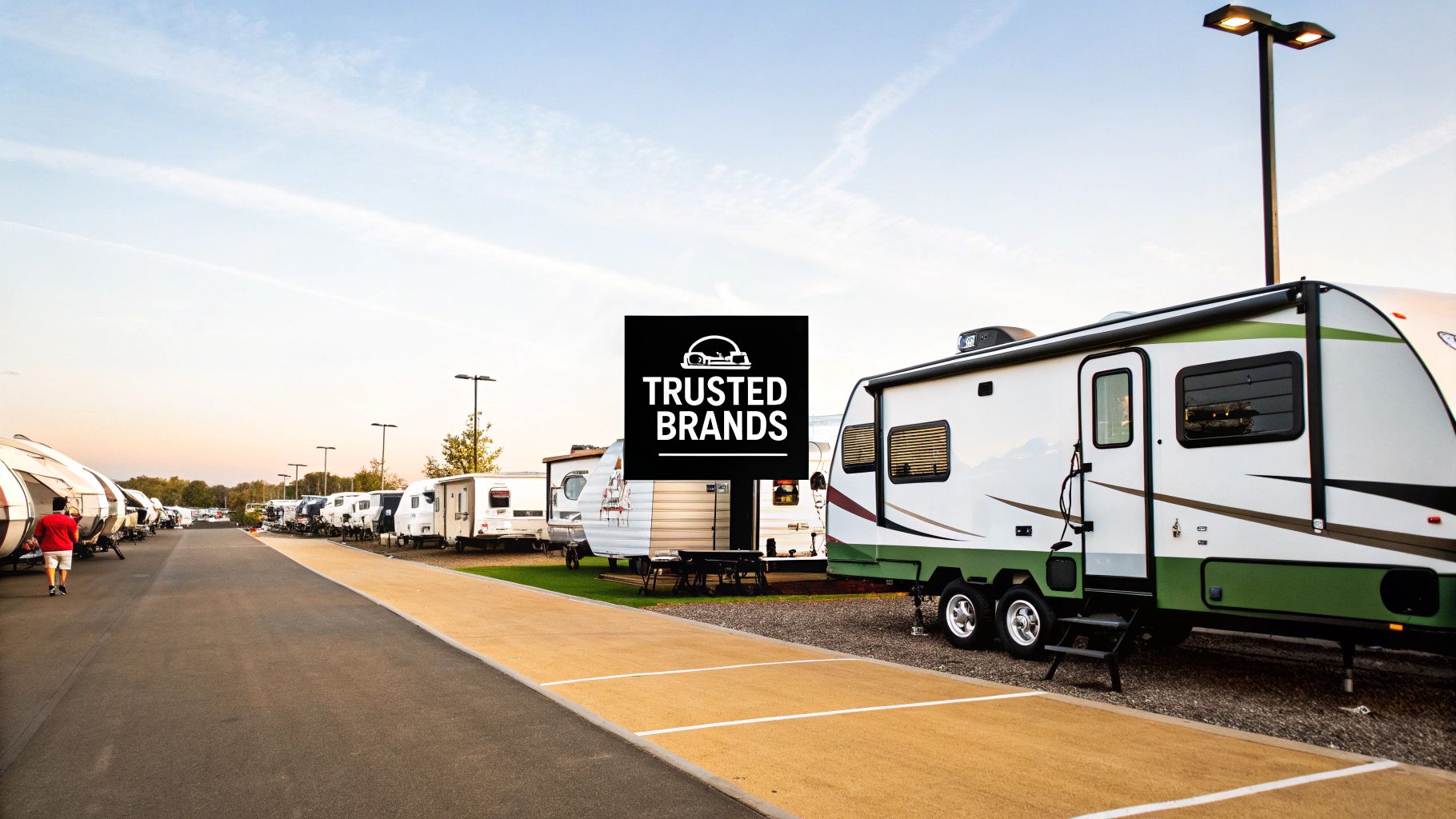
Ask any seasoned RVer what the best family travel trailer is, and you’ll likely hear names like the Jayco Jay Flight, Grand Design Imagine, or the Forest River Cherokee. They're popular for a reason—great bunkhouse layouts and solid construction. But the truth is, the "best" trailer is the one that’s best for you. It all comes down to your family's size, your travel plans, and what you’re driving to pull it.
Charting Your Course to the Perfect Family RV
Picking out a family travel trailer isn't just a purchase; it's the first step in designing your future adventures. It’s about the promise of waking up to a new mountain view, sharing s'mores around a crackling campfire, and building those core memories that stick around long after you’ve parked the rig back home. Whether you're planning quick weekend escapes or a cross-country summer trip, a travel trailer gives you the freedom to roam without leaving all the comforts of home behind.
And it's clear more families are catching on. The North American travel trailer market is booming, with revenues projected to hit $28.6 billion by 2025 and a staggering $57.3 billion by 2035. This isn't just a trend; it's a fundamental shift in how people want to vacation, trading resorts for the great outdoors.
Finding Your Ideal Home on Wheels
So, with all these options out there, how do you find the one that's just right? Think of this guide as your personal roadmap. We're going to help you move past the idea of a single "best" model and focus on finding the perfect match for your family's unique needs.
Before you get lost in floor plans and fancy features, it helps to understand the big picture. For most families, the first major decision is between a towable trailer and a drivable motorhome. If you're wrestling with that choice, our guide comparing motorhomes vs. travel trailers is a great place to start.
The goal isn't just to buy an RV. It's to invest in a vessel for family connection, one that carries you toward shared experiences and unforgettable moments on the open road.
We’ll walk through all the key factors, step-by-step, to make sure you feel confident and prepared to choose a trailer that will serve your family for years of adventures to come.
Matching Your Trailer to Your Tow Vehicle
Okay, before we get lost in the fun stuff like bunkhouse layouts and outdoor kitchens, we have to talk about the most important safety check there is. This is the one step you can't skip, the one that makes sure every trip is a safe one. It all boils down to a simple, non-negotiable rule: your vehicle must be able to handle the trailer you want to pull.
Think of your tow vehicle and travel trailer as a team. For that team to work, the stronger partner—your truck or SUV—has to be able to comfortably and safely manage the trailer's weight. Overloading your tow vehicle is like asking a runner to sprint a marathon with a backpack full of bricks. It’s stressful, incredibly dangerous, and simply won't end well.
Getting a handle on a few key weight terms is the first step to towing with confidence. This isn't about becoming an engineer; it's just about knowing your limits.
Decoding Trailer Weight Lingo
When you start looking at travel trailers, you’ll find a sticker on the side with a bunch of acronyms. Don't let them intimidate you. They just tell a simple story about the trailer's weight.
Here are the only numbers you really need to worry about:
Dry Weight (or UVW): This is what the trailer weighs completely empty, right off the factory line. It includes the standard appliances but no water, no propane, and none of your gear. Think of it as your starting point.
Cargo Carrying Capacity (CCC): This is the maximum weight of all the stuff you can load into the trailer. We're talking water, propane, food, clothes, camping chairs—everything.
Gross Vehicle Weight Rating (GVWR): This is the absolute maximum the trailer can weigh when it's fully loaded. It's simply the Dry Weight plus the Cargo Carrying Capacity. You should never, ever go over this number.
It’s just like packing a suitcase for a flight. The empty bag has a "dry weight." The clothes and shoes you pack are the "cargo." The airline's 50-pound limit is the "GVWR." It's that simple.
Finding Your Vehicle's Towing Capacity
Now, let's look at your tow vehicle. Its towing capacity is the maximum weight it can safely pull, period. The manufacturer sets this number based on the vehicle's engine, brakes, transmission, and frame.
Finding your vehicle's tow capacity is your top priority. You can usually find it on a sticker inside the driver's side door jamb. If not, dig out the owner's manual or check the manufacturer's website. This number isn't a suggestion—it's a critical safety limit.
A huge mistake people make is matching a trailer's dry weight to their vehicle's tow capacity. That’s a recipe for disaster because it leaves zero room for any of your gear. A much safer way to do it is to make sure your vehicle's tow capacity is comfortably higher than the trailer's GVWR. For a deeper dive into this, check out our complete guide to understanding RV trailer sizes for towing.
For example, if your SUV has a towing capacity of 7,500 pounds, you should really be looking for trailers with a GVWR of around 6,000 pounds or less. This buffer zone, often called the 80% rule, gives you a crucial margin of safety for braking, climbing hills, and just generally staying in control.
Getting this match right is the foundation of every safe and stress-free camping trip. Take the time to understand these numbers now, and you’ll avoid the gut-wrenching mistake of buying a trailer you can’t tow. More importantly, you’ll be keeping your family safe on the road.
Choosing the Right Floor Plan for Your Family
Think of the floor plan as the heart and soul of your travel trailer. It’s the blueprint that dictates how your family will live, eat, and relax on the road. This goes way beyond just counting how many people it can sleep. You need to picture your actual daily routine—from making breakfast on a rainy morning to unwinding after a long day of hiking.
The right layout is what turns a generic trailer into one of the best family travel trailers for your crew. Do you have young kids who need a dedicated zone for their toys? Or teenagers who would kill for a little bit of their own space? A good floor plan solves these problems before they start, keeping everyone happy in a relatively small space.
Let’s dive into the most popular layouts designed specifically for families.
Bunkhouse Models: The Family Camping Staple
For most families, the search for the perfect trailer starts and ends with a bunkhouse floor plan. There’s a good reason this layout is the undisputed champ of family camping: it gives the kids their own sleeping area, separate from the main living space and your bed. Trust me, that little bit of separation is a game-changer for everyone’s sanity.
But not all bunkhouses are built the same. The specific setup you choose will have a huge impact on both how many people you can sleep and how you use the space during the day.
Double-Over-Double Bunks: This is a super-efficient design, with two full-sized bunks stacked on top of each other. Each one can often sleep two smaller kids, meaning you can fit up to four children in one compact corner. It’s a fantastic choice for larger families or for when your kids want to bring friends along.
Quad Bunks: Usually found in a separate bunk room, this layout gives you four individual twin-sized bunks. It’s perfect for older kids or siblings who’ve outgrown sharing a bed, giving each child their own personal pod.
Dedicated Bunk Rooms: If you want the ultimate in space and separation, a private bunk room is the way to go. These rooms, often in a slide-out, might include the bunks, a small sofa, and even their own TV. On a rainy day, this space becomes a self-contained kids' haven, keeping the toy explosion contained and out of your living area.
Smart Designs for Maximizing Space
While bunkhouses get most of the attention, manufacturers have cooked up some other really clever layouts for family life. The industry is always innovating to keep up with what buyers want. In fact, the global travel trailer market is expected to grow from $105.94 billion in 2026 to $113.22 billion in 2025—that’s a 6.9% annual jump. You can read more about the global camper market trends to see how things are shifting.
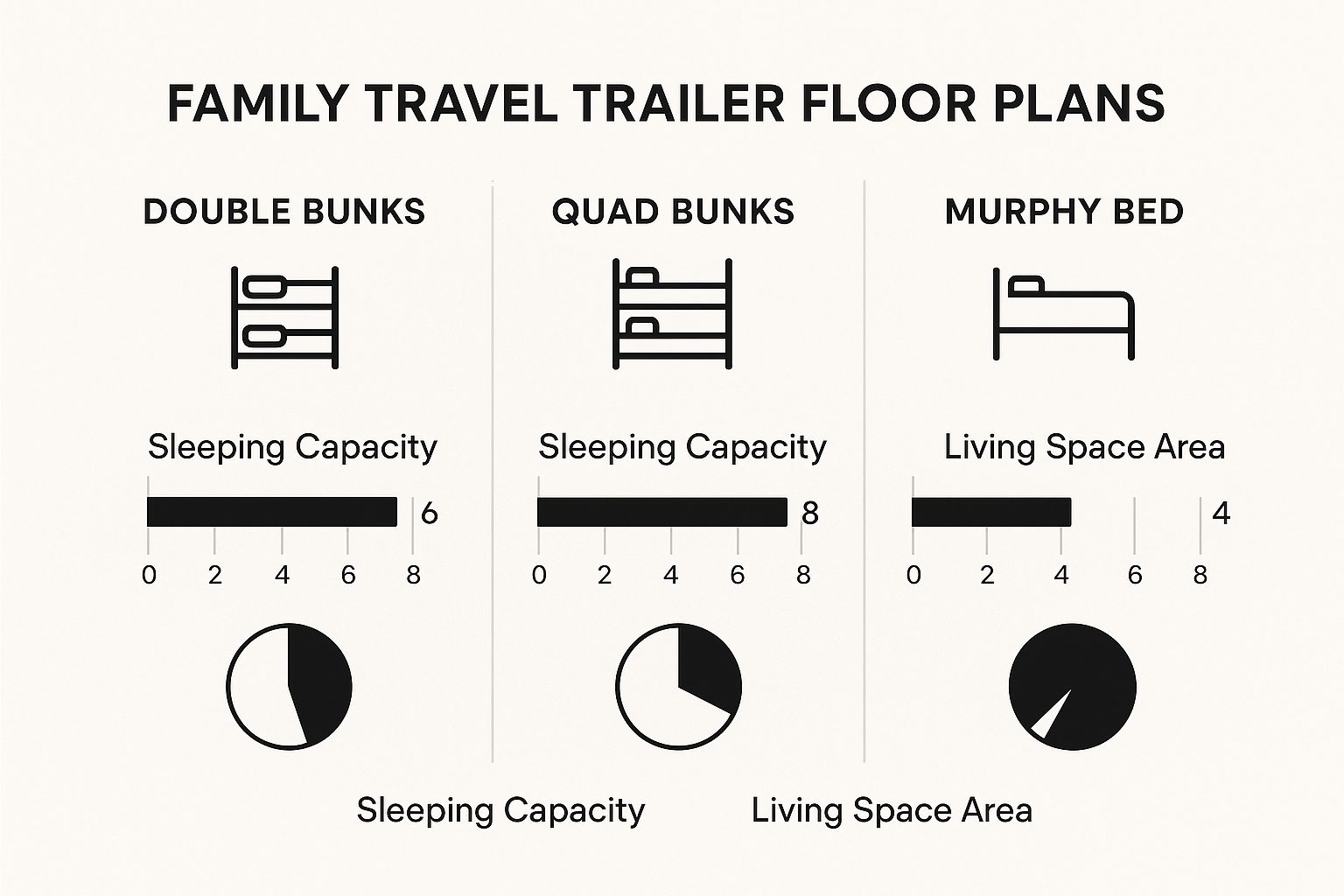
Here’s a quick look at how different layouts trade sleeping spots for living space.
As you can see, floor plans that use Murphy beds or have dedicated bunk rooms often give you a lot more usable floor space during the day.
Two other designs that families love are:
Murphy Bed Layouts: These are pure genius, especially in smaller, lighter trailers. During the day, the main queen bed flips up into the wall, revealing a comfy sofa. Your bedroom instantly becomes a living room, giving you a ton of extra space without making the trailer longer or heavier.
Rear Living Setups: This layout puts a big panoramic window and cozy seating (like a sofa or armchairs) at the very back of the trailer. It creates a bright, open living room that’s perfect for families who love parking in scenic spots and want a great space for movie nights.
The best floor plan is one that solves problems before they happen. It anticipates the need for storage, provides space for relaxation, and creates a natural flow that makes daily life on the road feel easy and intuitive.
Family Travel Trailer Floor Plan Comparison
Choosing a layout can feel overwhelming, so we've broken down the most common family-friendly options. This table compares the pros and cons to help you see which one might be the best match for your family's size and camping style.
Layout Type
Best For
Pros
Cons
Bunkhouse
Families with 2+ kids; those needing separate sleeping zones.
Maximizes sleeping capacity; gives kids their own space; keeps main area tidier.
Can reduce daytime living area; bunks may feel cramped for older teens.
Murphy Bed
Couples or small families; campers with lightweight tow vehicles.
Creates a huge amount of daytime floor space; feels very open; often lighter weight.
Bed must be made/put away daily; less permanent bedroom privacy.
Rear Living
Families who prioritize a comfortable lounge area and enjoy scenic views.
Bright, open living space; great for entertaining or relaxing; feels residential.
The living area is often far from the main entrance; can limit sleeping options.
Front Kitchen
Campers who love to cook and need lots of counter space.
Expansive kitchen prep area; often has a large front window for great views.
Kitchen traffic can be disruptive; sleeping areas may be smaller.
Ultimately, each layout offers a different way to live on the road. A bunkhouse is all about dedicated kid space, while a Murphy bed is about multi-functional, open-concept living. Consider your priorities to find the perfect fit.
Visualize Your Day-to-Day Life
The only way to know for sure is to imagine your family actually living in the trailer. Before you get swept away by a shiny new model, take a minute to walk through it and mentally run through a typical camping day.
The Morning Rush: Is there enough counter space to make coffee while the kids are grabbing cereal? Can people get around the kitchen without doing a constant clumsy dance?
Rainy Day Activities: If you’re all stuck inside, where are the kids going to play? Is there enough open floor for a board game or a comfy spot for them to curl up with a book?
Mealtime: Can everyone actually fit at the dinette? If you plan to eat outside, is it easy to get in and out without tracking mud all over the place?
Bedtime Routine: Can you get to the bathroom after the kids are asleep in their bunks without waking them? Is there enough privacy in the main bedroom?
Thinking through these simple, real-world scenarios is the secret to choosing a floor plan that doesn’t just look good on the lot—it truly works as a comfortable and practical home on wheels for your family.
Must-Have Features for Family Camping Comfort
A good floor plan is the skeleton of a great family camper, but the features and amenities are what bring it to life. These are the details that turn a good trip into a fantastic one, solving little problems you haven't even thought of yet and making your trailer feel like a real home on wheels.
Think about it this way: some amenities are just nice little luxuries, but others are total game-changers for family camping. As you start looking at different models, it helps to think in two categories: the absolute must-haves and the really nice-to-haves. This little mental trick will help you focus on what truly matters for how your family camps.
The Non-Negotiable Comforts
Some features have become so vital to family camping that you'll find them on almost any trailer worth its salt. These aren't just about adding frills; they’re smart, practical solutions for life on the road with kids.
Here’s what your "must-have" list should probably include:
A Second Exterior Door: You'll want to look for layouts with a second door leading directly into the bathroom. Trust me, this is a lifesaver. It means muddy kids can make a pit stop without tracking dirt all the way through the main living area. It’s a simple feature that keeps your floors infinitely cleaner.
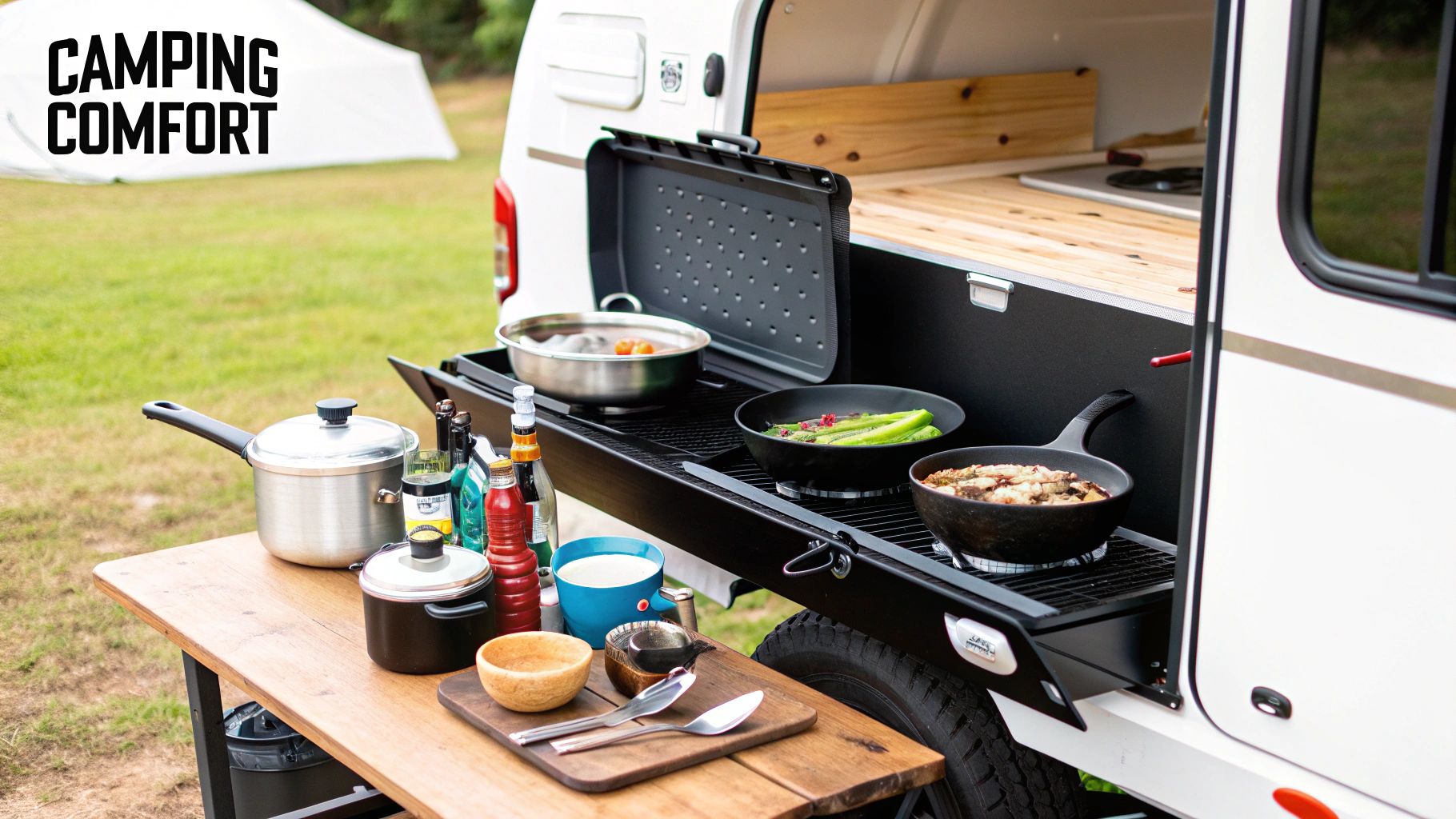
An Outdoor Kitchen: This is another game-changer. It gets all the messy cooking—think sizzling bacon or splattering burgers—out of your clean interior. It also becomes the go-to spot for grabbing drinks and snacks, so you don't have a constant stream of traffic through the main door.
Larger Water Tanks: If you have any plans to camp without full hookups (often called boondocking or dry camping), tank capacity is king. Bigger fresh, gray, and black water tanks mean you can stay off-grid for days without constantly worrying about where the next dump station is.
Upgrades That Add Real Value
Once you've got the essentials nailed down, you can start looking at the fun stuff—the features that add that extra layer of comfort and convenience. These upgrades can make a huge difference, especially on longer trips or those inevitable rainy days spent inside.
Consider these high-impact amenities:
USB Ports in Bunks: Every parent of a teen knows the struggle. Having dedicated USB ports in each bunk area puts an end to the squabbles over the kitchen outlet. Everyone gets to keep their phones and tablets charged in their own space.
Smart Entertainment Setups: A solid entertainment system is your best friend on a rainy afternoon. Look for rigs with smart TVs ready for streaming services and a speaker system that works both inside and out. It’s perfect for a cozy movie night or for playing some music around the campfire.
Solar Prep Packages: This is a forward-thinking feature. Even if you aren’t ready to install solar panels right now, buying a trailer that’s "solar prepped" is a massive win. The wiring is already in place, making it vastly easier and cheaper to add a solar system later on for true off-grid freedom.
Picking the right features is all about being honest about how your family actually travels. An outdoor kitchen is priceless for a family that loves grilling, but if you stick to simple meals, you might get more use out of extra storage space instead.
By weighing the must-haves against the nice-to-haves, you’ll find a travel trailer that doesn't just work for your family, but truly enhances your adventures together.
5. Planning Your Total Travel Trailer Budget
Buying a travel trailer is a huge step toward making incredible family memories, but the price you see on the tag is just the beginning. To really figure out which of the best family travel trailers is right for you, you need to look at the total cost of ownership, not just the purchase price.
Thinking only about the MSRP is a classic rookie mistake. It's like buying a house and completely forgetting you'll have to pay for insurance, utilities, and taxes. A smart, all-in budget keeps the RV a source of fun, not a financial headache. When you walk onto the dealer's lot knowing your true numbers, you're in complete control.
Beyond the Sticker Price: The Upfront Costs
Once you shake hands on a price, a handful of immediate costs pop up. These are the one-time expenses you'll need to cover to get your travel trailer on the road legally and ready for that first trip. Don't let them catch you off guard.
Here’s what you should plan for right away:
Sales Tax & Registration: Just like a car, you'll owe state sales tax, plus fees for the title and registration. This can add a surprisingly hefty chunk to the final amount.
Insurance: You can't legally tow it without insurance. Rates vary a lot depending on the trailer's value, your driving history, and how much coverage you want.
Essential Start-Up Gear: Your new rig won't come with everything you need. You'll have to buy necessities like a sewer hose, a drinking water hose, leveling blocks, wheel chocks, and a good surge protector to shield your electronics.
Weight Distribution Hitch: For most family-sized trailers, this is non-negotiable. It’s a critical piece of safety gear that makes towing much more stable and controlled. It's a worthwhile investment.
Anticipating Ongoing and Hidden Expenses
After you've got it home, a new set of costs will start to appear. These are the recurring expenses that come with actually using and taking care of your home-on-wheels. Building these into your budget from the start is the key to stress-free ownership.
These ongoing costs include routine maintenance (like checking seals and servicing the appliances), seasonal storage fees if you don’t have room at home, and of course, campground fees. You'll also need to budget for propane refills and the occasional repair as things wear out.
The true cost of an RV isn't just what you pay for it; it's what you pay to keep it ready for adventure at a moment's notice. A well-planned budget protects your investment and your peace of mind.
Knowing all this puts you in a powerful position. The North American RV market was valued at $21.8 billion in 2025, and sales are projected to hit $35.9 billion that same year. But here’s the good news for you: RV shipments have been outpacing sales lately. That means dealers are eager to move inventory, giving buyers like you some real negotiating power on new and last-year's models. You can dig into these current RV marketing statistics to get a better feel for the market.
Smart Financing and Budgeting
Most people finance their travel trailer, which adds another piece to the financial puzzle. Your monthly payment is a big deal, and locking in a good interest rate can save you thousands over the life of the loan.
For some solid advice on this, check out our guide on how to finance an RV the smart way. When you build a complete budget that covers everything—the purchase price, the upfront fees, and all the ongoing costs—you can choose a travel trailer that fits your family and your wallet perfectly.
Exploring Top Family-Friendly Travel Trailer Brands
When you start shopping, the number of travel trailer manufacturers can feel overwhelming. But just like with cars, a handful of brands consistently stand out for their family-friendly designs and proven reliability. Looking at these trusted names is a smart first step, as it helps you focus on some of the best family travel trailers available today.
Think of it this way: each brand has its own personality. Some are known for being rugged and dependable, others lean into luxury, and some are all about giving you the most bang for your buck. Let's dive into a few of the most respected names you'll see on the road.
Jayco A Legacy of Family Camping
You can’t walk through a campground without seeing a Jayco—and there's a good reason for that. They have spent decades perfecting family-focused RVs. Their Jay Flight series, in particular, has been one of America's bestselling travel trailers for years on end.
What really makes Jayco a go-to for families is their industry-leading warranty. It often includes multiple years of structural coverage, which offers incredible peace of mind when you're making such a big investment. They build practical, solid trailers designed to handle the bumps and scrapes that come with family adventures.
Grand Design A Focus on Quality and Service
In a relatively short time, Grand Design has earned a stellar reputation by prioritizing top-tier quality and customer service that actually helps. Talk to any Grand Design owner, and you'll likely hear them rave about the brand's attention to detail, from the high-end finishes to the thorough inspections done before a trailer ever leaves the factory.
Grand Design really puts the customer first. Their owners' groups are incredibly active and the company is known for being responsive, creating a loyal community that's hard to find. This makes them a fantastic choice for families who want a smooth, hassle-free ownership experience.
Models like the Grand Design Imagine are popular because they offer smart layouts with a more residential feel. You get a touch of luxury without losing the practical features your family needs. If build quality and solid support after the sale are at the top of your list, you have to check out Grand Design.
Forest River Unmatched Variety and Options
Forest River is an absolute giant in the RV industry, with a huge family of brands under its umbrella, including popular names like Cherokee, Wolf Pup, and Salem. Their greatest strength is the sheer variety they offer. No matter your budget or tow vehicle, they almost certainly have a model that fits.
This massive selection means you can find everything from a lightweight bunkhouse for your weekend trips to a huge destination trailer with a separate bunk room for the kids. A few key advantages are:
Broad Dealer Network: With so many brands, it’s usually easy to find a local dealer for sales and service, which is a huge plus.
Innovation Across Lines: Their different divisions are constantly trying out new floor plans and features, so their lineup always feels fresh.
By starting your search with well-known brands like these, you can be confident you're looking at trailers built by companies with years of experience creating homes-on-wheels for families just like yours.
Common Questions About Family Travel Trailers
As you get closer to pulling the trigger on the perfect travel trailer for your crew, a few last-minute questions always seem to pop up. It's totally normal. Getting straight answers to these common concerns can give you that final dose of confidence you need to make a great choice.
Let's walk through some of the things families wonder about most.
What Is the Best Month to Buy a Travel Trailer?
Timing your purchase can absolutely save you some serious cash. Hands down, the best deals on new travel trailers are found in the late fall and winter, typically from October through February.
This is the industry's slow season. Dealers are looking to move last year's models off the lot to make space for the incoming new inventory, which puts you in a much stronger negotiating position. Come springtime, everyone has "camping fever," and that high demand means prices get much firmer.
Should I Buy a New or Used Travel Trailer?
This is the classic dilemma, and there’s no single right answer—just what's right for you.
Buying a new trailer is great. You get that full manufacturer's warranty, the latest bells and whistles, and the simple peace of mind that comes with being the first owner. Of course, you pay a premium for that, and just like a new car, it starts depreciating the second you drive away.
On the flip side, a used travel trailer can be a fantastic value, often letting you afford a model with more space or better features than you could buy new. The catch? You're inheriting its history, and the biggest boogeyman is hidden water damage. It can be a total deal-breaker.
A professional, third-party inspection is the single most important thing you can do when buying a used RV. The few hundred dollars it costs could easily save you thousands in repair bills. Think of it as cheap insurance.
How Much Maintenance Does a Travel Trailer Require?
Don't let anyone tell you otherwise: travel trailers need consistent attention to stay in good shape. Just imagine your house enduring a constant, low-grade earthquake every time you hit the road—that’s what your trailer goes through.
You don't have to be a master mechanic, but you'll need to get comfortable with a few key tasks:
Sealant Checks: Every few months, you have to get on the roof and check the seals around vents, skylights, and the edges. This is your number one defense against leaks.
Tire Care: Check the tire pressure before every single trip. It’s a simple step that prevents dangerous blowouts.
Winterizing: If you live anywhere that freezes, you must winterize the water system. It's a process of draining the water and adding non-toxic antifreeze to prevent your pipes from bursting.
It might sound like a lot, but a simple seasonal checklist makes it easy to manage. A little proactive effort goes a long way in preventing small issues from becoming trip-ruining, expensive headaches.
Ready to find the perfect RV that fits all your family's needs? Use the powerful search tools and expert resources at Searchshop to compare floor plans, check specs, and connect with trusted dealers today. Your next adventure is just a click away at https://www.searchshop.com/rv.