Picking the right motorcycle is less about what looks cool and more about being brutally honest with yourself about how you'll actually use it. Are you planning epic cross-country tours or just trying to beat rush-hour traffic? The secret to finding a vehicle you'll love for years—whether it's a motorcycle, an RV, or a boat—isn't about horsepower; it's about matching the machine to your mission.
Before you even think about engine size or paint jobs, take a minute for some serious self-reflection. What does your ideal day on the road or water look like? Getting this part right is your compass—it’ll point you toward the right style of vehicle and keep you from ending up with a beautiful machine that just collects dust because it doesn't fit your life.
This single decision has a ripple effect on everything else. A nimble, lightweight bike that’s a dream for slicing through city traffic will feel twitchy and exhausting on a long highway trip. Likewise, that big, comfortable touring bike—much like a large RV—becomes a real handful when you’re just trying to find a parking spot downtown.
So, let's get specific. What will you be doing 80% of the time? Be realistic. While we all dream of that epic road trip, your daily reality might be a 15-mile commute.
-
The Daily Commuter: If your bike is your primary way to get to work or class, you need something practical. Think fuel efficiency, agility for tight spaces, and a comfortable, upright seating position. A standard or "naked" bike is often the perfect tool for this job.
-
The Weekend Adventurer: Do you spend your weekdays dreaming of twisting backroads or open water? You'll want a vehicle that can handle a bit of everything. Adventure (ADV) and dual-sport bikes are the swiss army knives of the motorcycle world, much like a versatile Class B RV is for land-based exploration.
-
The Long-Distance Tourer: For those who measure trips in days, not hours, comfort is non-negotiable. You’ll be looking for bikes with great wind protection, a seat you can live in, and plenty of room for gear. Cruisers and dedicated touring machines are engineered from the ground up to gobble up highway miles without beating you up.
Choosing a recreational vehicle is a deeply personal decision. It’s not just about specs—it’s about finding a machine that matches your personality and the adventures you have planned.
It's a great time to be a rider. The global motorcycle market is booming, valued at an estimated USD 189.32 billion, and it's only getting bigger. Motorcycles command a massive 81.3% market share over scooters, mostly because riders value their superior stability and power.
But the choices are also getting more complex. It's not just about gas engines anymore. The rise of impressive electric motorcycles and the integration of smart tech are changing the game. This means you have more options than ever, which makes it even more critical to nail down what you really need. You can dive deeper into these trends in the full motorcycle market analysis.
The price you see on the tag? That’s just the beginning. Anyone who owns a motorcycle, RV, or boat will tell you that the real cost of ownership is a lot more than what you pay at the dealership. Getting a handle on the total cost of ownership right from the start is the best way to make sure your new ride is a source of joy, not financial stress.
Think of it this way: the vehicle is the ticket to the show, but you still need to pay for everything else. Essential safety gear—a good helmet, a proper jacket, gloves, and boots—isn't optional. It’s part of the startup cost. Skimping here is a mistake you don't want to make.
Once you've bought the bike and the gear, the spending doesn't stop. The ongoing expenses are what really determine if a vehicle fits your lifestyle long-term.
-
Insurance: This one’s a biggie, and it's mandatory. Insurance rates can vary wildly based on the bike, your age, and your driving record. As you figure out what you can afford, remember to get some insurance quotes. Learning how to choose the perfect insurance policy is a critical step in managing this major recurring expense.
-
Registration and Taxes: Every year, you’ll be paying fees to keep your vehicle legal. It’s easy to forget, but your state wants its cut. Factor this into your annual budget.
-
Maintenance: Bikes need love. We're talking regular oil changes, new tires every few thousand miles, chain adjustments, and brake checks. Setting aside a few hundred dollars a year for basic upkeep is a smart move.
This kind of realistic budgeting is more critical than ever. The industry has seen some turbulence lately, sometimes called a 'motorcycle market crisis,' fueled by high prices and tough financing terms. As a result, buyers are getting smarter and focusing more on long-term value. For more on this, check out these motorcycle industry trends.
One of the first major decisions you'll face is whether to buy a shiny new vehicle off the showroom floor or go for something with a few miles on it already. There's no single right answer—it all comes down to your priorities and budget.
Pro Tip: I almost always recommend a used bike for a new rider. There's a decent chance you'll have a low-speed tip-over while you're getting the hang of it. Dropping a used bike stings a lot less than putting the first scratch on a brand-new machine.
Buying new is tempting. You get a full warranty, the latest tech and safety features, and that unbeatable feeling of being the first owner. The downside? Depreciation hits you the second you ride it off the lot. A used vehicle, however, lets someone else take that initial financial hit. You can often get a much more capable machine for your money and learn to ride without the constant fear of that first scratch. The trade-off, of course, is you're on the hook for any potential mechanical surprises and you won't have a warranty to fall back on. This choice will be one of the biggest factors shaping your initial investment.
Now that you've got a handle on how you plan to ride, let's talk about the bikes themselves. The motorcycle world is way more diverse than you might think, with each category built for a very specific job. It’s a lot like choosing any recreational vehicle—you wouldn’t buy a two-seater sports car to haul a family of five, and you wouldn't take a massive Class A motorhome down a tight city street.
Getting to know the core design philosophy behind each type of bike is crucial. It’s the only way to look past a cool paint job and find a machine that actually fits your life and your riding goals.
When you close your eyes and picture a classic motorcycle, you're probably imagining a cruiser. These bikes are all about a relaxed, feet-forward riding position, a low seat, and an engine that delivers smooth power right from a stop.
They aren't built to break land-speed records. They're built for comfortable, easygoing rides down the highway. That low seat height also makes them incredibly confidence-inspiring for new riders, since you can easily plant both feet flat on the ground at a red light.
Flip the script completely, and you have the sport bike. These are pure performance machines, dripping with technology born on the racetrack. The riding position is aggressive and forward-leaning, the footpegs are high and back, and the engines scream for high RPMs.
While they are an absolute thrill on a canyon road or a track day, that committed riding position can be tough on your back and wrists during a daily commute. Their lightning-quick handling requires focus and skill, making them a better fit for riders who already have some solid experience under their belt.
For the rider whose dreams are filled with cross-country epic journeys, the touring bike is king. Think of these as the luxury sedans of the motorcycle world, built from the ground up for maximum comfort over long distances.
A great touring bike makes the miles melt away. They come equipped with large fairings for wind protection, plush seating for rider and passenger, and integrated luggage systems to carry everything you need for a week-long adventure.
But what if your riding isn't so black and white? What if you want a bike that can do a little bit of everything? That’s where standard and adventure bikes come in.
-
Standard Bikes: Often called "naked bikes," these are the ultimate all-rounders. They feature a neutral, upright riding position that strikes a perfect balance between comfort and control. This makes them fantastic for everything from zipping through city traffic to carving up backroads on the weekend.
-
Adventure (ADV) Bikes: If a standard bike is a sedan, an ADV bike is an SUV. With long-travel suspension, rugged construction, and often knobby tires, they are designed to be just as happy on a dirt trail as they are on the interstate. They offer the ultimate freedom to explore wherever the road—or lack thereof—takes you.
To help you see how these categories stack up, here’s a quick-glance comparison.
| Motorcycle Type |
Best For |
Riding Position |
Key Characteristics |
| Cruiser |
Relaxed highway riding, city cruising, shorter trips |
Laid-back, feet forward, low seat |
V-twin engines, low-end torque, classic styling |
| Sport Bike |
Canyon carving, track days, performance riding |
Aggressive, forward-leaning, high pegs |
High-revving engines, advanced tech, aerodynamic fairings |
| Touring |
Long-distance travel, two-up riding, commuting |
Upright, relaxed, maximum comfort |
Large fairings, luggage, infotainment systems |
| Standard/Naked |
Commuting, weekend rides, general-purpose fun |
Neutral and upright, a mix of comfort and control |
Minimal bodywork, versatile performance, user-friendly |
| Adventure (ADV) |
On- and off-road exploring, long-distance touring |
Upright and commanding, built for standing |
Long suspension travel, rugged build, versatile tires |
This table should give you a solid starting point for narrowing down the field based on what you really need from a motorcycle.
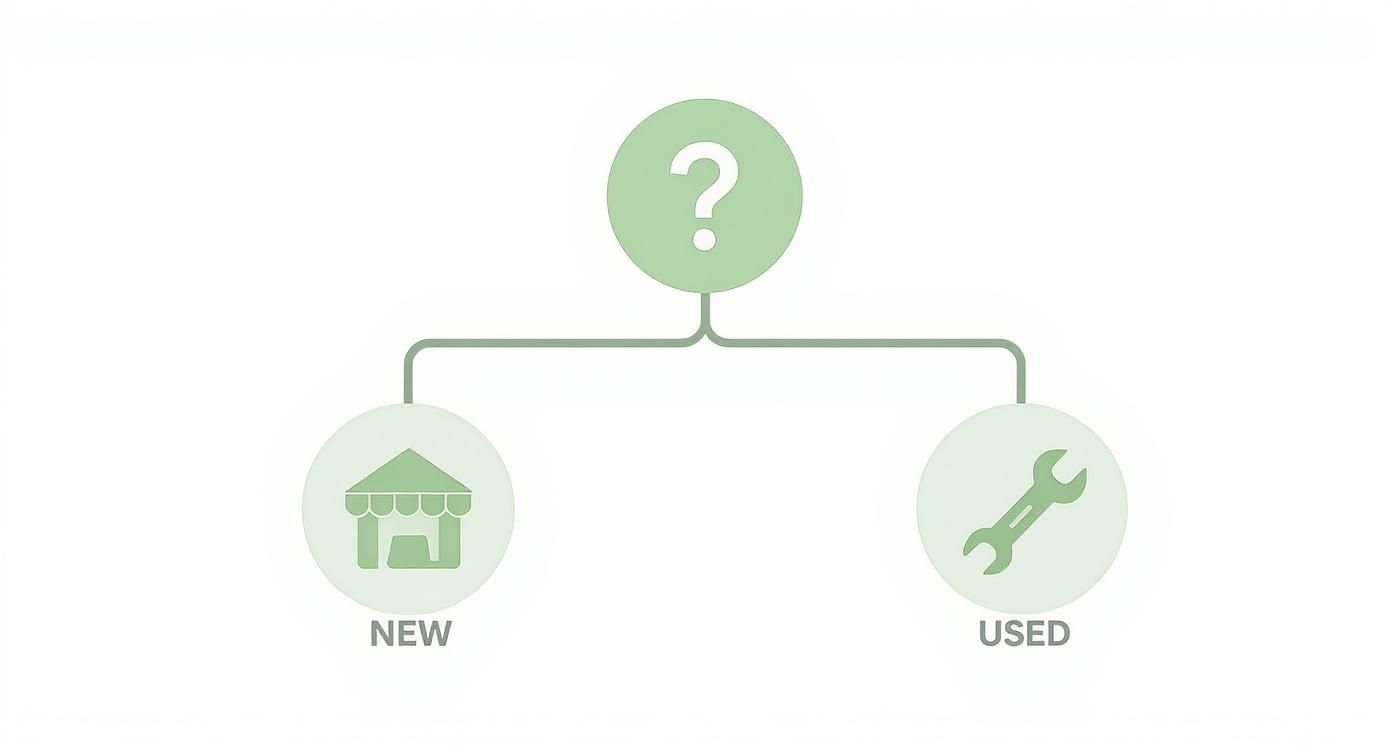
This decision tree is a great visual for one of the first big questions you'll face: new or used? Your budget will often make this decision for you, pointing you toward either a dealership showroom or the pre-owned market.
Engine size, measured in cubic centimeters (cc), is the first spec most people look at. It's easy to get caught up in the numbers game, but when you're starting out, bigger is almost never better. The single most important decision you'll make is picking an engine with a manageable amount of power. It's the foundation for your confidence, your safety, and your ability to build good habits from day one.
Think of engine displacement as the bike's raw potential. A smaller engine is a patient teacher—it responds predictably and won't throw you for a loop with a sudden, unintentional twist of the throttle. That forgiveness is your best friend while you’re getting the hang of the delicate dance between the clutch, throttle, and brakes.
For almost every new rider, I recommend starting with an engine under 500cc. There's a reason for this. Bikes in this range are typically lighter, more nimble, and far less intimidating at low speeds, which is where you'll spend a ton of time learning. You get to focus on mastering the fundamentals without feeling like you're trying to tame a monster.
The global motorcycle market, now valued at around USD 71.92 billion, has exploded with options that prove this point. We're seeing everything from tiny 100cc commuters to massive 1000cc+ touring machines. This growth isn't just about raw power; it's about riders choosing the right tool for the job. You can discover more about these motorcycle market insights and see how this trend plays out worldwide.
A smaller, more manageable motorcycle allows you to become the master of the machine. Starting too big often means the machine masters you, which can be both intimidating and dangerous.
It's not just about the cc's. The type of engine completely changes how a bike feels and delivers its power on the road. You don't need to be a mechanic, but knowing the basics will help you find a bike with a personality that clicks with yours.
-
V-Twin Engines: The heart and soul of most cruisers. They're famous for that deep, rumbling sound and a ton of low-end torque. That means they pull hard right from a stop without you needing to scream the engine, making for a relaxed, muscle-bike feel.
-
Inline-Four Engines: The classic sport bike engine. They're incredibly smooth and absolutely love to be revved high. All their excitement and power lives way up in the RPM range, rewarding a more aggressive riding style with a thrilling rush of speed.
The real goal here is to match the engine to where and how you’ll actually be riding. A fire-breathing superbike built for a racetrack will feel clumsy and miserable in stop-and-go city traffic. On the flip side, a small, nimble bike that's a joy in town will teach you skills in control and precision that will stay with you for your entire riding career, no matter what you ride next.
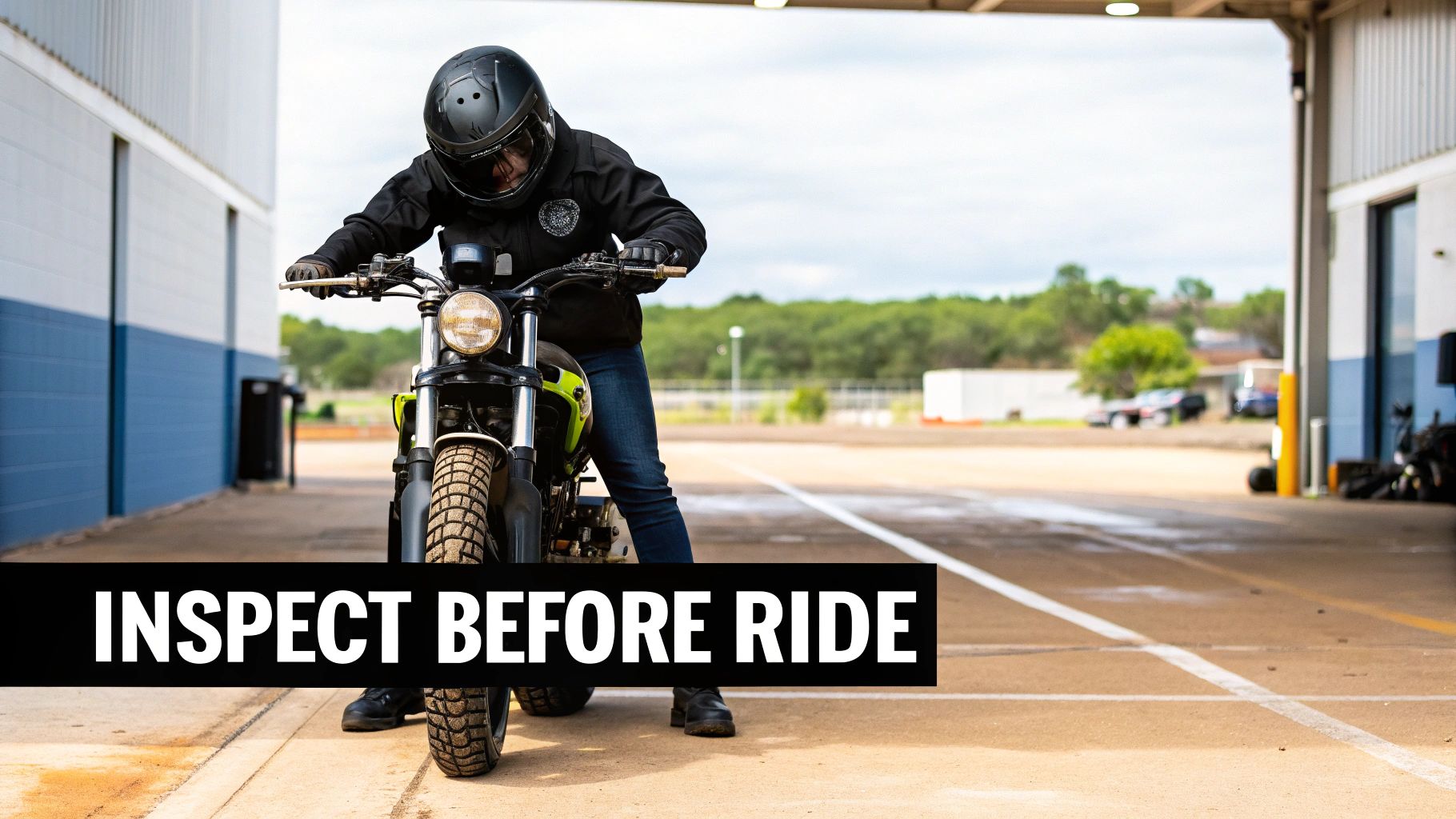
Alright, you've done the homework. You know what you need, you've crunched the numbers, and you have a bike in your sights. Now for the fun part—seeing if the reality matches the brochure. This is where you get your hands on the machine and find out if it truly fits.
Before you even think about firing it up, just sit on it. Seriously. Swing a leg over and get a feel for the bike's ergonomics. Can you plant the balls of both feet firmly on the ground? Being able to hold the bike steady at a stoplight is a massive confidence booster, and it’s a non-negotiable for safety.
Now, grab the handlebars. Your arms should have a comfortable, slight bend. If you're stretching uncomfortably or feel cramped, that's a red flag. The same goes for the footpegs and controls—they should feel natural and easy to reach without twisting your ankles into weird positions.
A test ride tells you everything a spec sheet can't. You're not just there to feel the acceleration; you're getting to know the bike's personality. Pay close attention to how it handles at low speeds, because that’s where you'll spend most of your time in city traffic.
The goal of a test ride isn't to see how fast the bike can go, but how well it communicates with you. A good motorcycle feels like an extension of your body, responding predictably to your inputs.
While you're out there, really focus on these key points:
-
Throttle Response: Is it smooth as butter or jerky and aggressive? A gentle, predictable throttle is your best friend when you're starting out.
-
Braking Feel: The levers should feel firm and give you solid stopping power without being too grabby. Squeeze the front and press the rear brake separately to understand how each one behaves on its own.
-
Handling and Balance: Lean it into a few corners. Does the bike feel eager and stable, or do you have to fight it? A bike that feels light and nimble on its feet is far more enjoyable and confidence-inspiring.
Eyeing a pre-owned bike? Great! But this means you need to play detective. A detailed visual inspection can save you from a world of mechanical and financial headaches down the road. Don't be afraid to bring a small flashlight and get on your knees for a closer look.
Here’s a quick-and-dirty checklist to run through:
-
Tires: Check the tread depth, obviously, but also look closely at the sidewalls for cracks or dry rot. Weird wear patterns can hint at bigger alignment problems.
-
Chain and Sprockets: The chain should be clean, lubed, and have about 1 to 1.5 inches of slack. Look at the teeth on the sprockets—if they look hooked or sharpened like a shark’s fin, they're toast and need replacing.
-
Leaks: Scan the engine, fork seals, and brake lines for any drips or wet spots. A tiny bit of weeping oil can signal a much more expensive problem brewing under the surface.
-
Electrics: Pop the key in and flick every switch. Test the headlight (both high and low beams), turn signals, brake lights, and the horn. Electrical gremlins are notoriously frustrating to fix.
This final, hands-on step is what ties everything together. It’s the ultimate confirmation that all your research has led you to a motorcycle that doesn't just fit your budget and riding plans, but actually fits you. Get this part right, and you're setting yourself up for thousands of safe, happy miles.
As you get closer to pulling the trigger, a few final questions always seem to pop up. Answering these is the last step before you can buy with total confidence. We've all been there, so let's walk through the things that are probably on your mind.
This isn't just about buying a bike; it's about buying your bike—the one that makes those first few thousand miles a joy, not a headache. Think of this as the final gut-check.
I almost always recommend a used bike for a first-time rider. Why? Because you're probably going to drop it. It happens to the best of us—usually a slow-speed tip-over in a parking lot. Scratching up a used bike stings a lot less than putting the first dent in a brand-new machine. Plus, the previous owner already took the biggest depreciation hit, so you get more motorcycle for your money.
That said, a new bike has its own appeal. You get a full factory warranty, the latest safety tech like ABS, and that unbeatable feeling of being the first and only owner. It really comes down to whether your budget prioritizes value or that fresh-from-the-factory peace of mind.
Choosing your first motorcycle is a deeply personal decision. It's about comfort, confidence, and finding something that matches you as a rider starting from scratch.
Yes. Next question.
Okay, a little more detail: Anti-lock Braking System (ABS) is arguably the single most important safety feature on a modern motorcycle, especially for a newer rider. It prevents your wheels from locking up and skidding during a panic stop. This means you can keep steering and stay upright when you need it most.
Even seasoned riders can get into trouble on a wet road or when a car pulls out unexpectedly. ABS is that safety net you hope you never need, but you'll be incredibly grateful it's there if you do. For the confidence and protection it provides, we highly recommend making ABS a non-negotiable feature.
You have to be comfortable on the bike—period. When you sit on it, you should be able to get at least the balls of your feet flat on the ground. If you're on your absolute tiptoes, you're going to feel unstable at stops. Your arms should reach the handlebars with a slight, natural bend, and you shouldn't feel like you're stretching or cramping up to reach the controls.
For a beginner, an engine somewhere between 250cc and 650cc is the sweet spot. This range gives you enough juice to comfortably handle highway speeds without being so powerful that it's intimidating or twitchy in town. It's all about finding a bike that feels manageable. As you get into the nitty-gritty of ownership, you'll run into practical questions, like figuring out how to program vehicle keys if you lose one. Starting on a modest engine lets you build your core skills before you ever think about upgrading to something with more power.
At SearchShop.com, we are committed to improving the vehicle buying experience. Use our tools to analyze prices, read reviews, research pricing history, and search thousands of listings for your perfect first motorcycle, RV, or boat today. Find your next adventure at https://www.searchshop.com.