The moment you start searching for fishing sport boats for sale, the adventure has already begun. This isn't just about buying something; it’s about opening the door to countless days on the water, chasing the next big catch. Think of this guide as your first mate, here to help you navigate the process and turn what can feel like a complex purchase into a confident, exciting experience.
Let's be honest, staring at a sea of listings can feel a little overwhelming. But it doesn't have to be. The trick is to break it down, just like you would when planning a major fishing trip. You wouldn't leave the dock without a plan and the right gear, and buying a boat is no different.
We've designed this guide to be your personal consultant, giving you the real-world knowledge to look at any listing with a sharp eye. We'll start with the basics—figuring out which boat types match your style of fishing, what really matters in an engine, and how to spot the features that will make your time on the water unforgettable.
The market for these boats is absolutely booming. Right now, the global sport fishing boat market is estimated to be worth around $2.5 billion in 2025 and is expected to climb to nearly $4 billion by 2033. This isn't just a random spike; it’s fueled by a growing passion for fishing and some incredible leaps in boat technology. You can dig into the numbers yourself by reading the full research about the sport fishing boat market.
What does this mean for you? More choices. Better boats. From high-tech fish finders to incredibly efficient engines, the features available today were once the stuff of pro tournament circuits. Now, they're within reach for everyday anglers.
Your goal isn't just to buy a boat—it's to find a partner. The right vessel will get you to those hidden spots and help create memories with friends and family that last a lifetime.
We’re going to walk through everything you need to know to make a smart investment that pays off in years of enjoyment. No fluff, no jargon—just practical advice that gets straight to the point. When you understand the fundamentals, you’ll be in a much stronger position to evaluate any boat that catches your eye.
Here’s a quick look at what we'll cover:
- Boat Types and Hull Designs: We'll break down how a boat's shape affects its ride and stability.
- Engine Options: Outboard, inboard, sterndrive? We’ll clear up the confusion.
- Essential Features: Learn about the must-have gear for serious fishing and the nice-to-haves for family fun.
- Financing and Negotiation: Get our best tips for securing a good loan and making a deal you feel great about.
By the time you finish this guide, you won't just be a shopper. You'll be ready to choose the perfect platform for all your future adventures.
Before you start looking at listings for fishing sport boats for sale, you’ve got to get the basics down. Think of it like learning the rules of the road before buying a new car or RV. Boats are purpose-built machines, and their shape—especially the hull—is what dictates their performance. It determines how they handle rough seas and how steady they are when you're casting a line. Getting these fundamentals right is the first step to finding a boat that actually fits your fishing style.
A boat’s hull is its foundation, the part that actually sits in the water. The design of that hull has the single biggest impact on how the boat performs. The two most common designs you’ll come across are the Deep-V and the Flat-Bottom, and they couldn’t be more different.
A Deep-V hull does exactly what it sounds like: it cuts through the water with a sharp, V-shaped profile. Picture a knife slicing through water—that's a Deep-V. This design is your best friend for offshore fishing because it gives you a much smoother, more stable ride in choppy seas. It slices through waves instead of getting tossed around by them.
On the flip side, you have the Flat-Bottom hull. This one is more like a raft gliding across the surface. Because it sits on top of the water, it’s incredibly stable in calm, shallow places like lakes, rivers, and coastal flats. But that stability comes at a price; take it into any kind of chop, and you’re in for a rough, teeth-rattling ride.
The hull design is the single most important factor determining where you can safely and comfortably fish. Choosing the right hull for your primary fishing environment is a non-negotiable first step.
Now that you know a bit about hulls, let's look at the most popular types of fishing sport boats you'll find out there. Each of these styles pairs a specific hull with a deck layout designed for a certain kind of fishing.
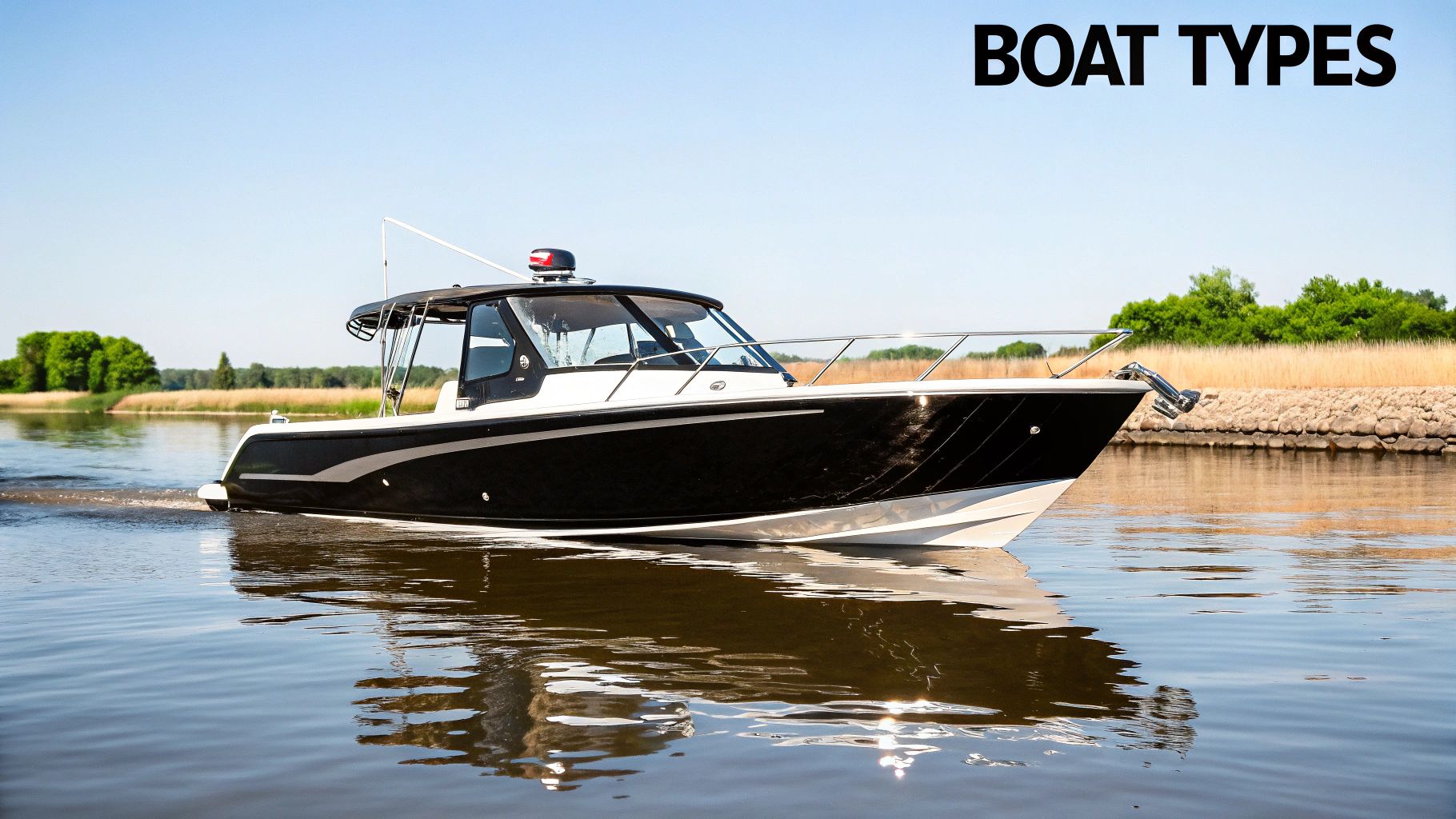
To help you sort through the options, here's a quick comparison of the most popular fishing boat types you'll encounter.
| Boat Type |
Best For |
Typical Hull Design |
Key Advantage |
| Center Console |
Offshore & Inshore Versatility |
Deep-V or Modified-V |
360-degree fishability from an open deck |
| Bay Boat |
Inshore & Nearshore Fishing |
Modified-V |
A perfect blend of shallow draft and chop-handling |
| Dual Console |
Family Fishing & Watersports |
Deep-V or Modified-V |
Crossover appeal with more seating and protection |
| Flats Boat |
Extremely Shallow Water |
Flat-Bottom or Tunnel |
Unmatched access to skinny water where fish hide |
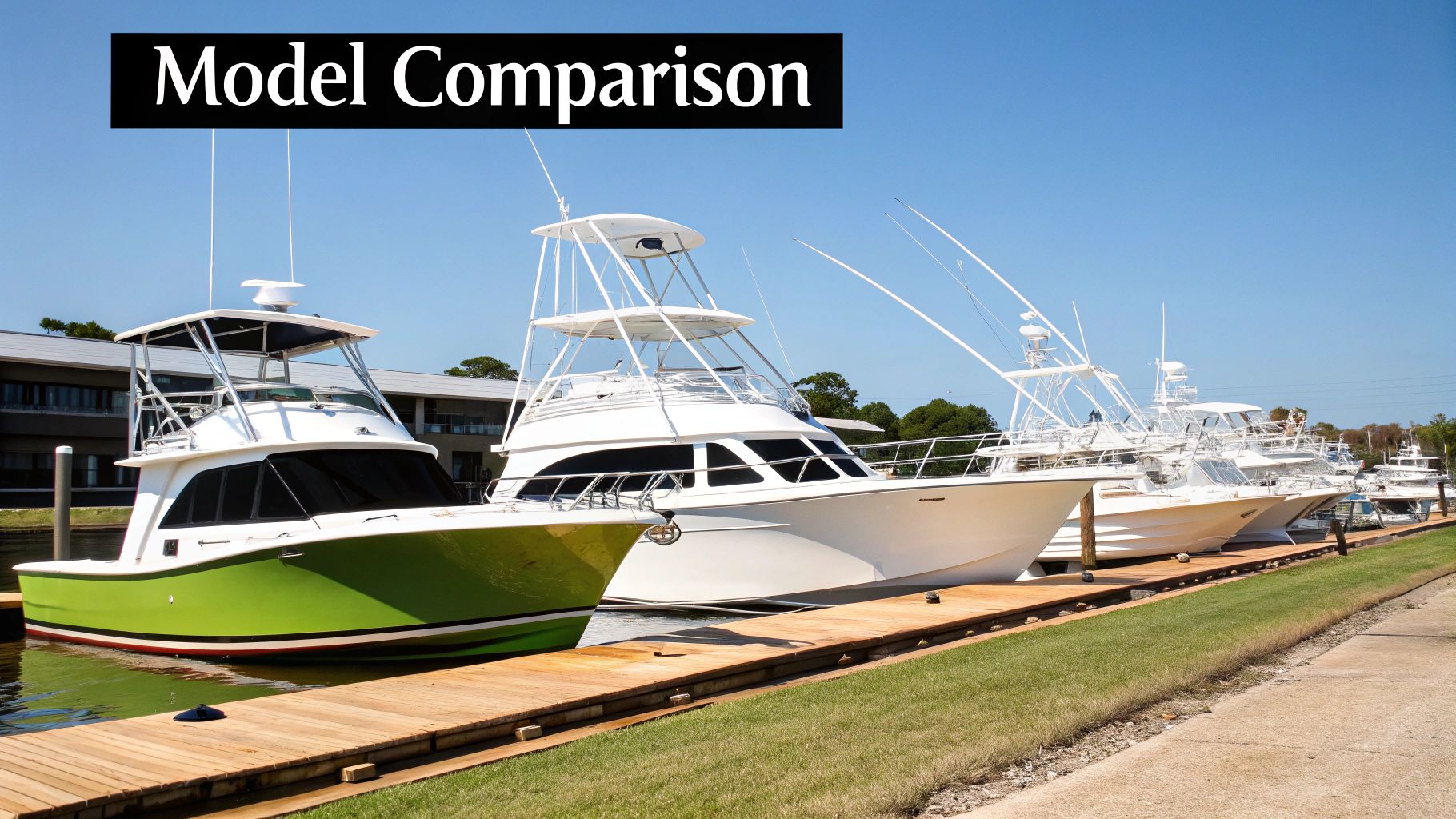
This table gives you a starting point. While a Center Console is often seen as the ultimate do-it-all fishing machine, a Dual Console might be the better pick if you need to keep the family happy on weekend cruises.
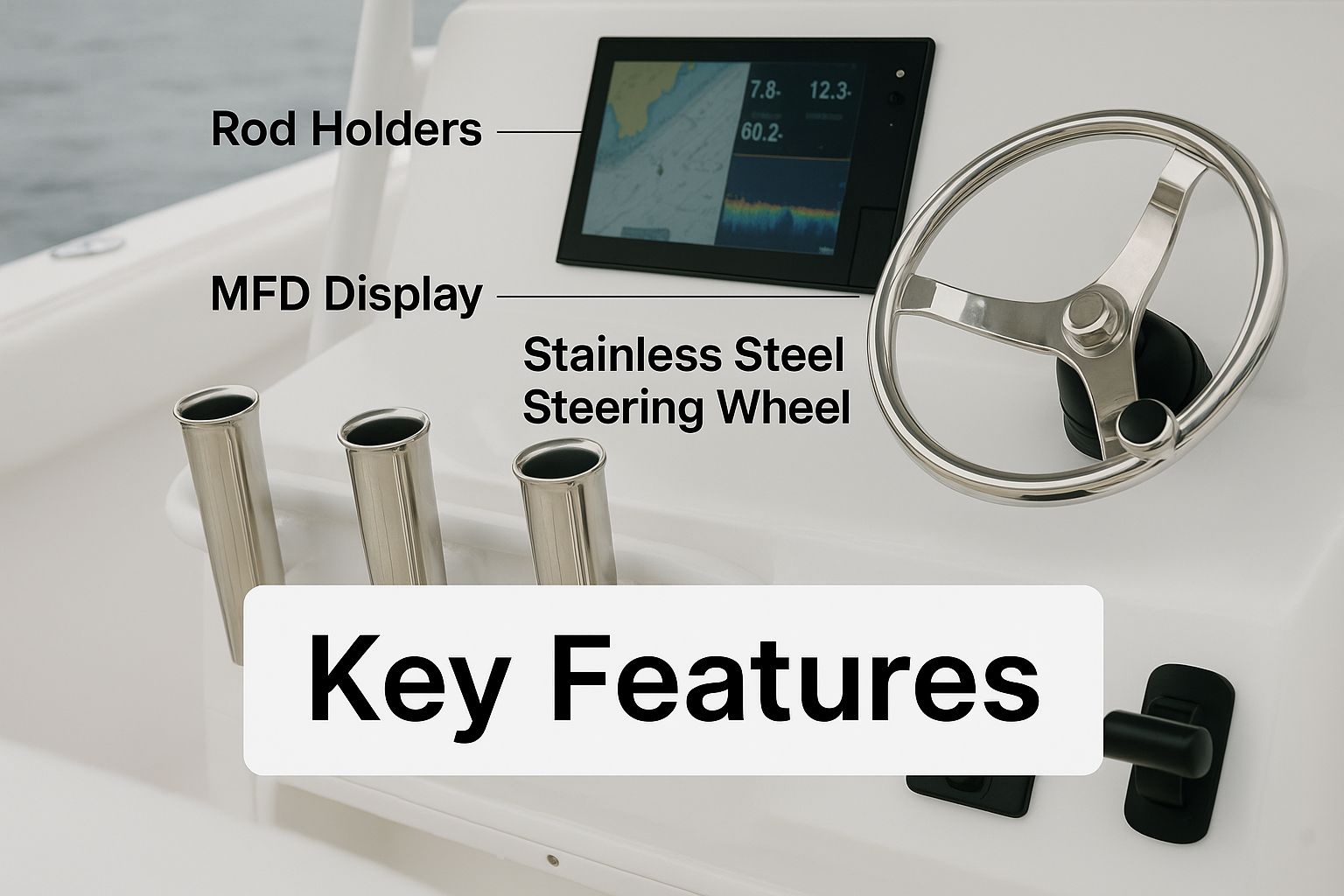
As you can see, even though the layouts and passenger comforts vary, the non-negotiables for any serious fishing boat—like rod storage and livewells—are almost always there.
Another big decision you'll face is the boat's construction material, which usually comes down to fiberglass versus aluminum. Fiberglass boats are heavier, which helps them plow through rough water for a smoother, quieter ride. That weight also allows for more complex hull shapes and cool, integrated features like built-in coolers and tackle stations.
Aluminum boats, on the other hand, are the tough, lightweight contenders. They’re more durable against bumps and scrapes, and they generally require less upkeep. Because they're lighter, you can tow them with a smaller truck or SUV, and they’re often more fuel-efficient. It's no wonder the global aluminum fishing boat market was valued at around $1.7 billion in 2024 and is expected to grow to $2.6 billion by 2034. You can discover more insights about the aluminum boat market to see why they are gaining traction.
Armed with this foundational knowledge, you can now look past a boat’s shiny gelcoat and start to really understand if it’s the right fit for where and how you plan to fish.
If the hull is the boat's skeleton, the engine is its heart and soul. The right power plant doesn’t just get you to the best fishing spots fast; it’s what gives you the confidence to know you’ll always get back home safely. As you start looking at different fishing sport boats, you’ll mainly run into three types of engines, and knowing the pros and cons of each is a game-changer.
Getting this choice wrong can lead to a whole world of frustration. You could be stuck with constant maintenance headaches, high fuel bills, or a boat that can't even get into the shallow spots where you want to fish. Let's break down what you'll find out there so you can look at any boat's engine with a sharp, experienced eye.
Walk down any marina dock, and you’ll see them everywhere. For sport fishing, the outboard motor is undoubtedly king. These are the engines you see mounted right on the transom (the back wall) of the boat. Their popularity isn't a fluke—they deliver a potent mix of power, convenience, and flexibility that’s tough to argue with.
Their biggest selling point is how easy they are to work on. Everything is right there, outside the boat, which makes routine service and winterization a much simpler—and cheaper—job. You can also tilt the entire engine completely out of the water. This is a massive advantage for preventing saltwater corrosion and for sneaking into shallow coves without chewing up your propeller.
- Easy Maintenance: Every part of the engine is mounted externally, right where you or a mechanic can get to it.
- Shallow Water Performance: The ability to trim the engine way up lets you explore skinny water where big fish often hide.
- Simple Repowering: When it's time for an upgrade, swapping out an old outboard for a new one is a relatively straightforward process.
While you won't see them as often on newer sport fishing boats, you'll definitely come across inboard and sterndrive motors, especially in older or larger vessels. An inboard is essentially a car or truck engine marinized for boat use, tucked away inside the hull. A propeller shaft runs through the bottom of the boat, making them incredibly reliable with fantastic torque—perfect for big, heavy sportfishing yachts that need to muscle through rough seas.
A sterndrive, often called an inboard/outboard (I/O), is a hybrid system. It combines an automotive-style engine inside the hull with a drive unit on the transom that looks and functions like the bottom half of an outboard. This design gives you a wide-open, uncluttered transom that's perfect for fishing. The downside? You're dealing with the maintenance challenges of both an inboard engine and an outboard drive unit.
A good way to think about it: Outboards are like versatile, all-in-one power tools you can easily service or swap out. Inboards are the heavy-duty, built-in machinery for the biggest jobs. Sterndrives are the complex hybrids trying to give you a bit of everything.
This is one of the biggest forks in the road you'll face. Is one engine enough, or do you need two? A single-engine boat is far simpler. It costs less to buy, less to maintain, and burns less fuel. For most folks fishing inshore bays or sticking close to the coast, a modern, reliable single outboard is all you'll ever need.
But if you dream of heading miles offshore, twins offer the ultimate safety net: redundancy. If one engine quits 50 miles from land, the other one is your ticket home. That peace of mind is priceless for serious offshore anglers. As a bonus, twin engines give you incredible maneuverability, letting you spin the boat on a dime when docking. The trade-off, of course, is that you’re looking at nearly double the cost for everything—purchase price, fuel, and maintenance.
The entire fishing vessel market is experiencing a huge surge, driven by better, more reliable technology in engines and navigation. Projections show the market growing from an estimated $1.69 billion in 2025 to a massive $3.45 billion by 2035. You can read the full research about the fishing vessel market to see how this innovation is shaping the industry. For a buyer like you, this is great news—it means the engine options hitting the market are more powerful and efficient than ever before.
Once you've nailed down the right hull and engine combo, it's time for the fun part: the features that turn a boat into a genuine fishing machine. Think of it this way: the hull and motor are your workhorse, getting you to the job site. The gear and layout are your tools—they determine how well you can actually get the work done. This is where you really need to separate your absolute must-haves from the "nice-to-have" extras.
When you start digging through listings for fishing sport boats for sale, this is the stuff that will help you quickly filter out the pretenders from the contenders. Let's walk through the non-negotiable essentials and the modern tech that can give you a serious edge out on the water.
Some features are just so fundamental to fishing that a boat without them should be an immediate deal-breaker. We're not talking about fancy bells and whistles here. These are the core components that make or break a day of fishing. Without them, you’ll spend more time fumbling with gear and less time actually fishing.
First up, the livewell. A good livewell is so much more than a glorified bucket. It's a self-contained ecosystem engineered to keep your bait frisky and ready for action all day. Look for systems with solid aeration and constant circulation—stale, oxygen-starved water will kill your bait fast, and dead bait doesn't catch fish.
Just as critical are the rod holders. They seem simple, but their number and placement tell you a lot about a boat's design. You need them in the right spots to keep your expensive rods safe while blasting through chop, and you need enough of them to troll multiple lines without creating a tangled mess. A boat with only a couple of poorly placed holders is a huge red flag that it wasn't designed with serious anglers in mind.
Here’s a quick checklist of the absolute must-haves:
- A Real Livewell: Make sure it has proper plumbing for circulation and aeration. The goal is to keep bait as lively at 3 p.m. as it was at 7 a.m.
- Plenty of Rod Storage: This means both gunwale-mounted holders for when you're fishing and secure spots to stow rods when you're on the move.
- A Solid Fish Finder: At a bare minimum, you need a basic depth sounder and fish finder. This is your set of eyes underwater, showing you structure, drop-offs, and where the fish are hiding.
- Smart Tackle Storage: You need dedicated, dry compartments to keep your tackle boxes, tools, and other gear organized and off the deck. A cluttered deck is an unsafe deck.
Moving beyond the basics, today's marine tech offers some incredible tools that can completely change your fishing game. Sure, you can catch fish without them, but there's a reason these features are becoming standard on new fishing sport boats for sale—they work.
Probably the single most impactful piece of modern gear is a GPS-enabled trolling motor. Think of it as a digital anchor. With the push of a button, its "spot-lock" feature uses GPS to hold your boat in one exact spot, fighting wind and current for you. This is an absolute game-changer, letting you focus 100% on fishing a specific rock pile or drop-off instead of constantly messing with the motor.
Modern marine electronics aren't just gadgets; they are force multipliers. A GPS trolling motor and a high-quality fish finder working together can give an average angler the kind of precision that was once only possible for seasoned professionals.
Another piece of tech worth its weight in gold is a high-quality chartplotter/fish finder combo. These multifunction displays (MFDs) become the nerve center of your boat. They blend detailed GPS navigation charts with incredible sonar tech like side-scan and down-scan imaging, which literally paints a picture of what’s below and around you. You'll see submerged trees, individual rocks, and schools of bait with almost photographic clarity.
Finally, let's talk about the features that, while not essential for catching fish, make a huge difference in your stamina and overall enjoyment. These are the things that turn a grueling, sun-beaten day into a comfortable, memorable adventure.
A T-top or hardtop is a big one, offering critical shade and a place to duck under during a passing shower. Also, look for padded coaming bolsters—those cushions lining the inside of the boat that give your legs a comfortable place to brace when you're leaning over to fight a big one. And don't underestimate a raw-water washdown pump; being able to quickly rinse fish scales, blood, and bait slime off the deck is a luxury you won't want to live without.
So, you’ve pinpointed the kind of boat you’re after. Awesome. Now comes the exciting part—turning that dream into a reality you can park at the dock. This is where you’ll shift from browsing online listings to actually making a deal. Getting this stage right is what makes the difference between a fantastic purchase and a boatload of problems.
Think of it a bit like buying any other major purchase, like a new truck or an RV. You wouldn't start making offers without knowing what you can afford, and boats are no different. For most buyers, this means getting a boat loan. Lenders will be looking at your credit score, your debt-to-income ratio, and the size of your down payment, which is usually somewhere in the 10-20% range. Getting pre-approved for a loan before you even step on a boat gives you a hard budget and shows sellers you’re a serious buyer.
Whether you’re eyeing a shiny new model right off the showroom floor or a pre-loved classic, a thorough inspection is an absolute must. This is way more than just kicking the tires; it’s a detailed checkup that could literally save you thousands of dollars down the road. A good checklist keeps you honest and prevents that "new boat excitement" from blinding you to potential issues.
The most expensive boat you can buy is a cheap one that needs major repairs. A meticulous inspection isn't about finding flaws to walk away—it's about understanding the true condition and value of the vessel before you sign anything.
As you start looking at the fishing sport boats for sale on your list, it helps to have a game plan. What you look for on a brand-new boat is a little different from what you need to hunt for on a used one.
Here’s a simple checklist to guide you through the inspection process, whether the boat has zero hours or a few hundred.
| Inspection Area |
What to Check on a New Boat |
What to Check on a Used Boat |
| Hull & Deck |
Check for a perfect finish. Make sure the gelcoat is consistent and there are no factory blemishes. |
Hunt for stress cracks (especially around hardware), signs of old repairs, and any soft spots on the deck floor. |
| Engine |
Confirm you're getting the exact model and horsepower you paid for. Double-check that all warranty paperwork is in order. |
Get the engine hours. Ask for service records and look for any signs of corrosion, leaks, or shoddy wiring. |
| Electronics |
Flip every switch. Test the GPS, fish finder, lights, and bilge pumps to make sure everything works as advertised. |
Power everything on. Look for corroded wires or connections, and make sure the electronics aren't outdated or failing. |
| Trailer |
Give the tires a once-over and make sure all the lights are working correctly before you tow it away. |
Look for rust, especially on the frame and axles. Check the brakes, wheel bearings, and tire wear very closely. |
This checklist is your first line of defense, but the real truth comes out on the water.
You wouldn’t buy a car or RV without taking it for a spin, right? The same rule applies ten-fold for a boat. The sea trial is, without a doubt, the most critical part of this whole process. It's your only chance to feel how the boat actually performs in its natural habitat.
During a sea trial, you're doing more than just opening up the throttle.
- Performance: How does it get on plane? Is it sluggish or does it pop right up? How does it handle tight turns?
- Engine Health: Listen. Do you hear any strange knocking, whining, or sputtering from the engine? Are the gauges giving steady, normal readings?
- Ride Quality: This is a big one. Pay attention to how the hull cuts through the chop. Is it a dry, smooth ride, or are you getting soaked from spray and bounced around?
- Systems Check: Now’s the time to put everything under a real-world load. Turn on the livewell pumps, the stereo, the navigation lights—everything.
A sea trial reveals a boat's true character. A vessel that looks perfect sitting on the trailer can show its weaknesses the moment it hits the water. Whatever you do, don't skip this step. It's your last, best chance to be 100% sure this is the right boat for you.
Let's be honest—the price you see on the boat is just the ticket to get in the game. The real cost of ownership kicks in the second you tow it away. To make sure your new fishing boat is a source of joy and not a constant financial headache, you have to look at the big picture from the very beginning.
Think of it this way: the purchase price is just the down payment on years of adventure. The ongoing costs are what keep those adventures happening. Getting a handle on these expenses upfront means no nasty surprises later, just more stress-free time on the water.
First up, you'll need boat insurance. Most marinas won't even let you in the gate without it, and it's a non-starter if you're financing. A good rule of thumb is to budget about 1.5% of the boat's insured value per year. This covers you for theft, accidents, and liability, which is peace of mind you can't put a price on.
Then, where is the boat going to live? Keeping it on a trailer in your driveway is obviously the cheapest route. But if you need to keep it at a marina, slip fees or dry storage costs can add up fast. We're talking anything from a few hundred to several thousand dollars a year, all depending on where you are and the size of your boat.
The "Rule of 10" is a lifesaver for new boaters. A great starting point is to set aside 10% of your boat's purchase price for annual running costs. So, for a $50,000 boat, you should plan on about $5,000 a year to keep it going.
You can’t run a boat on good intentions. Fuel is a major variable cost, and it's directly tied to how often and how hard you run your engine. And don't forget the small stuff, like the annual registration fees with your state—you can't legally hit the water without them.
Speaking of engines, regular maintenance is your best friend. This isn't an area to cut corners. Annual oil changes, new filters, and proper winterization will save you from disastrous (and expensive) failures down the road and ensure your boat is ready to go when you are.
Here’s a quick rundown of the main players in your annual budget:
- Insurance: The essential safety net for your investment.
- Storage/Slip Fees: A significant cost unless you have space at home.
- Fuel: A variable expense that hinges on how much you fish.
- Maintenance & Registration: The predictable costs to stay safe and legal.
Mapping these expenses out gives you a clear, realistic budget. That way, when you start looking at fishing sport boats for sale, you'll know you can afford not just the boat itself, but the incredible lifestyle that comes with it.
It's completely normal to have a few last-minute questions swirling around as you get close to buying a boat. In fact, it’s a good sign—it means you’re thinking things through. Getting straight answers to these common questions will give you the confidence to pull the trigger on the right boat.
Let’s walk through some of the most frequent queries that pop up when people start looking seriously at fishing sport boats for sale.
You might think springtime, right before the season kicks off, is the best time to buy. That's when everyone has boating on the brain, but it’s also when demand skyrockets, and prices tend to be at their peak.
If you want to find a great deal, aim for the fall and early winter. This is when many owners decide to sell rather than pay for another season of winter storage. You'll find more boats on the market and far less competition from other buyers. Boat shows, typically held in the dead of winter, are another goldmine for finding special pricing and seeing a ton of different models all in one place.
For any used boat, a pre-purchase marine survey is absolutely critical. Don't even think about skipping it. It’s like a home inspection, but for something that floats—and where hidden problems can have much more immediate consequences.
A certified marine surveyor is your best friend here. They'll provide an unbiased, top-to-bottom inspection of the hull, engine, electrical systems, and all the safety gear. This report can uncover issues you'd never see on your own and gives you incredible leverage for negotiation. Plus, most banks and insurance companies won't even talk to you about a loan or policy without one.
Think of it this way: spending a few hundred dollars on a survey can save you from a boat with thousands of dollars in hidden problems. It's the smartest money you'll spend in the entire process.
This one really boils down to what you value more: a lower price or total peace of mind.
Going through a private seller can definitely save you some money. They don't have the overhead of a big dealership, so you can often negotiate a better price. The catch? These are almost always "as-is" deals. Once the cash changes hands, that boat is your problem, for better or worse.
A reputable dealership, on the other hand, might cost a bit more upfront, but that extra cost buys you a lot. Dealers often offer warranties, handle all the frustrating title and registration paperwork, and can even help you line up financing. Their boats have usually been inspected and serviced, which adds a valuable layer of confidence to your purchase.
The classic debate! The best material really hinges on where you fish and what you prioritize in a boat.
- Fiberglass Boats: These boats are heavier, which is a good thing in choppy water. They slice through waves, giving you a much smoother and quieter ride. Fiberglass can also be molded into sleek, complex hull shapes with built-in featur
Whether you prioritize the smooth, quiet ride of fiberglass or the lighter weight of aluminum, the right fishing sport boat comes down to the water you fish and how you fish it. Browse fishing sport boats by hull type, engine, and price at SearchShop.com.