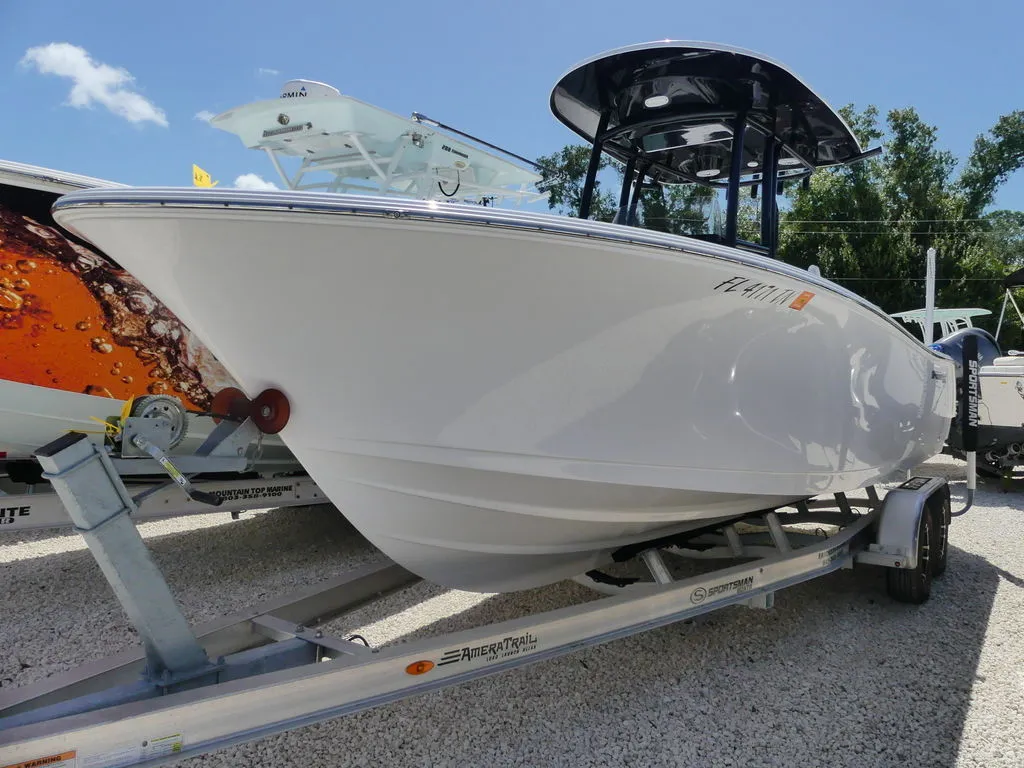
Single vs twin outboards comes down to cost against backup. A single outboard costs less, weighs less and burned less fuel at top speed in Yamaha's same-boat tests. Twin outboards give you a second engine if one fails and more control at the dock. Choose twins for long offshore runs; choose a single for most bay, lake and near-shore boating.
| Factor |
Single outboard |
Twin outboards |
| Yamaha list price for 300 hp (MSRP, July 2026) |
$39,020 (one F300) |
$44,035 (two F150s) |
| Engine weight for 300 hp (Yamaha listed weights) |
551 to 588 lb (one F300) |
1,044 lb (two F150s, digital controls, 20-inch shaft) |
| Fuel at wide-open throttle, Xpress X23 Bay test (2020) |
26.2 gal/hr |
31.7 gal/hr |
| Backup if one engine fails |
None unless you add a kicker |
A second engine |
| Scheduled oil changes (Yamaha: every 100 hours) |
One engine |
Two engines |
Prices are Yamaha's suggested retail prices for 25-inch-shaft engines with digital electronic controls and exclude installation and rigging, accessories, shipping, fees and taxes. Browse boats for sale on Searchshop to see single- and twin-engine boats from dealers near you.
This comparison uses published manufacturer data, not sea trials by Searchshop. Engine prices come from Yamaha's outboard price list effective July 1, 2026. Engine weights come from Yamaha's own specification pages. Speed and fuel figures come from Yamaha performance bulletins, where Yamaha tested the same boat model with one 300 hp engine and with two 150 hp engines. All sources were read on October 30, 2026.
Yamaha was used because it publishes list prices, weights and same-boat tests in one place, so every figure sits on one basis. Yamaha says its bulletins are a guideline only and that your boat's results will depend on its actual weight, options, wind, water, temperature and the operator.
Twin outboards cost more than a single engine of the same total horsepower. The table below adds up Yamaha's suggested retail prices for 25-inch-shaft engines with digital electronic controls in Pearl White. Each twin pair is priced as one standard engine and one counter-rotation engine, which Yamaha lists at a higher price.
| Setup |
Total hp |
Engine MSRP |
Versus one F300 |
| One F300XSB2 |
300 |
$39,020 |
Base |
| One F350XSA2 |
350 |
$42,840 |
+$3,820 |
| F150XSA2 and LF150XSA2 |
300 |
$44,035 |
+$5,015 |
| F200XSA2 and LF200XSA2 |
400 |
$52,650 |
+$13,630 |
Engine price is only part of the bill. Yamaha's price list says installation and rigging charges, accessories, shipping, fees and taxes are not included in its suggested prices. A twin setup also needs a second propeller and more rigging, so ask the dealer for a fully rigged price on both options before comparing.
Two smaller outboards weigh more than one larger outboard of the same total horsepower. Yamaha lists its F150 with digital electronic controls at 522 lb with a 20-inch shaft, so a pair weighs 1,044 lb. Yamaha lists its 4.2-liter V6 F300 at 551 to 588 lb, depending on version. That makes two F150s at least 456 lb heavier than any version of one F300, before oil and propellers.
Yamaha measures these weights at the shortest shaft length, without engine oil, gearcase oil or propeller. The extra weight sits on the transom, so check the builder's maximum horsepower and weight ratings for your boat, and ask whether the hull was designed for twins.
In both of Yamaha's same-boat tests below, twin F150s burned more fuel at wide-open throttle than a single F300 and reached a higher top speed. The tests are useful because the boat model, the total horsepower and the fuel load were the same for each pair.
The Xpress X23 Bay tests were run in August 2020, each with 75 gallons of fuel and two people aboard. The twin-engine boat was 572 lb heavier as tested, and it also carried four batteries and a 36-volt trolling motor against one battery and a 24-volt trolling motor.
| Measure |
One F300 |
Two F150s |
| Weight as tested |
3,882 lb |
4,454 lb |
| Top speed (6,000 rpm) |
59.6 mph |
60.0 mph |
| Fuel at top speed |
26.2 gal/hr |
31.7 gal/hr |
| At 3,000 rpm |
30.1 mph, 4.37 mpg |
31.8 mph, 3.65 mpg |
| 0 to 20 mph |
5.01 seconds |
5.17 seconds |
The single F300 went 4.37 miles per gallon at 3,000 rpm against 3.65 for the twins. At wide-open throttle, the twins burned 21 percent more fuel for 0.4 mph more speed.
The Sportsman Open 252 tests were run in December 2023 with twin F150s and in April 2024 with a single F300, each with 50 gallons of fuel and three people aboard. Unlike the Xpress tests, the single-engine boat was the heavier one: 7,334 lb as tested against 6,766 lb for the twins. Yamaha also lists a different published dry weight and fuel capacity for the boat on each bulletin, so treat this pair as a rougher guide.
| Measure |
One F300 |
Two F150s |
| Weight as tested |
7,334 lb |
6,766 lb |
| Top speed |
47.0 mph (5,800 rpm) |
49.5 mph (6,100 rpm) |
| Fuel at top speed |
26.8 gal/hr |
33.7 gal/hr |
| At 4,000 rpm |
31.3 mph, 2.53 mpg |
30.3 mph, 2.40 mpg |
| 0 to 30 mph |
9.25 seconds |
6.77 seconds |
Even though the twin-engine boat was 568 lb lighter as tested, the single F300 still went slightly farther per gallon at 4,000 rpm. The twins burned 26 percent more fuel at wide-open throttle.
In these two tests, the boat that accelerated faster was the one that was lighter as tested, whether it had one engine or two. On the Xpress X23 Bay, where the twin-engine boat was heavier, the single F300 reached 20 mph slightly sooner, in 5.01 seconds against 5.17. On the Sportsman Open 252, where the single-engine boat was heavier, the twin F150s reached 30 mph in 6.77 seconds against 9.25.
When you read performance bulletins or magazine tests, compare the weight as tested, the fuel load, the number of people and the propeller before crediting the engines. The boats in each pair here were not loaded or propped the same way, and those differences affect the result as well as the engine count.
A second engine is the main reason to choose twins, and it helps most when the problem stays inside one engine. If one outboard has a mechanical or electrical fault, the other can still move the boat. If both engines draw from the same tank and the fuel is bad, both can be affected.
Before you pay for twins as backup, ask the dealer three questions:
- Will this boat get on plane, or at least run at a safe speed, on one engine with a normal load?
- Does each engine have its own fuel filter and water separator?
- Does each engine have its own battery and charging circuit?
For boats that stay within reach of a tow service, a single engine plus a towing membership, or a small kicker motor, may give enough backup for less money.
Twin outboards make low-speed handling easier because you can push one engine forward and the other in reverse to turn the boat in place. That matters if you dock in tight marinas, in current or in wind.
Joystick docking is the other difference. Yamaha's price list says its Helm Master EX joystick system is sold through boat builders on select new single, twin, triple and quad Yamaha outboards, but dealers install it afterwards only on twin, triple and quad setups. If you want a Yamaha joystick on a single-engine boat, buy one that has it from the factory.
Maintenance and running costs
Twin outboards mean two engines to maintain. Yamaha says owners should change engine oil and lower unit oil every 100 hours, flush engines regularly, replace fuel filters and prevent corrosion. With twins, each of those jobs is done on two engines, and each engine needs its own parts.
Fuel is the other running cost. In both of Yamaha's same-boat tests, twin F150s burned 21 to 26 percent more fuel at wide-open throttle than a single F300. From 3,000 to 5,000 rpm the single went farther per gallon in both tests.
A single outboard suits most buyers whose boat is offered both ways, unless they run far offshore or dock in tight quarters often. Use this as a starting point:
- Choose a single if you mostly fish bays, lakes or near-shore water, want the lowest price and fuel bill, and have a tow service or kicker as backup.
- Choose twins if you run well offshore, want a second engine to get home on, or want a dealer to add a Yamaha joystick later.
- Choose twins with more total horsepower if you want the boat to run well on one engine; ask the dealer to show it on a sea trial.
- Either way, ask for a rigged price, the weight as tested and a sea trial with your usual load.
For more help choosing a boat, read the center console buying guide, compare engine brands in Yamaha vs Mercury outboards, or see how hull types differ in center console vs bay boat. When you are ready, compare single- and twin-engine boats for sale on Searchshop and contact dealers directly from each listing.
Twin outboards are safer only against problems that stop one engine, because the second engine can still move the boat. They do not protect against bad fuel shared by both engines, and they only get you home at a useful speed if the boat runs well on one engine. Ask the dealer to show single-engine running on a sea trial.
A single 300 is the better buy for most boaters who do not need a backup engine. In Yamaha's July 2026 list prices for 25-inch-shaft models with digital controls, one F300 costs $5,015 less than an F150 pair, weighs less, and burned less fuel than twin F150s at wide-open throttle and from 3,000 to 5,000 rpm in both of Yamaha's same-boat tests. Twin 150s give you a second engine and easier docking.
Twin outboards do not burn twice as much fuel as a single engine of the same total horsepower, but they burned more in Yamaha's tests. At wide-open throttle, twin F150s used 21 percent more fuel than a single F300 on an Xpress X23 Bay and 26 percent more on a Sportsman Open 252. The single also went farther per gallon from 3,000 to 5,000 rpm in both tests.