When you're searching for a Polaris for sale, you're looking for more than just a machine—you're looking for a key to unlock new adventures. For those who embrace the RV and boating lifestyle, a Polaris isn't just an accessory; it's an essential piece of equipment. It’s the vehicle that gets your gear to a remote campsite, helps you launch a boat from a hidden cove, or explores the trails around your favorite lake.
Before you start browsing listings, the first step is to ask one simple question: What, exactly, do I need this machine to do for my RV or boating trips?
It sounds obvious, but skipping this step is the fastest way to get overwhelmed and end up with a vehicle that's a poor fit. You have to match the model to your mission.
Think about it. An RVer who needs a workhorse to haul firewood, maintain a large campsite, and shuttle gear down to the lake has completely different needs than a boater trying to navigate tight, wooded trails to a secluded launch spot.
Get specific about the real-world scenarios you'll face. Will you be towing a small utility trailer around the campground? Do you need enough seats for the family visiting your RV site, or is a nimble one-seater ATV all you need for solo scouting trips to the boat ramp?
Nailing this down will narrow your focus in a big way. Here are the core questions to ask yourself:
- Workhorse or Trail Ripper? Are you looking for a utility machine for hauling coolers and towing a small boat trailer, or a sport model built for exploring the trails around the lake?
- Solo or Crew? How many people are coming along? You can get everything from a single-person ATV to a six-seater side-by-side for family outings from the RV.
- What Are You Hauling? Think about everything you plan to carry. Coolers, fishing tackle, camping gear, and boat supplies all take up space and add weight. Payload capacity matters.
Getting this right from the start saves you from overspending on features you'll never use or buying a vehicle that can't handle the one job you truly need it for.
Your ideal Polaris should solve a problem. It could be accessing that hard-to-reach fishing spot, making campsite logistics a breeze, or just exploring the backcountry around your favorite RV park.
Polaris didn't become a giant in the powersports world by accident. They have distinct vehicle lines designed for very specific jobs, from the legendary Sportsman ATV to the work-focused Ranger. This is a big reason why Polaris has captured a huge piece of the market—in fact, North America alone accounted for over 46.7% of the global all-terrain vehicle market share in recent years.
That variety is great news because it means the perfect machine for your RV or boating adventures is out there.
To help you get a clearer picture, I've put together a quick breakdown of the main Polaris lines and who they're best for.
| Polaris Model Line |
Best For |
Key Features for RV & Boating Lifestyles |
| Polaris Ranger |
Utility & Work. Hauling gear, campsite maintenance, towing small trailers. |
Massive payload and towing capacity, dump bed for firewood/supplies, smooth ride, multi-person cabs. |
| Polaris RZR |
Sport & Trail Riding. Exploring trails near the campground or lake. |
Nimble handling, long-travel suspension for rough terrain, high horsepower, performance-focused. |
| Polaris General |
The Hybrid. A mix of sport performance and utility features. |
Good for both trail riding and light work like carrying gear to the boat dock; has a small dump bed. |
| Polaris Sportsman |
Versatile ATV Use. Solo scouting, accessing tight spots, light hauling. |
Excellent maneuverability, easy to transport with an RV, powerful towing for its size, great value. |
Looking at a table like this makes it clear how defining your needs first makes the choice so much easier. Once you know what you need, your "Polaris for sale" search transforms from a casual browse into a targeted mission to find the perfect asset for every trip you take.
Once you’ve settled on the perfect Polaris model line for your adventures, you’ll hit the next big fork in the road: should you buy new or used? This decision ripples through everything—your budget, what to expect for maintenance down the line, and your overall peace of mind.
Honestly, there's no single right answer here. It’s all about weighing the pros and cons to see what fits your wallet and your risk tolerance.
There’s a certain magic to buying a brand-new Polaris. You get that factory-fresh shine, the latest technology, and components that have never seen a trail. But the biggest win? A full factory warranty. That’s a massive safety net, especially for a machine you’ll be counting on far from home on an RV trip.
Imagine you're planning long backcountry trips from a remote campsite, far from any service center. In that scenario, the near-guaranteed reliability of a new Polaris General is probably worth the higher price tag. It buys you freedom from worrying about surprise breakdowns.
When you buy new, you’re buying certainty. You know its entire history because you’re the one starting the clock. No need to stress about hidden damage from a previous owner’s hard riding or shoddy maintenance.
Here’s a quick rundown of the advantages:
- Warranty Coverage: This is your shield against the cost of any unexpected defects. For many buyers, this alone seals the deal.
- Latest Features: New models roll out with the newest bells and whistles—think updated suspension, better engine performance, and slick tech like advanced digital displays and Ride Command integration.
- Favorable Financing: Dealerships often run special promotions and offer attractive financing rates on new vehicles. Sometimes, this can make the monthly payment surprisingly close to a loan on a used machine.
On the flip side, the used market is where you can find some truly incredible deals. Powersports vehicles depreciate fast, which means a machine that's only a couple of years old can often be had for a huge discount off its original sticker price. Your search for a "Polaris for sale" could turn up some serious budget-friendly gems.
A lightly-used Polaris Ranger, for example, can be the perfect workhorse for your lakeside property or RV lifestyle without that steep initial investment. The trick is to be patient and do your homework—a thorough inspection is non-negotiable. You’re taking on a bit more risk, but the savings can be massive.
It also pays to keep an eye on market trends. Polaris has been managing its inventory carefully, and in a recent fiscal year, it reported a decline in worldwide sales due to planned shipment reductions. According to industry reports on sales and inventory, this kind of thing can affect both new and used prices, making it a smart factor to watch.
"A used Polaris with a solid maintenance history is one of the smartest buys you can make. You let the first owner take the biggest depreciation hit, and you get a capable machine for thousands less."
Ultimately, the choice comes down to balancing risk and reward. A new Polaris gives you top-tier reliability and the latest features, all backed by a warranty. A used one offers major cost savings but demands more diligence from you as the buyer. Be honest about your budget and how much uncertainty you can handle, and you’ll make a smart decision that sets you up for years of adventure.
Knowing where to hunt for your next ride is half the battle. A fantastic deal from a sketchy source can quickly turn into a massive headache, while a trusted seller can set you up for years of fun. Your search for a Polaris for sale should always start with the most reliable spots before you venture into the wild west of private listings.
The most obvious, and often safest, place to start is your local authorized Polaris dealer. This is your go-to for brand-new models, full factory warranties, and certified pre-owned machines that have already passed a rigorous inspection. It's the path of least resistance and offers the most peace of mind.
And don't just accept the sticker price. Dealerships have wiggle room. If they won't budge on the price, see if they'll throw in accessories like a winch or a roof to sweeten the pot. Building a good relationship with a local dealer can also pay off down the road when you need parts or service for your RV or boat support vehicle.
Once you've checked out the dealership, it's time to cast a wider net online. Marketplaces open up a nationwide inventory from both dealers and private sellers, making them incredible tools for price comparison and finding that specific model that isn't available in your area.
For off-road vehicles, specialty sites are king. A platform like ATV Trader is designed for exactly this purpose. A quick search there lets you filter by make, model, year, and location, giving you an instant snapshot of the market.
As you can see, a dedicated site like this puts a huge number of Polaris listings right at your fingertips, which is invaluable for getting a handle on fair market value.
While these sites offer an amazing selection, they demand more from you as a buyer. You have to do your homework, especially when you're looking at a machine from a private seller. Plenty of great, honest people sell their rigs online, but this is also where you'll find scams and vehicles with hidden problems.
A word of hard-earned advice: Never, ever send a deposit or agree to buy a machine you haven't seen with your own eyes. If a private party deal looks too good to be true, it is. Period.
Finally, don’t discount the local scene. Platforms like Facebook Marketplace or even Craigslist can be goldmines for hidden gems. This is where you might find a barely used Polaris that someone only used to cruise around their lake property—often with thousands in upgrades already installed. Sellers here are typically more motivated and flexible on price than a dealership.
When you're dealing with a private owner, your inspection and questioning process is everything. Be prepared to ask direct questions:
- Why are you selling it?
- Do you have the clean title in hand, in your name?
- Can I see any service records or receipts for parts?
How they answer—or if they're willing to answer at all—tells you a lot. An open, transparent seller is usually a sign of a well-maintained machine. By combining official dealership visits with some smart online searching, you'll put yourself in the best possible position to find the perfect Polaris for your next adventure.
Alright, you've found a Polaris that looks promising. This is where the real work begins. Getting hands-on with the machine is the single most important step in separating a great deal from a money pit waiting to happen.
Don't let a freshly washed exterior fool you. A quick power wash can hide years of abuse, so you need to look deeper. Let’s get into what really matters.
The frame is everything. Seriously. Get on the ground with a good flashlight and look at every single weld, especially where the suspension and A-arms connect. You're hunting for cracks, bends, or any fresh paint that looks out of place—that’s a classic sign of a cover-up after a major hit.
Once you’re satisfied with the frame, turn your attention to the suspension and steering.
- A-Arms and Bushings: Go to each front tire, grab it at the top and bottom, and give it a good shake. If you feel a lot of slop or hear a clunking noise, you're likely looking at worn-out bushings or ball joints. They’re common wear items, but they add up.
- Shocks and Springs: Check the shock absorbers for any signs of leaking oil. A damp, grimy shock is a blown shock, plain and simple. Replacing them isn’t cheap.
- CV Boots: This is a big one. Carefully inspect the rubber CV boots on all four axles. Even a tiny tear lets in dirt and water, which will quickly grind a CV joint into dust. That’s a repair you don't want to be surprised with.
Now it’s time to check the machine’s vitals. You don't need to be a certified mechanic to spot some major red flags here, and you should always do this before the engine is started.
First, pull the engine oil dipstick. Normal oil will be a clear-ish brown or black. If it looks like a chocolate milkshake—milky, frothy, and nasty—walk away. That’s the telltale sign of coolant mixing with the oil, which could mean a blown head gasket. This is a deal-breaker.
Next, check the coolant in the overflow reservoir. It should be clean and topped off.
The off-road vehicle market is booming. Projections show the global ATV and UTV market could grow from USD 10.72 billion to over USD 22.32 billion within the next decade. As you can see from the full market projections, this explosive growth means more used machines are hitting the market. That's great for selection, but it makes a thorough inspection more critical than ever.
Top 3 Things First-Time Buyers Forget:
- The Air Filter: Pop the cover and pull the air filter. If it's caked in dirt, it's a huge sign of poor maintenance and means the engine has probably been breathing in grime.
- 4WD Engagement: Don't just take the seller's word for it. You have to test that the four-wheel drive clicks in and out smoothly.
- Title and VIN Match: It sounds obvious, but you’d be surprised. Make sure the VIN stamped on the frame is an exact match for the VIN on the title. No exceptions.
This infographic gives you a snapshot of typical financing figures you might see when shopping, which is helpful for getting a sense of the total cost of ownership.
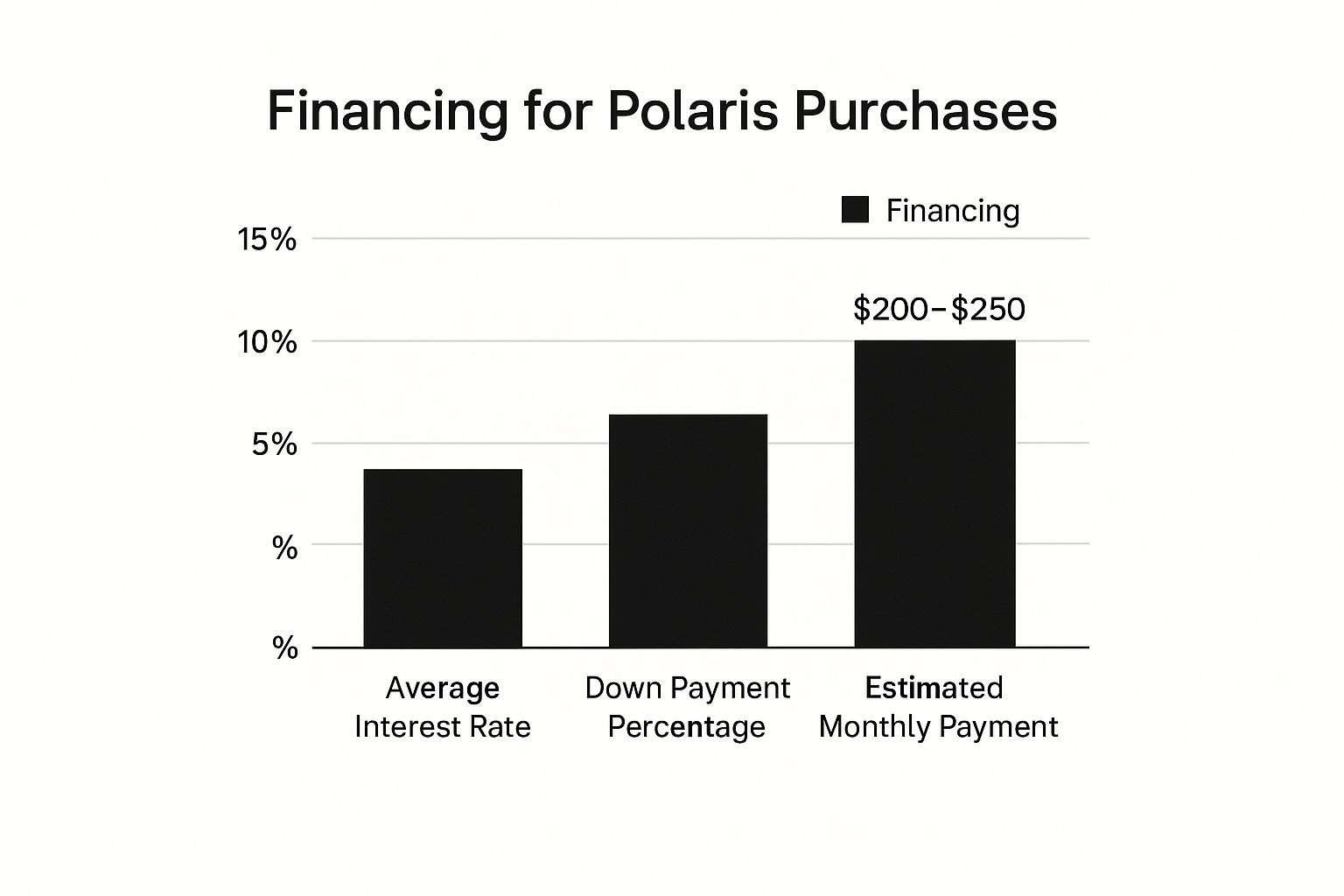
These numbers aren't set in stone, of course, but they provide a solid baseline for budgeting what your monthly payments and interest rates could look like.
When you're inspecting a used machine, knowing what to look for and what a potential repair might cost can be a huge advantage. Here’s a quick guide to some common red flags.
| Inspection Point |
What to Look For |
Potential Cost to Fix (Low to High) |
| Engine Oil |
Milky or frothy appearance |
$1,000 - $3,000+ (Head Gasket/Engine) |
| CV Boots |
Rips, tears, or grease splatters |
$150 - $600 (Per Axle) |
| A-Arm Bushings |
Excessive play or clunking sounds |
$100 - $400 (Per Side) |
| Frame |
Cracks, bent tubes, suspicious welds |
$500 - $5,000+ (Could total the machine) |
| Tires |
Uneven wear, cracks, low tread |
$600 - $1,500 (Full Set) |
| 4WD System |
Fails to engage or makes grinding noise |
$300 - $1,200 (Could be simple or major) |
This table isn't exhaustive, but it covers the big-ticket items that can turn a "good deal" into a financial nightmare. Use it as a mental checklist when you're doing your walk-around.
Finally, the moment of truth. A test ride is completely non-negotiable.
Pay close attention when it starts. Does it fire right up, or does it crank and struggle? As you get going, listen for any sounds that don't belong—knocking, ticking, or whining from the engine or drivetrain are all bad news.
On the ride, test everything. Shift through all the gears. Engage the 4WD. Test the brakes—they should feel firm, not spongy. The steering should feel tight, with no slop. Find a safe spot to do some tight turns and listen for any clicking or popping sounds from the axles. That's a classic sign of a bad CV joint you might have missed in your visual inspection. A good ten-minute ride can tell you more than an hour of just looking at it.
You’ve done the hard work. You've inspected the machine and decided it's the perfect one for your RV trips and boating excursions. Now for the final hurdle: negotiating a price and closing the deal.
Honestly, this is where a little preparation can save you hundreds, if not thousands, of dollars.
The key to a successful negotiation is to start from a position of knowledge, not emotion. Before you even think about making an offer on a Polaris for sale, you need to know its fair market value. Using a resource like NADA Guides is a fantastic starting point because it's based on real-world data for that specific year and model.
This isn't about trying to lowball the seller. It’s about anchoring the entire conversation around a realistic number. When you can confidently say, "Based on my research, similar models are selling in the $X to $Y range," it completely shifts the dynamic from a tense confrontation to a fact-based discussion.
Your first offer needs to be confident and backed by all that research you did. If you're standing in a dealership, remember that the sticker price is almost always just a friendly suggestion. They absolutely have room to move, but they won't unless you ask.
For private sellers, the approach is similar but usually a bit more direct. A fair but firm offer that’s a little below their asking price is a great way to kick things off.
If your inspection turned up any issues—like worn-down tires or a torn CV boot—now is the time to politely bring them up as justification for your offer. Something like, "I really like the machine, but I know I'll need to put about $800 into a new set of tires right away, so I can offer you..."
The goal isn't to "win" the negotiation; it's to land on a price that both you and the seller feel good about. A calm, respectful approach is always more effective than aggressive haggling.
Once you’ve shaken hands on a price, it's time to tackle the critical final steps. This is where you absolutely must be meticulous to ensure a clean and legal transfer of ownership. Don't rush this part, no matter how excited you are to get the machine home.
Here’s a checklist of what you must verify and complete:
- Verify the VIN: Grab your phone's flashlight and double-check that the Vehicle Identification Number (VIN) stamped on the frame matches the VIN on the title document perfectly. Any mismatch is a giant red flag.
- Inspect the Title: Make sure the seller has a clean title in their name. Look carefully for any lienholder information. If there’s still a loan on the vehicle, it has to be paid off before the title can be legally transferred to you.
- Complete a Bill of Sale: Even if your state doesn't require one, always create a bill of sale. This simple document is your official receipt. It should list the vehicle's year, make, model, VIN, the final price, the date, and the names and signatures of both you and the seller.
Finally, you need to agree on a secure payment method. For private sales, a cashier's check from your bank is one of the safest bets for everyone involved. It's guaranteed funds, which gives the seller peace of mind, and it gives you a clean paper trail. I'd strongly advise against carrying large amounts of cash.
Only hand over the payment when the seller is ready to hand you the signed-over title and the keys.
With the paperwork in order and the payment made, the deal is officially done. Now you can focus on the best part: loading up your new Polaris and planning its first big adventure.
As you zero in on a decision, a few common questions always seem to surface. Getting straight answers to these can provide that final dose of confidence you need to make the right move on your new Polaris for sale. Let's tackle them head-on.
This is a bit of a moving target because you’re looking at both miles and engine hours. For most experienced riders, a machine creeping over 3,000 miles or 300 hours starts to get into "high usage" territory.
But that's only half the story. The real litmus test is the maintenance history. I'd take a well-maintained machine with 5,000 miles over a neglected one with 1,500 miles any day of the week. Always, always prioritize a Polaris with a thick stack of service records over one with low but mysterious mileage.
Here's a pro tip: Engine hours can be more revealing than the odometer. A machine with low miles but high hours probably did a lot of slow-crawling, tough work—which can be harder on the engine and drivetrain than cruising on easy trails.
Honestly, there isn't a single Polaris model that's a complete dud. However, certain model years are known for their own little quirks or have had significant factory recalls. For instance, some of the early RZR 1000 models had well-documented recalls for heat shield problems that a dealer needed to fix.
The best way to protect yourself is with a little bit of targeted digging. Once you’ve picked out a specific year and model, jump onto some owner forums and search for phrases like "common problems" or "recalls." A few minutes of reading can save you from a world of headaches later.
This is a great question, and it’s something a lot of first-time buyers forget. I always recommend budgeting between $300 and $800 for immediate service on any used powersports vehicle you buy. This isn't for fixing surprise problems; it's about setting a fresh, clean baseline for your own maintenance.
What does that budget cover? The essentials.
- Engine oil and a new filter
- A fresh air filter
- Swapping out the transmission and differential fluids
Getting this done right after you get it home buys you incredible peace of mind. You’ll know for a fact that your "new" Polaris is ready for its first big adventure with you.
You absolutely can, but it’s a different ballgame than walking into a dealership. The key is to secure a pre-approved powersports or personal loan from your bank or a local credit union before you even start negotiating. Credit unions, in my experience, are usually the better option here.
Your lender will ask for the vehicle’s VIN and a copy of the title to get the paperwork rolling. After you're approved, they'll typically cut a check directly to the seller. Getting pre-approved first not only makes the transaction smoother but also gives you more leverage as a "cash" buyer.
Ready to find the perfect vehicle to complement your RV and boating lifestyle? At SearchShop.com, we provide powerful tools to analyze prices, research history, and browse thousands of listings. Start your search today on SearchShop.com and make your next purchase with confidence.